
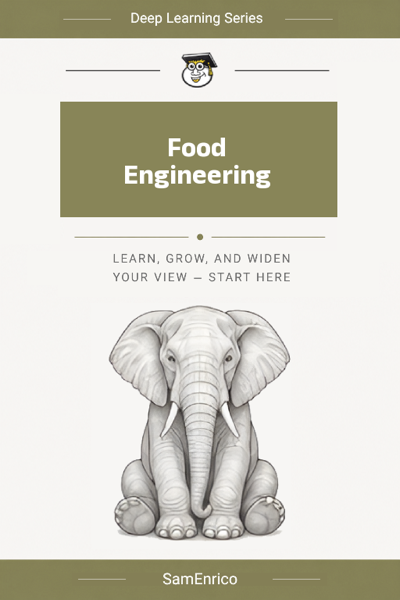
Non-FictionInformativeEducational
Food Engineering eBook
A Coursebook on Food Engineering
by Liles Sheron
A Coursebook on Food Engineering
Formats
Free sample
Chapter 1: The Edible Machine...--–- Look at the sandwich on your plate. Really look at it. The bread is a porous, foam-like structure of gelatinized starch. The lettuce is a hydrated cellulose composite held together by internal osmotic pressure. The slice of turkey is a protein gel interspersed with fat globules and bound water.
The mayonnaise is a concentrated emulsion of oil droplets in a continuous water phase, stabilized by egg lecithin. You are not looking at "lunch." You are looking at a collection of complex physical structures, each one engaged in a furious chemical and biological battle against entropy, decay, and thermodynamic equilibrium. Every single bite you take is an edible machine, and like all machines, it is designed to fail. Your teeth are the disassembly tools. Your stomach acid is the final solvent.
But before you eat it, the food engineer has one job: to keep that machine running—to keep it safe, stable, and delicious—from the moment it leaves the farm to the moment it touches your tongue.This is the hidden world you are about to enter. It is a world where a tomato is not a fruit but a viscoelastic solid with a specific water activity. Where a freezer is not a box but a heat pump governed by the laws of thermodynamics. Where a pipe full of ketchup is a rheological problem waiting to be solved. Most people see a kitchen.
You, after reading this book, will see a laboratory. Most people see a factory. You will see a symphony of unit operations.Welcome to Food Engineering.1.1 The Guardians of the Supply Chain Every year, the world produces approximately four billion metric tons of food. Nearly one-third of it—1.3 billion tons—is never eaten. It spoils in transit, rots in storage, or is thrown away because it looks "ugly." The food engineer is the first line of defense against this planetary tragedy.
Your job is not merely to design machinery. Your job is to slow down time. You manipulate temperature, pressure, humidity, and flow to create an environment where microbes cannot thrive, enzymes cannot react, and texture remains intact.The Three Pillars of Engineering Practice Every decision you make will be weighed against three sometimes-competing priorities:Microbiological Safety (Absolute): You will design processes that destroy or inhibit pathogens like Clostridium botulinum, Salmonella enterica, and Listeria monocytogenes. There is no negotiation here. A process that fails safety is a process that kills people.
Period.Sensory and Nutritional Quality (Relative): Heat kills bacteria. It also kills vitamins and destroys flavor compounds. Your art is to apply exactly enough heat to achieve safety while preserving as much quality as possible. This is the engineering optimization problem at the heart of thermal processing.Economic Efficiency (Practical): Food is a low-margin business. Wasting energy, water, or raw ingredients drives up prices and drives away customers.
An efficient plant uses every scrap of raw material, recaptures waste heat, and minimizes cleaning time. The most beautiful engineering solution in the world is useless if it costs more than the product it protects.1.2 The Language of Measurement Before we build anything, we must learn to speak a common language. Every number you write down must carry its unit with it, attached like a shadow. A number without a unit is not data. It is a guess.The SI System (Le Système International d'Unités)This is the universal language of science.
You will use it for 90% of your calculations in this book.Dimension Unit Symbol Lengthmeterm Masskilogramkg Timeseconds Temperature Kelvin K (though °C is common for convenience)Amount of substancemolemol Force Newton N = kg·m/s²Pressure Pascal Pa = N/m²Energy Joule J = N·m Power Watt W = J/s The Imperial System (The Necessary Evil)Much of the existing food processing equipment in North America was built using feet, pounds, and degrees Fahrenheit. You must be bilingual.Dimension Unit SI Conversion Lengthfoot (ft)0.3048 m Masspound-mass (lbm)0.4536 kg Forcepound-force (lbf)4.448 NPressurepound per square inch (psi)6894.76 Pa Energy British Thermal Unit (BTU)1055.06 JTemperature Fahrenheit (°F)(°F - 32) × 5/9 = °CDimensional Analysis: The Lifesaver Here is the single most important habit you will develop: write your units, then cancel them.Example: You need to convert a flow rate of 100 gallons per minute to cubic meters per second.Known: 1 gallon (US) = 0.00378541 m³.Known: 1 minute = 60 seconds.Calculation: 100galmin×0.00378541 m3gal×1 min60 s=0.006309m3s100 \frac{\text{gal}}{\text{min}} \times \frac{0.00378541 \text{ m}^3}{\text{gal}} \times \frac{1 \text{ min}}{60 \text{ s}} = 0.006309 \frac{\text{m}^3}{\text{s}}100mingal×gal0.00378541 m3×60 s1 min=0.006309sm3Notice how "gal" cancels with "gal" and "min" cancels with "min," leaving only m³/s. This is dimensional analysis. It will save you from catastrophic errors.1.3 Unit Operations: The Vocabulary of Process Design Every food factory, whether it produces beer, baby formula, or breakfast cereal, is built from the same small set of physical operations. We call these Unit Operations.
They are the verbs of our language.Historical Note The concept of unit operations was formalized in the early 20th century by chemical engineer Arthur D. Little. He realized that while factories looked different, they were all doing the same things: moving fluids, transferring heat, separating mixtures. This insight transformed industrial education and practice.A Crucial Distinction: Elementary vs. Composite To avoid confusion (and to help you navigate this book), you must understand two levels of unit operations.Elementary Unit Operations: These are the atomic actions.
You cannot break them down further without changing the nature of the process.Mixing: Combining two or more components into a uniform distribution.Heating: Raising temperature via a heat source (steam, electricity, flame).Cooling: Lowering temperature via a heat sink (refrigerant, cold water).Separation: Dividing a mixture into its components (filtration, centrifugation, distillation).Size Reduction: Breaking solids into smaller pieces (grinding, chopping, milling).Shaping: Forming a material into a specific geometry (extrusion, molding).Composite Processes: These are sequences of elementary unit operations combined to achieve a specific preservation or transformation goal. Composite processes have their own chapter in Part III of this book because they require integration of multiple principles.Canning (Chapter 9): Filling + Sealing + Heating (sterilization) + Cooling.*Freeze-Drying (Chapter 10):* Freezing + Vacuum Application + Sublimation Drying.Extrusion (Chapter 11): Mixing + Cooking (heating under pressure) + Shaping.Aseptic Processing (Chapter 9): Separate sterilization (product + package) + Filling in sterile environment.Throughout Part II of this book (Chapters 4 through 8), we will focus on the elementary unit operations. Once you understand how heat moves (Chapters 5-6) and how fluids flow (Chapter 4), you will be ready to assemble them into the composite processes of Part III.1.4 The Personality of Food: Physical Properties Every engineering calculation begins with the properties of the material you are processing. Water behaves one way. Honey behaves another.
Solid chicken breast behaves a third way. You must know your materials.Thermal Properties These determine how your food responds to heating and cooling.Specific Heat Capacity (cpc_pcp): The energy required to raise the temperature of one kilogram of a substance by one degree Celsius (or one Kelvin). Units: k J/(kg·K) or k J/(kg·°C).Substance Specific Heat (k J/(kg·K))Water4.18Ice2.10Vegetable oil2.00Chicken (muscle)3.60Flour1.80Why this matters: A soup with 90% water content requires nine times more energy to heat than a dry cracker with 10% water content. Your boiler sizing…
This is the end of the free sample. Get the eBook to keep going. Buy now
About this book
Details
- Author
- Liles Sheron
- Publisher
- SamEnrico
- Language
- English
- Genre
- Non-Fiction, Informative, Educational
- Released
- 2026-05-11
- Pages (approx.)
- 158
- Available as
- eBook, Audiobook

Read better in the ZLOADR app
Your eBooks on your phone or tablet. Sign in with your SamEnrico account and start reading.
More by Liles Sheron
 Jay Leno Garage Talk JourneyLiles Sheron$11.99
 Phone Call Conversation GuideLiles Sheron$11.99
 Early Nobel DiscoveriesLiles Sheron$11.99
 Motivational Interviewing for AddictionLiles Sheron$11.99
 The Promotion Denial Anger GuideLiles Sheron$11.99
 Silent Echoes: The Mime Letters of Jean Darcouze and the Algerian RevolutionLiles Sheron$11.99
 Understanding Pure Red Cell AplasiaLiles Sheron$17.99
 GBP Receiving African ExportersLiles Sheron$12.99
 DoorDash GuideLiles Sheron$12.99
 How to Start a Chicken Paste Business (Beginners Guide)Liles Sheron$11.99
You may also like
 Hong Kong Handover 1997Dunn Johnnie$11.99
 Zumba For Postnatal Recovery CourseNeal Christian$11.99
 Zumba for BeginnersLadner Nikia$11.99
 YouTube Comment Mining GuideHumes Pandora$12.99
 Worry Box MeditationCarlin Rudy$11.99
 Workplace Stress MeditationNguyen Lynn$11.99
 Workplace Stress and Sleep RepairHawley Ivory$11.99
 Workplace Perfectionism CureDelaney Jeffry$11.99
 Workplace Injustice Anger GuideWallen Isabelle$11.99
 Work Addiction and Burnout LinkGreenwood Ester$11.99
 Women in Yoga and WellnessBeattie Galina$11.99
 Women in Stand Up ComedyChun Evangeline$11.99