
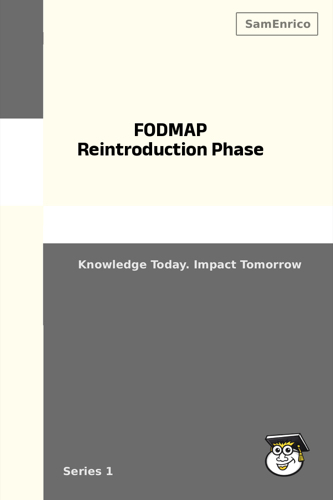
FODMAP Reintroduction Phase eBook
Systematically test tolerance after elimination pe
Systematically test tolerance after elimination period.
Formats
Free sample
Chapter 1: The Bucket Beneath the Faucet--–- The email arrived at 11:47 on a Tuesday night. Sarah had been scrolling through Instagram, watching a former college roommate eat ramen in Tokyo, when her phone buzzed. It was her gastroenterologist's nurse, responding to the message she'd sent three days earlier. Sarah had asked a simple question: "How long do I need to stay on this elimination diet?"The nurse's answer: *"Most patients stay on it for 2-6 weeks before reintroduction. But if you're feeling good, many choose to stay on it longer.
It's really up to you."*Sarah stared at the screen. She had been on the low-FODMAP elimination diet for eleven months.In that time, she had memorized the ingredient labels of seventeen different gluten-free cracker brands. She had stopped saying yes to dinner invitations, then stopped receiving them. She had brought her own food to her sister's wedding, eating cold rice cakes at a table of eight while everyone else devoured prime rib and garlic mashed potatoes. She had not eaten a single slice of pizza, bitten into a warm piece of bread, or tasted her mother's Thanksgiving stuffing – the one with the caramelized onions that used to be her favorite food on earth.She felt better.
That was the cruel irony. Her bloating had vanished. The abdominal pain that used to wake her at 3 AM was gone. She no longer spent forty minutes in the bathroom every morning, crying from the cramping. The diet had worked exactly as promised.But she had also never been more isolated, more anxious around food, or more aware that her "safe" list was shrinking, not expanding.
She had started with forty safe foods. Now, after eleven months of fear-driven restriction, she was down to fourteen. Every time she tried something new and felt a twinge, she cut it out forever. She wasn't managing her gut. She was starving it of diversity.The nurse's casual phrase – "It's really up to you" – landed like an indictment.
Sarah realized she had no idea what she was doing. No one had given her a protocol, a timeline, or a sense of what "success" was supposed to look like. She was just... avoiding. Forever.That night, she googled "low-FODMAP reintroduction phase" and found nothing but scattered blog posts and conflicting advice.
One site said to test one food per week. Another said to test for five days straight. A forum thread warned that reintroduction caused "unbearable pain" and to "never try it unless supervised by a doctor." Another commenter said they'd reintroduced everything with no problem at all.Sarah closed her laptop at 1:23 AM, more confused than when she started. She was living proof of the single biggest failure in the low-FODMAP world: the elimination phase has become a permanent trap for millions of people, not because the diet doesn't work, but because no one has taught them how to leave it.If you're reading this book, you might be Sarah. Or you might be someone who hasn't started yet, still scrolling through Reddit threads and Monash University updates, terrified of what happens when you take the training wheels off.
You might be someone who tried reintroduction once, had a bad reaction, and swore never again. Or you might be someone who has never even heard of the reintroduction phase – who thought the elimination diet was the whole program.Here is the truth that no one told you, and it is the most important sentence in this entire book: The elimination diet is not a treatment. It is a diagnostic test. And a diagnostic test that never ends is just a prison.This chapter is about why you need to read this book right now, why the reintroduction phase is the real game-changer, and why staying on the elimination diet for too long may be doing more harm to your gut than the FODMAPs ever did. But before we go any further, let me tell you a different story – one that ends the way yours can.The Forgotten Phase The low-FODMAP diet was developed by researchers at Monash University in Australia in the early 2010s.
It is, without question, one of the most evidence-based dietary interventions for irritable bowel syndrome (IBS) in existence. More than thirty randomized controlled trials have shown that approximately 50-80% of people with IBS experience significant symptom improvement during the elimination phase.But here is what the researchers have been saying for years, and what almost no one hears: The elimination phase is only the first step.The full protocol has three phases:Elimination (2-6 weeks): Remove all high-FODMAP foods to establish a symptom-free baseline.Reintroduction (6-10 weeks): Systematically test each FODMAP group to identify personal triggers and thresholds.Personalization (lifelong): Build a varied, nutritious diet based on your unique tolerance profile, with occasional re-testing as your gut changes.In the research setting, this three-phase protocol works beautifully. Patients go from misery to management. They learn that they can eat garlic at restaurants but not at home, or that they can handle half an apple but not a whole one. They stop fearing food and start enjoying it again.But in the real world – outside the carefully controlled environment of a clinical trial – the reintroduction phase is skipped, botched, or abandoned by the vast majority of people who attempt the low-FODMAP diet.Why?Because reintroduction is hard.
It requires structure, patience, and a tolerance for uncertainty. It requires you to intentionally eat foods that might cause symptoms – something your brain has been trained to avoid at all costs. It requires you to keep a detailed journal, measure portions with a kitchen scale, and distinguish between "normal digestion" and "problematic reaction." And it requires a guide.Most people never get that guide. Their doctors – if they even mentioned the low-FODMAP diet in the first place – hand them a photocopied list of "yes" and "no" foods and send them on their way. The dietitian appointments are too expensive or too infrequent.
The online resources focus overwhelmingly on the elimination phase because that's what people search for. ("What can I eat?" is a much more common question than "How do I test my tolerance?")The result is a silent epidemic of what researchers call "chronic elimination" – people who stay on the restrictive phase for months or years, not because it's medically indicated, but because no one has given them a safe, structured way out.The Hidden Costs of Staying Too Long Let me be very clear: the elimination diet is not dangerous for a few weeks. For 2-6 weeks, it is an effective diagnostic tool. But when elimination stretches into months or years, the costs begin to compound in ways that most people never anticipate.Cost #1: Loss of gut microbiome diversity Your gut is home to trillions of bacteria, fungi, and other microorganisms collectively known as the microbiome. These microbes play essential roles in digesting food, producing vitamins, regulating your immune system, and even influencing your mood.
Different microbes eat different things. Some thrive on fiber. Some love resistant starch. And some – the ones that help you digest FODMAPs – actually require FODMAPs to survive.When you eliminate all high-FODMAP foods for an extended period, you starve…
This is the end of the free sample. Get the eBook to keep going. Buy now
About this book
Details
- Author
- Hensley Alejandra
- Publisher
- SamEnrico
- Language
- English
- Genre
- Non-Fiction, Health & Wellness, Food Challenge
- Released
- 2026-06-10
- Pages (approx.)
- 149
- Available as
- eBook, Audiobook

Read better in the ZLOADR app
Your eBooks on your phone or tablet. Sign in with your SamEnrico account and start reading.
More by Hensley Alejandra
 Work Addiction and PerfectionismHensley Alejandra$11.99
 Internal Comms Issue LogHensley Alejandra$11.99
 Anger for Police OfficersHensley Alejandra$11.99
 The Telemedicine Investment ForecastHensley Alejandra$11.99
 Shadows in the Shadows: The Hunt for the Kenyan Police MoleHensley Alejandra$11.99
 Assistant ControllerHensley Alejandra$11.99
 Micro Break Tracker JournalHensley Alejandra$12.99
 Cooperative Registration ProcessHensley Alejandra$12.99
 Understanding Spondyloepiphyseal Dysplasia Tarda Progressive ArtHensley Alejandra$17.99
 How to Become a Continuous-towel RollerHensley Alejandra$11.99