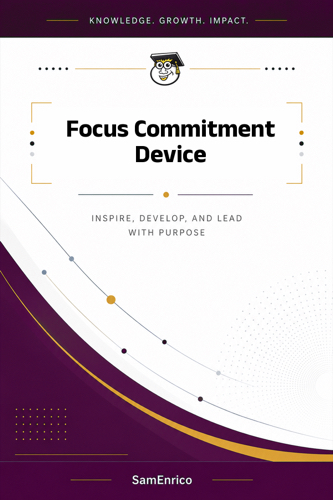
Focus Commitment Device eBook
Locks distractions with physical keys.
Locks distractions with physical keys.
Formats
Free sample
Chapter 1: The Engineered Hijack...–- You are standing in line at a coffee shop. Your phone buzzes. You glance down. It is a notification from an app you barely remember downloading. You swipe it away.
Then you check your email. Then Instagram. Then the news. Then back to email. Your latte arrives.
You have no memory of the last 90 seconds. This is not a failure of your character. It is a triumph of their engineering.The Billion-Dollar Question Let me ask you something uncomfortable. If I offered you $1,000 to sit in a quiet room for one hour with no phone, no computer, no distractions—just your own thoughts—could you do it? Most people cannot.
In a famous study by the University of Virginia, 67% of men and 25% of women chose to give themselves mild electric shocks rather than sit alone with their thoughts for 15 minutes. They preferred physical pain to the absence of distraction.This is not because we are weak. It is because we are being played.The average smartphone user touches their phone 2,617 times per day. The average person unlocks their phone 150 times daily. That is once every six and a half waking minutes.
And here is the detail that should terrify you: in most cases, you do not remember doing it. Your hand reaches for your pocket, pulls out the device, unlocks it, opens an app, scrolls, closes it, and returns it to your pocket—all on autopilot. You are a passenger in your own body.This chapter is not here to make you feel guilty. Guilt sells books, but guilt does not create change. This chapter is here to show you the blueprint of the machine that has been built around your attention.
Because once you see the gears, you cannot unsee them. And once you cannot unsee them, you can begin to fight back.The Attention Economy: Your Focus Is the Product In the 1970s, Herbert Simon, a Nobel Prize-winning economist, made a prophetic statement. He observed that in an information-rich world, the scarce resource is not information. It is attention. Forty years later, his prediction became the business model of the twenty-first century.Here is how it works.
Companies like Google, Meta (Facebook), Tik Tok, and Twitter do not sell you a product. You are the product. They sell your attention to advertisers. Every second you spend looking at a screen, you are generating revenue. Every swipe, every like, every comment, every view—these are not neutral acts.
They are transactions. Your attention is the currency, and the exchange rate is set by algorithms designed to maximize the time your eyeballs spend on the screen.Consider this: in 2023, Meta generated approximately $131 billion in advertising revenue. That is $131 billion dollars paid by companies to access your eyeballs. You did not see a penny of that money. In fact, you paid for the phone, you pay for the data plan, and then you pay again—with your time, your focus, and your peace of mind.But here is what most people do not understand.
These companies do not just want your attention. They want your addicted attention. They want you to check your phone not because you need to, but because you cannot help yourself. And they have spent billions of dollars learning exactly how to make that happen.Variable Rewards: The Slot Machine in Your Pocket The most powerful psychological mechanism in the attention economy is something called variable rewards. The term comes from research conducted by B.F.
Skinner in the 1950s. Skinner placed a hungry rat in a box with a lever. When the rat pressed the lever, a food pellet dropped. The rat learned to press the lever. That is a fixed reward.
Predictable. Effective but boring.Then Skinner changed the game. He programmed the lever so that sometimes it dispensed a pellet, sometimes it dispensed nothing, and sometimes it dispensed ten pellets. The rat went crazy. It pressed the lever obsessively.
It ignored food elsewhere. It pressed until it collapsed from exhaustion. This is a variable reward. Unpredictable. And wildly addictive.You are the rat.
Your phone is the lever. The pellets are likes, comments, messages, and notifications.Open Instagram. When do new posts appear? You do not know. Scroll.
Maybe there is something interesting. Maybe there is nothing. Scroll again. This unpredictability triggers a dopamine response in your brain stronger than a guaranteed reward. Open your email.
Is there an important message? Maybe. Maybe not. You check anyway. Open Tik Tok.
The algorithm serves you a video. You swipe. Another video. You swipe. Another.
You have no idea what comes next, and that uncertainty is precisely what keeps you swiping.Tristan Harris, a former Google design ethicist, calls this the "brain's hijack." He testified before the U.S. Senate that smartphones are designed to exploit the same neural circuitry as slot machines. "Every time I check my phone," he said, "I'm playing a slot machine to see, 'What did I get?' This is exactly the same mechanism that makes slot machines so addictive."The numbers bear this out. The average Tik Tok session lasts 10.9 minutes. The average user opens the app 8 times per day.
That is nearly 90 minutes daily, just on Tik Tok. Across all social media, the average person spends 2 hours and 24 minutes per day scrolling. That is 36 full days per year. Five years of your adult life, if you live to 80, will be spent staring at a screen of variable rewards.And you are not getting paid for any of it.Attention Residue: The 23-Minute Lie You tell yourself a lie every single day. The lie sounds like this: "I'll just check this really quick." You believe that a 30-second glance at your phone costs you 30 seconds of productivity.
This is catastrophically wrong.The truth is far worse. When you interrupt a focused task to check a notification, you do not simply lose the 30 seconds of the interruption. You lose, on average, 23 minutes of productive time. This phenomenon is called attention residue, and it was first identified by Professor Sophie Leroy at the University of Washington.Here is how attention residue works. You are writing a report.
Your phone buzzes. You glance at it for 30 seconds. You return to the report. But your brain does not return fully. A portion of your cognitive bandwidth remains stuck on the interruption.
What was that message? Should I respond? Who was it from? Why did they message me now? Even if you consciously decide to ignore it, your unconscious mind continues to process the distraction.Leroy's research found that after an interruption, it takes an average of 23 minutes and 15 seconds to return to the same depth of focus you had before the interruption.
And here is the kicker: that timer resets with every interruption. If you check your phone every 20 minutes, you will never, in the entire day, achieve a single minute of deep focus. You will be permanently trapped in a state of attention residue.This is not hypothetical. Gloria Mark, a professor at the University of California, Irvine, studied knowledge workers in their natural environments. She found that the average worker switches tasks every 3 minutes and 5 seconds.
When measured digitally, the average is even worse: 47 seconds per task. Most people cannot focus on a single screen…
This is the end of the free sample. Get the eBook to keep going. Buy now
About this book
Details
- Author
- Mooney Tennille
- Publisher
- SamEnrico
- Language
- English
- Genre
- Non-Fiction, Self-Help, Commitment Devices
- Released
- 2026-06-05
- Pages (approx.)
- 149
- Available as
- eBook, Audiobook

Read better in the ZLOADR app
Your eBooks on your phone or tablet. Sign in with your SamEnrico account and start reading.
More by Mooney Tennille
 The Immigrant EV FounderMooney Tennille$11.99
 C 2 Greyhound PilotMooney Tennille$11.99
 Instant Pot Meal PrepMooney Tennille$11.99
 Ideation Methods HandbookMooney Tennille$11.99
 Overcoming Loneliness Without PetsMooney Tennille$11.99
 Writer Morning RoutineMooney Tennille$11.99
 Resilience for LawyersMooney Tennille$11.99
 The Iron Will of Eddie Arcaro: How a Jockey Mastered the Mind Game of Horse RacingMooney Tennille$11.99
 How to Produce Laundry AppliancesMooney Tennille$11.99
 Service Providers Guide to Directory PublishingMooney Tennille$11.99
 How to Produce Video Camera LensesMooney Tennille$11.99
 A Collector's Handbook to the Marmon Big EightMooney Tennille$11.99