
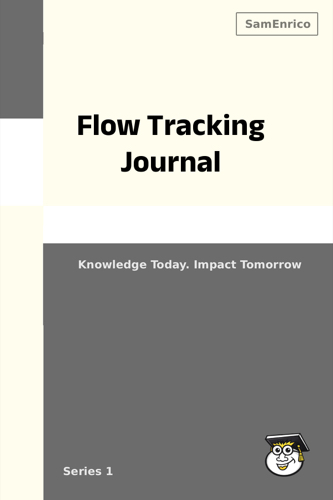
Non-FictionSelf-HelpJournaling
Flow Tracking Journal eBook
Provides daily log to identify personal flow trigg
Provides daily log to identify personal flow triggers and blockages over time.
Formats
Free sample
Chapter 1: The Accidental Addict--–- You don’t have a focus problem. You have a pattern problem.Let me say that again, because it’s the single most important sentence in this entire book, and if you forget everything else, remember this: You already know how to focus. You’ve done it before. Maybe it was yesterday for fifteen minutes. Maybe it was three years ago for an entire afternoon that felt like magic.
Maybe it was childhood, building Lego towers while the world disappeared around you.The issue isn’t that you can’t focus. The issue is that you can’t predict when focus will show up.And that unpredictability is costing you more than time. It’s costing you your sense of competence, your creative energy, and—if you’re honest—a quiet but persistent feeling that everyone else has figured out something you haven’t.They haven’t.What they have is not a superpower. What they have is a system. And systems can be learned.The Confession Every High-Achiever Hides Let me tell you about a client I’ll call Maya.
She was a senior designer at a tech company, thirty-four years old, respected by her peers, and completely exhausted. When she came to me, she said something I’ve heard hundreds of times since:“I know I’m capable of amazing work. I’ve done it. But most days, I sit down to do the thing I’m supposed to do, and I just… can’t. I scroll.
I reorganize my files. I get a glass of water. And then at 5 PM, I feel like a failure. So I work at night to catch up. Then I’m tired the next morning.
It’s a loop.”Maya wasn’t lazy. She wasn’t undisciplined. She was a high-achiever who had accidentally trained herself to associate her desk with resistance.She had become an accidental addict—not to substances, but to a specific, destructive pattern: effort followed by frustration followed by avoidance followed by guilt. And that pattern, repeated daily, had become her default.Here’s what Maya didn’t know until we started tracking: her best work never happened at her desk. It happened on the train commute home, in the shower on Saturday mornings, and once, memorably, while she was supposed to be listening to her cousin’s wedding toast.
Her flow states were real. They were also completely accidental.She was waiting for inspiration like a farmer waiting for rain instead of learning to build a well.This book is the well.The Myth of the Always-On Performer Before we go any further, we need to kill an idea that has secretly poisoned the way you think about your own attention.The idea is this: Productive people are always productive. Focused people are always focused. If you were truly disciplined, you would be able to sit down and do the work whenever you needed to.This is a lie. And it’s a particularly cruel lie because it sets an impossible standard, then blames you for failing to meet it.I want you to think about the most productive person you know.
Really think about them. Do they work twelve hours straight without losing focus? Or do they work in intense bursts, then disappear, then reappear? Do they handle every task with the same energy? Or do they save their deep focus for specific things and coast through others?If you watch closely, even the most impressive performers have dead zones.
They have tasks they procrastinate on. They have afternoons that slip away. The difference is not that they never lose focus. The difference is that they have learned to recognize the conditions that create focus—and they arrange their lives to produce those conditions more often.That’s it. That’s the entire secret.Flow is not a personality trait.
It is not something you are born with or without. It is a state—a temporary, context-dependent, neurochemical condition that your brain enters when specific conditions are met. And the best performers in the world, from concert pianists to neurosurgeons to video game designers, have simply gotten very good at arranging those conditions.They are not better at focusing. They are better at triggering focus.What Is Flow, Really?You’ve probably heard the term before. It was coined by psychologist Mihaly Csikszentmihalyi (pronounced “chick-sent-me-high”) in the 1970s after he noticed something strange: artists would get so lost in their work that they forgot to eat, forgot to sleep, and lost all sense of time.
When he asked them how it felt, they described it as being carried by a current—hence, “flow.”But let’s get more specific. Flow is a state of consciousness with six measurable features:Complete concentration – You are not thinking about other things. The past and future disappear.Clarity of goals – You know exactly what you are trying to do at each moment.Immediate feedback – You can tell, instantly, whether you are succeeding or failing.Loss of self-consciousness – You stop worrying about how you look or what others think.Distorted time – Hours can feel like minutes, or minutes can feel like hours.Autotelic experience – The activity itself becomes the reward. You do it because it feels good, not for an external outcome.If you’ve ever been “in the zone” while playing a sport, writing, coding, cooking, painting, or even having a deep conversation—you’ve felt these things. You know the feeling.
It’s not mysterious. It’s biological.When you are in flow, your brain releases a specific cocktail of neurochemicals: dopamine (pleasure, focus), norepinephrine (alertness, arousal), anandamide (bliss, creative thinking), and endorphins (pain suppression, euphoria). This is not metaphor. This is measurable chemistry.And here’s the crucial insight: your brain does not release these chemicals randomly. It releases them in response to specific conditions—what researchers call flow triggers.The problem is that most people encounter these triggers by accident.
They stumble into flow the way you might stumble into a good restaurant while lost in a foreign city: it’s wonderful, but you can’t find it again.This book is about learning to navigate. By the time you finish the ninety-day experiment, you will no longer stumble. You will choose.Why Generic Advice Fails You Let me pause here to address something that might be bothering you. If flow is so biological, if the triggers are known, why hasn’t some app or productivity guru already solved this for you?Because almost all productivity advice is generic. And your brain is not generic.Wake up at 5 AM.
Use the Pomodoro technique. Block your calendar. Turn off notifications. Make your bed. Eat the frog.
These are not bad suggestions. For some people, some of them work. But none of them work for everyone, and none of them work all the time.Here’s why.Your chronotype—whether you are a morning lark, a night owl, or something in between—is largely genetic. Telling a night owl to wake up at 5 AM is like telling a left-handed person to use right-handed scissors. They can do it.
But they will be slower, more frustrated, and more likely to quit.Your sensitivity to distraction also varies. Some people can…
This is the end of the free sample. Get the eBook to keep going. Buy now
About this book
Details
- Author
- Desimone Alise
- Publisher
- SamEnrico
- Language
- English
- Genre
- Non-Fiction, Self-Help, Journaling
- Released
- 2026-06-06
- Pages (approx.)
- 136
- Available as
- eBook, Audiobook

Read better in the ZLOADR app
Your eBooks on your phone or tablet. Sign in with your SamEnrico account and start reading.
More by Desimone Alise
 Overland India To Siberia ExpeditionDesimone Alise$11.99
 Climate Anxiety BreathDesimone Alise$11.99
 Loving Kindness for Dementia CaregiversDesimone Alise$11.99
 The Shadow Warriors of the Silk Road: The Untold Story of the Persian Martial MastersDesimone Alise$11.99
 How to Start a Milk Sterilising Business (Beginners Guide)Desimone Alise$11.99
 Lunch and Break Period Legal RequirementsDesimone Alise$12.99
 How to Produce Calculator AccessoriesDesimone Alise$11.99
 Healthcare Business AnalystDesimone Alise$11.99
You may also like
 Hong Kong Handover 1997Dunn Johnnie$11.99
 Zumba For Postnatal Recovery CourseNeal Christian$11.99
 Zumba for BeginnersLadner Nikia$11.99
 YouTube Comment Mining GuideHumes Pandora$12.99
 Worry Box MeditationCarlin Rudy$11.99
 Workplace Stress MeditationNguyen Lynn$11.99
 Workplace Stress and Sleep RepairHawley Ivory$11.99
 Workplace Perfectionism CureDelaney Jeffry$11.99
 Workplace Injustice Anger GuideWallen Isabelle$11.99
 Work Addiction and Burnout LinkGreenwood Ester$11.99
 Women in Yoga and WellnessBeattie Galina$11.99
 Women in Stand Up ComedyChun Evangeline$11.99