
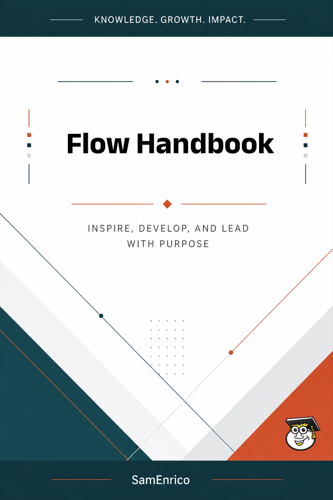
Non-FictionSelf-HelpComplete Guide
Flow Handbook eBook
Complete guide to achieving optimal experience.
Complete guide to achieving optimal experience.
Formats
Free sample
Chapter 1: The Happiness Trap--–- Most people spend their lives chasing the wrong thing. They wake up believing that happiness is a destination—a corner they will turn once they get the promotion, find the partner, lose the weight, or retire to the beach. And every single day, that corner recedes further into the distance. This is not a moral failing. It is a design flaw in how we have been taught to think about well-being.
For the past century, psychology has largely studied what makes people miserable: anxiety, depression, trauma, addiction. The result is a staggering library of knowledge about human suffering and almost no practical science about human flourishing. That changed in the early 1960s when a young Hungarian psychologist named Mihaly Csikszentmihalyi (pronounced “Me-high Chick-sent-me-high”) had a revelation while watching artists in a Parisian studio. They were painting for hours without eating, without sleeping, without any promise of money or fame. When he asked them why they did it, they did not say “for happiness.” They said the act itself was worth it.
That moment, perhaps more than any other, birthed a new science—the science of optimal experience. And at its heart lies a single, counterintuitive truth: Happiness is not found by relaxing. It is found by engaging. It is not a feeling you chase. It is a state you enter.
That state is called flow.The great irony of modern life is that we have more comfort, more entertainment, and more leisure time than any generation in human history—and yet rates of anxiety, depression, and existential dread have never been higher. The average person now spends over four hours a day on their smartphone, much of it scrolling through carefully engineered feeds designed to trigger outrage and envy. We have mistaken the absence of pain for the presence of joy. We have confused the soft glow of a screen for the deep satisfaction of a challenge met. This chapter will dismantle that illusion.
It will introduce you to the most important psychological discovery of the last fifty years: the concept of flow. You will learn the eight characteristics of optimal experience, the research that proved its existence, and why almost everything you have been told about happiness is backward. By the end of this chapter, you will never ask yourself “What will make me happy?” again. Instead, you will ask a better question: “What will absorb me completely?”The Failure of the Happiness Industry Before we can understand flow, we must first understand why the conventional approach to happiness has failed. Walk into any bookstore and you will find entire shelves dedicated to happiness: ten steps to joy, seven habits of happy people, the secrets of the Danish, the Bhutanese, the monks of some distant mountain.
These books share a common structure. They promise that happiness is achievable through specific techniques: gratitude journals, positive affirmations, decluttering, mindfulness meditation, or simply deciding to be happy. The underlying assumption is that happiness is a mental state you can summon at will, like flexing a muscle. This assumption is wrong.The problem is not that these techniques are useless. Gratitude does help.
Meditation does calm the mind. The problem is that they treat happiness as a direct goal. And direct pursuit of happiness is a trap. Psychologists call this the paradox of hedonism: the more you consciously strive to feel happy, the less happy you actually become. Why?
Because trying to feel happy forces you to constantly monitor your own emotional state. You are standing outside yourself, asking “Am I happy yet? How about now? Why not?” That meta-awareness pulls you out of the very experiences that might actually make you happy. It is like trying to fall asleep by yelling at yourself to sleep.
It does not work.Consider a simple experiment. Researchers asked two groups of people to listen to a piece of beautiful music. One group was told to try to feel happy while listening. The other group was told simply to listen. Afterwards, the first group reported less enjoyment than the second.
Their very effort to feel happy interfered with their ability to lose themselves in the music. This is the trap. Modern self-help tells you to chase happiness directly. Flow science tells you to chase engagement instead, and let happiness arrive as a byproduct, uninvited and unannounced.The Experience Sampling Method: How We Actually Feel In the 1970s, Csikszentmihalyi and his colleagues developed a research method that would revolutionize the study of human experience. They called it the Experience Sampling Method, or ESM.
The protocol was simple but brilliant. Participants wore pagers or wristwatches that would beep at random intervals throughout the day—approximately eight times between 8 a.m. and 10 p.m. Each time the device beeped, the participant would stop what they were doing and fill out a short questionnaire. What are you doing right now?
Who are you with? How challenging is the activity? How skilled do you feel? And most importantly: How happy, focused, creative, and satisfied are you in this moment?Over the decades, this method has captured millions of data points from thousands of people across dozens of cultures: teenagers in Chicago, monks in Italy, assembly line workers in Detroit, surgeons in Tokyo, rock climbers in the Alps, elderly women in Korea. The results were so consistent that they amount to a universal law of human experience.
Here is what the data shows: People report the highest levels of enjoyment, creativity, and life satisfaction not when they are relaxing, but when they are fully engaged in a challenging activity that requires their complete attention. Let that sink in. The beeper goes off while someone is watching television. They report mild pleasure, low concentration, and a vague sense of passivity. The beeper goes off while someone is playing a difficult piece of music, or performing surgery, or climbing a rock face, or writing a complex computer program.
They report intense enjoyment, deep concentration, and a feeling of being alive.The most striking finding is this: People are actually unhappier during passive leisure than they think they are. When asked to predict how they will feel watching TV for two hours, people guess they will feel relaxed and happy. But when the beeper catches them actually watching TV, they report feeling distracted, mildly bored, and often vaguely guilty. The gap between anticipated pleasure and actual experience is enormous. We have been sold a fantasy that rest is restorative.
But most rest is merely the absence of effort, not the presence of fulfillment.The Eight Characteristics of Flow Based on decades of ESM research, Csikszentmihalyi identified eight shared characteristics that define the flow state. When people report being in flow, they describe these eight experiences. We will explore each in depth.First: Clear goals every step of the way. In flow, you always know what you need to do next. A chess player knows that the goal is to checkmate the king.
A surgeon knows that the goal is to complete the incision without damaging the tissue. A rock climber knows that the goal is to reach the next handhold. This does not mean the overall task is simple. It…
This is the end of the free sample. Get the eBook to keep going. Buy now
About this book
Details
- Author
- Gilman Gregorio
- Publisher
- SamEnrico
- Language
- English
- Genre
- Non-Fiction, Self-Help, Complete Guide
- Released
- 2026-06-10
- Pages (approx.)
- 127
- Available as
- eBook, Audiobook

Read better in the ZLOADR app
Your eBooks on your phone or tablet. Sign in with your SamEnrico account and start reading.
More by Gilman Gregorio
 Email Follow Up System GuideGilman Gregorio$11.99
 Holiday Party Small TalkGilman Gregorio$11.99
 Food Addiction Visualization GuideGilman Gregorio$11.99
 The Weekly Meal Prep Sunday GuideGilman Gregorio$11.99
 Anansi's Lyrical Web: The Spider's Symphony of TrickeryGilman Gregorio$11.99
 How to Start a Photocopier Printing Business (Beginners Guide)Gilman Gregorio$11.99
 Ghana Mobility Startup GuideGilman Gregorio$12.99
 Depressed CEO HandbookGilman Gregorio$12.99
 Understanding Wiedemann–grosse–dibbern SyndromeGilman Gregorio$17.99
 Veterinary SurgeonGilman Gregorio$11.99
You may also like
 Hong Kong Handover 1997Dunn Johnnie$11.99
 Zumba For Postnatal Recovery CourseNeal Christian$11.99
 Zumba for BeginnersLadner Nikia$11.99
 YouTube Comment Mining GuideHumes Pandora$12.99
 Worry Box MeditationCarlin Rudy$11.99
 Workplace Stress MeditationNguyen Lynn$11.99
 Workplace Stress and Sleep RepairHawley Ivory$11.99
 Workplace Perfectionism CureDelaney Jeffry$11.99
 Workplace Injustice Anger GuideWallen Isabelle$11.99
 Work Addiction and Burnout LinkGreenwood Ester$11.99
 Women in Yoga and WellnessBeattie Galina$11.99
 Women in Stand Up ComedyChun Evangeline$11.99