
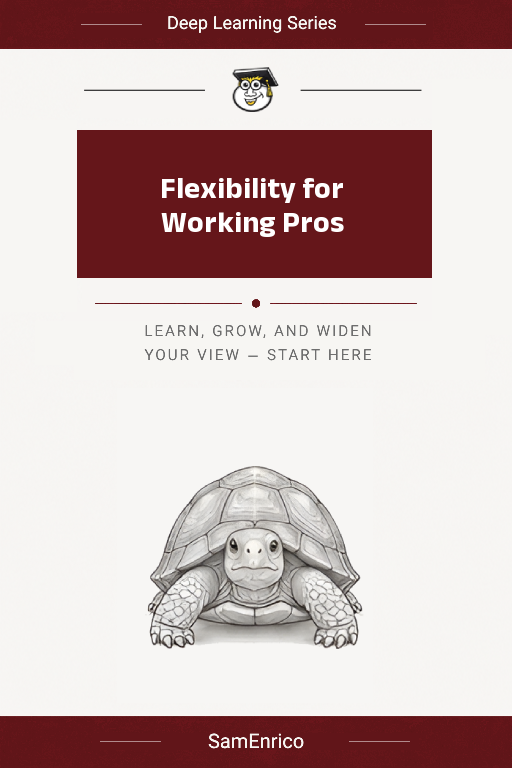
Non-FictionStudent's ShortcutWork-Life BalanceScheduling
Flexibility for Working Pros eBook
Balance asynchronous self-paced courses at Harvard
Balance asynchronous self-paced courses at Harvard Extension against LSE's structured weekly deadlines and live sessions.
Formats
Free sample
Chapter 1: The Mirror Test--–- The first time Sarah tried to complete a self-paced Harvard Extension course, she told everyone it was because she was busy. Work had been intense. Her daughter’s soccer schedule was chaotic. The holidays landed right in the middle of the semester. All of these things were true.
None of them was the real reason she failed.The real reason sat in her browser for fourteen weeks: a playlist of unwatched lectures, growing like a to-do list that had learned to reproduce. Every Tuesday, she told herself she would watch two recordings on Wednesday. Every Wednesday, something urgent came up. By Thursday, the recordings felt stale. By Friday, they felt impossible.
By week four, she stopped opening the course portal entirely. The emails from the professor became background noise. The discussion board posts from classmates—people who somehow were keeping up—became indictments she refused to read.Sarah was not lazy. She was a senior marketing director at a mid-sized tech firm, praised for her ability to handle crisis after crisis. She had completed three in-person certificate programs before having children, all with top marks.
She had recommended Harvard Extension to two colleagues, both of whom finished their courses without issue. The problem was not her work ethic, her intelligence, or her time management. The problem was that Sarah had never learned to distinguish between two fundamentally different ways of showing up to a learning environment.She was a Deadline-Driven learner who had chosen a Self-Starter’s format. And no amount of grit was going to fix that mismatch.Across town, Marcus was living the mirror image of Sarah’s failure. He had enrolled in LSE’s structured Executive MSc program, attracted by the prestige and the promise of live, weekly seminars with global peers.
Marcus was a product manager who had built his entire career on self-direction. He learned Python from You Tube tutorials. He taught himself SQL using free online resources. He had completed three self-paced certifications without ever needing a deadline. He was, by every measure, a Self-Starter.But LSE’s program required attendance.
Not suggested attendance. Not "we highly recommend you join live" attendance. Compulsory attendance. Every Wednesday at 7 PM London time, which meant 2 PM for Marcus on the East Coast. His calendar had a red block that said "DO NOT BOOK" for four hours every week.
And every week, something came up. A client emergency. A product launch meeting. A last-minute call with the London office that overlapped perfectly with his live session.Marcus attended the first three weeks. By week five, he was showing up late, camera off, apologizing in the chat.
By week seven, he stopped logging in entirely. The recordings were available, but watching them felt like surrender. He had paid for a live, interactive experience. What he got was a series of Zoom links he couldn't bring himself to click.He told himself the program was too rigid. He told himself the time zone difference was unmanageable.
He told himself that LSE should offer more flexibility. All of these things were true. None of them was the real reason he quit.The real reason was that Marcus was a Self-Starter who had chosen a Deadline-Driven format. And like Sarah, he had never been taught how to diagnose his own learning architecture before making a decision that would cost him thousands of dollars and months of his life.The Epidemic of Misdiagnosis Sarah and Marcus are not outliers. They are the rule.Over the past decade, adult learning has exploded into a multi-billion-dollar industry.
Harvard Extension School alone serves more than 13,000 students annually across its three formats: synchronous (live online), asynchronous (self-paced), and on-campus intensives. LSE’s hybrid-flex Executive programs attract professionals from more than sixty countries, all paying premium tuition for the privilege of live, structured interaction with faculty and peers. Coursera, Udemy, Linked In Learning, and a thousand other platforms offer self-paced courses to millions. Meanwhile, traditional universities have rushed to build online extensions, weekend MBA programs, and executive certificates that promise the best of both worlds.But beneath this abundance of choice lies a hidden crisis: most professionals are choosing their learning formats for the wrong reasons.They choose based on prestige ("Harvard sounds better than my local university"). They choose based on convenience ("Self-paced means I can do it whenever").
They choose based on peer pressure ("My boss recommended this program"). They choose based on fear of missing out ("Everyone in my industry has this certification"). Almost no one chooses based on a systematic diagnosis of their own accountability architecture.The result is an epidemic of misdiagnosis. Deadline-Driven professionals sign up for self-paced courses and vanish after week four, just like Sarah. Self-Starters enroll in rigid, synchronous programs and suffocate under compulsory attendance, just like Marcus.
Neither group is incapable of learning. Both groups are capable of extraordinary achievement—in the right environment. But they have never been given the tools to know which environment that is.This book exists to fix that gap.The Independence Trap To understand why so many professionals fail at flexible learning, we need to understand a concept from Stephen Covey’s The 7 Habits of Highly Effective People: the difference between independence and interdependence.Most adults in the professional world have been taught to value independence above almost everything else. Independence means self-reliance. It means not needing anyone else to get things done.
It means being the kind of person who can be trusted with a project and left alone to complete it. These are valuable traits. They are also, when applied to learning, a trap.Here is the paradox: many professionals who are highly independent in their work lives are actually interdependent learners. They need deadlines. They need accountability.
They need the social pressure of a live class or a weekly check-in. Without these external structures, their independence becomes a liability—not because they lack discipline, but because they have outsourced their discipline to environments that no longer exist.Covey’s matrix helps us see this clearly. Independence is about self-mastery. Interdependence is about teamwork, accountability, and shared goals. When you are learning alone, watching recorded lectures in your living room, you have no team.
You have no shared goals. You have only yourself. If you are a Deadline-Driven learner, that is a disaster waiting to happen.The professionals who succeed at asynchronous learning are not the ones who "work harder" or "have more willpower." They are the ones who accurately diagnosed themselves as Self-Starters before they enrolled. And the professionals who thrive in LSE’s structured environment are not the ones who "love rules" or "need hand-holding." They are the ones who recognized their Deadline-Driven nature and chose a format that would supply the external pressure they require.The question is not whether you are disciplined enough for flexibility. The question is whether you are honest enough about what kind of learner you actually are.The Three Formats You Need to Understand Before we go further, let me clarify the three learning formats that will appear throughout this book.
Understanding their distinctions is essential to diagnosing your own fit.Asynchronous (Self-Paced) Learning This is the Harvard Extension model that Sarah…
This is the end of the free sample. Get the eBook to keep going. Buy now
About this book
Details
- Author
- Anders Marybelle
- Publisher
- SamEnrico
- Language
- English
- Genre
- Non-Fiction, Student's Shortcut, Work-Life Balance, Scheduling
- Released
- 2026-06-01
- Pages (approx.)
- 124
- Available as
- eBook, Audiobook

Read better in the ZLOADR app
Your eBooks on your phone or tablet. Sign in with your SamEnrico account and start reading.
More by Anders Marybelle
 Facilitating Creative Meetings GuideAnders Marybelle$11.99
 Nonviolent LeadershipAnders Marybelle$11.99
 Migraine and Exercise GuideAnders Marybelle$11.99
 The Stress Cancer Risk LinkAnders Marybelle$11.99
 Distraction Audit WorkbookAnders Marybelle$11.99
 The Cockroach InfestationAnders Marybelle$11.99
 Car Nap Safety GuideAnders Marybelle$11.99
 Blue Zone Family MealsAnders Marybelle$11.99
 Google Plus InfluencerAnders Marybelle$11.99
 The Lazarus Code: Cracking the DNA of the ImmortalAnders Marybelle$11.99
 The Silk and Gold Caravans: The Wealth of the Swahili CoastAnders Marybelle$11.99
 Power from the Deep: The Ocean’s Untapped Energy RevolutionAnders Marybelle$11.99
You may also like
 Hong Kong Handover 1997Dunn Johnnie$11.99
 Zumba For Postnatal Recovery CourseNeal Christian$11.99
 Zumba for BeginnersLadner Nikia$11.99
 YouTube Comment Mining GuideHumes Pandora$12.99
 Worry Box MeditationCarlin Rudy$11.99
 Workplace Stress MeditationNguyen Lynn$11.99
 Workplace Stress and Sleep RepairHawley Ivory$11.99
 Workplace Perfectionism CureDelaney Jeffry$11.99
 Workplace Injustice Anger GuideWallen Isabelle$11.99
 Work Addiction and Burnout LinkGreenwood Ester$11.99
 Women in Yoga and WellnessBeattie Galina$11.99
 Women in Stand Up ComedyChun Evangeline$11.99