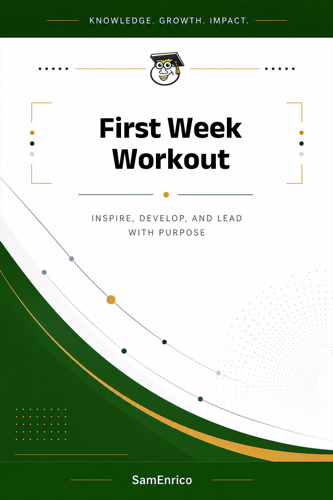
First Week Workout eBook
Teaches manageable daily sessions for complete beg
by Newby Samuel
Teaches manageable daily sessions for complete beginners.
Formats
Free sample
Chapter 1: The Night Before...--The evening before everything changes is always quieter than you expect. There is no drumroll, no orchestral swell, no cosmic announcement that tomorrow you will become someone who moves differently. Instead, there is just you, sitting on your couch or lying in bed, scrolling through your phone, half-thinking about starting something new and half-dreading the familiar cycle of false starts and quiet quitting. You have been here before. You have bought the gym membership in January, downloaded the fitness app in March, watched the inspirational video in September.
And yet, here you are again, standing at the edge of another beginning, wondering if this time will be any different.This chapter is not a workout. There are no push-ups here, no squats, no sweating. This chapter is something far more important: it is the strategic preparation that separates people who start from people who continue. The difference between a failed attempt and a successful first week is almost never about willpower, motivation, or how badly you want to change. The difference is about what you do the night before you begin.
Drawing from the environmental design principles in Atomic Habits by James Clear and the concept of "removing friction" from Tim Ferriss's *The 4-Hour Body*, this chapter will transform your physical space, your mental framing, and your evening routine so that when your alarm goes off tomorrow morning, movement is not just possible—it is inevitable.You are about to learn why the five minutes immediately after waking are the most dangerous for beginners, how a simple glass of water can double your follow-through rate, and why the single greatest predictor of whether you will exercise tomorrow is not your level of motivation but whether your workout clothes are within arm's reach of your bed. This is not self-help philosophy. This is behavioral engineering. And it works whether you feel motivated or not.The All-or-Nothing Trap That Has Been Lying to You Before we rearrange a single item in your home, we need to understand why your previous attempts to start exercising have failed. And the answer is almost certainly not what you think.
You have likely blamed yourself. You have called yourself lazy, undisciplined, or weak-willed. You have told yourself that you just didn't want it badly enough. None of that is true.The real culprit is a cognitive distortion called the all-or-nothing mindset. It sounds like this: "If I cannot do a full 45-minute workout, there is no point in doing anything." Or: "If I miss one day, I have failed completely, so I might as well quit." Or: "Real exercise means sweating, suffering, and feeling sore the next day.
Anything less doesn't count."This mindset is not your fault. It has been fed to you by fitness marketing, social media influencers, and a culture that celebrates extreme transformation over sustainable change. But it is also the single greatest destroyer of beginner fitness habits. Research from exercise psychology, particularly in the work of Dr. Michelle Segar at the University of Michigan, shows that people who define success as "showing up" rather than "suffering" are three times more likely to still be exercising six months later.Here is the truth that will anchor your entire first week: Success is not measured by how hard you worked.
Success is measured by whether you showed up. A day when you do eight minutes of gentle mobility work counts exactly as much as a day when you run a marathon. In the context of habit formation, showing up is the only metric that matters. The intensity, duration, and quality of your workout are irrelevant if you do not first establish the pattern of showing up.Your goal for Week 1 is not to get fit. Your goal is to become someone who moves every day, even if only for a few minutes.
That is it. That is the entire point. Once you have established that identity—"I am someone who moves daily"—everything else becomes easier. But you cannot skip to the advanced chapter. You have to start with Page One.
And Page One begins tonight.The Five-Minute Rule: Your Anti-Procrastination Weapon The single most effective psychological tool you will use in this entire book is called the Five-Minute Rule. It is deceptively simple, almost laughably so. But it has been validated by decades of behavioral science, and it works when nothing else does.Here is how it works: You commit to doing just five minutes of movement. That is all. Five minutes.
After five minutes, you have full permission to stop. You can go back to bed, return to the couch, or start your day. No guilt. No shame. No "should have done more."Here is what actually happens when people try this: nearly all of them continue past the five-minute mark.
Why? Because the hardest part of any behavior is not the behavior itself—it is the decision to start. The resistance you feel is almost entirely front-loaded. Once you are in motion, inertia works in your favor. Your brain, which has been screaming "Don't do this!" for the past twenty minutes, suddenly goes quiet.
Your muscles warm up. Your breathing settles. And you realize, almost with surprise, that you are capable of more than you thought.But here is the crucial detail: you are not allowed to use the Five-Minute Rule as a trick to force yourself to do more. You must genuinely give yourself permission to stop. The moment you think, "I'll just tell myself five minutes but secretly plan to do fifteen," the rule stops working.
Why? Because your brain is not stupid. It knows when it is being manipulated. If you secretly intend to do more, your brain will resist the first five minutes just as hard as it would resist fifteen. The magic of the rule comes from the genuine freedom to stop.
That freedom lowers the barrier to entry so dramatically that starting feels almost easy.For tomorrow morning, you are not committing to a workout. You are committing to five minutes of movement. That might be the eight-minute mobility routine from Day 1, or it might be just three minutes of gentle stretching and two minutes of walking in place. Both are acceptable. Both count as success.
The only failure is not starting at all.Environmental Design: Making the Right Choice the Easy Choice James Clear, in Atomic Habits, writes: "You do not rise to the level of your goals. You fall to the level of your systems." Your system for tomorrow morning begins with your environment. Every object in your home is either a trigger for a good habit or a trigger for a bad habit. Your phone on the nightstand triggers scrolling. Your workout clothes in the drawer trigger nothing.
Your running shoes in the closet trigger nothing. Your water bottle in the cabinet requires four steps to access.We are going to redesign your environment tonight so that the path of least resistance leads directly to movement.Step One: Lay Out Your Entire Workout Outfit Not just your shirt. Not just your shoes. Everything. Shirt, shorts or pants, socks, sports bra if applicable, and shoes.
Place them in a visible location between your bed and the bathroom. If you have to walk past them to…
This is the end of the free sample. Get the eBook to keep going. Buy now
About this book
Details
- Author
- Newby Samuel
- Publisher
- SamEnrico
- Language
- English
- Genre
- Non-Fiction, Health & Wellness, Beginner
- Released
- 2026-06-05
- Pages (approx.)
- 145
- Available as
- eBook, Audiobook

Read better in the ZLOADR app
Your eBooks on your phone or tablet. Sign in with your SamEnrico account and start reading.
More by Newby Samuel
 Freelance Financial StressNewby Samuel$11.99
 Burnout Recovery For Sales ProfessionalsNewby Samuel$11.99
 Jimmy Hoffa Organized Crime Enforcer ProfilesNewby Samuel$11.99
 The Brag Sheet Mastery HandbookNewby Samuel$11.99
 OKR Template GuideNewby Samuel$11.99
 WFH Productivity HandbookNewby Samuel$11.99
 Goodreads Reading Challenge ComparisonNewby Samuel$11.99
 Valkyrie's Oath: The Forgotten Shieldmaiden of AsgardNewby Samuel$11.99
 Growing Brassaia (Octopus Tree)Newby Samuel$11.99
 UAE Free Zone VAT ComplianceNewby Samuel$12.99
 Citation Management Tools GuideNewby Samuel$12.99
 A Collector's Handbook to the Rover 2000scNewby Samuel$11.99