
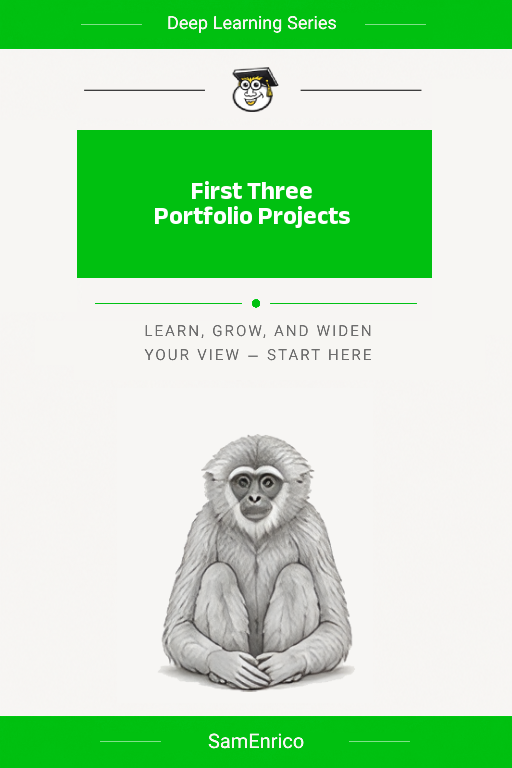
Non-FictionZero-to-One CreatorAction Guide
First Three Portfolio Projects eBook
Identify and execute three signature projects that
Identify and execute three signature projects that showcase skills without prior work history. This manual focuses on high-impact deliverables that recruiters actually verify.
Formats
Free sample
Chapter 1: The Trust Deficit--The most dangerous sentence in a job search is not “You’re not qualified.” It is “We have no way of knowing if you can actually do the work.”You feel this sentence before anyone speaks it. It lives in the silence after you submit your thirtieth application. It hides behind the generic rejection email that says “we decided to move forward with other candidates.” It whispers when you look at job descriptions demanding “3-5 years of experience” for roles you know you could fill today if someone would just give you a chance.The problem is not your potential. The problem is not your willingness to learn. The problem is not even your skill level, which may be entirely adequate for the job you want.The problem is trust.Or more precisely, the problem is a trust deficit that has grown so wide and so deep that hiring managers have built entire screening systems to avoid falling into it.
And those systems are designed, whether intentionally or not, to filter out exactly the kind of candidate you are right now: someone with no formal work history in the field they want to enter.This chapter is not about fixing your resume. It is not about learning new technical skills. It is about understanding the single most important dynamic in every hiring decision you will ever face, and then learning how to reverse it. Because once you understand the trust deficit, you stop fighting against it and start building the only thing that can close it: verifiable proof.The Real Reason You Are Not Getting Hired Let us be brutally honest with each other. You have probably been told a dozen comforting lies about why you are struggling to find work.
You have heard that the market is tough right now. You have been told to network more. You have been advised to tailor your resume to each job description. You have been encouraged to “keep your head up” and “stay positive.”None of these are wrong, exactly. But they are all surface-level remedies for a structural problem.Here is the structural problem: hiring is a risk management exercise disguised as a talent identification process.When a hiring manager opens your application, they are not primarily asking “Is this person talented?” They are asking “Will this person cost me my reputation if I hire them?” Every hire is a bet.
The manager is betting their credibility, their team’s performance, and often their own career trajectory on the people they bring in. A bad hire costs months of productivity, damages team morale, and creates a paper trail of failed performance reviews that follows the hiring manager for years.Given those stakes, what do you think matters more: your untested potential or someone else’s proven track record?The candidate with three years of experience at a recognizable company has already been vetted. Someone else took the risk of hiring them, trained them, watched them work, and decided to keep them employed. That external validation is incredibly valuable to a hiring manager because it shifts the risk away from them. They can say to their boss, “Look, Google hired this person and kept them for two years.
They cannot be a complete disaster.”You, on the other hand, offer no such validation. Your resume shows a gap, or a degree, or a bootcamp certificate, or a career in a completely different field. None of these are reliable signals of job performance. The hiring manager does not know if you will show up on time, handle feedback professionally, meet deadlines, or produce work that does not need to be completely redone by someone else.That uncertainty is risk. And in a competitive market, risk is rejected before talent is ever evaluated.The Tutorial Clone Epidemic Here is where the situation gets even more frustrating for honest, hardworking candidates.
Not only do you lack the external validation of previous employment, but the portfolio projects you have been told to build have become almost worthless as signals of competence.Think about what you see when you look at the portfolios of other job seekers in your field. If you are applying for web development roles, you have seen a thousand to-do list applications. You have seen weather apps that call a free API. You have seen Netflix clones with hardcoded movie data. If you are applying for UX design roles, you have seen a hundred redesi gns of the same travel booking app.
If you are applying for data analytics roles, you have seen the same Titanic survival dataset analyzed with the same three charts.These projects are not evidence of problem-solving ability. They are evidence of the ability to follow a tutorial.Hiring managers have developed a sixth sense for what industry veterans call “tutorial clone smell.” They can spot it from across the room. A portfolio filled with projects that look exactly like every other beginner’s portfolio tells them one thing with absolute certainty: this candidate has never had to figure anything out on their own.The bootcamp graduate who builds a Pinterest clone following a step-by-step video has learned how to copy code. They have not learned how to debug a production issue at 2 AM. They have not learned how to negotiate scope with a stakeholder who keeps changing requirements.
They have not learned how to make a technical trade-off between speed and reliability when neither is optional.And here is the cruel irony: you may actually have those skills. You may have spent hundreds of hours debugging your own projects, making hard decisions about what features to cut, and solving problems no tutorial ever covered. But if your portfolio looks like everyone else’s, the hiring manager will never discover that. They will see the clone and move on before reading a single word of your case study.The Bureaucratic Drag Paradox Now we arrive at the most important reframe in this entire book. It is so counterintuitive that you may initially reject it.
Please stay with me.Your lack of work history is not a weakness. It is a superpower dressed in disguise.Here is why. Every person who has worked in a large organization for more than a year has accumulated what we will call bureaucratic drag. This is the weight of institutional habits, legacy systems, approval processes, and political constraints that slow down every decision and every action.The corporate employee cannot build something new without three rounds of approval. They cannot change a feature without updating six different documentation systems.
They cannot try a bold approach because if it fails, they will be blamed for wasting company resources. They have been trained, often without realizing it, to move slowly, ask for permission, and prioritize safety over speed.You do not have any of that.You have no boss telling you that your idea is too risky. You have no legacy codebase that breaks if you change one line. You have no compliance team requiring sign-off before you deploy. You have no meetings scheduled for the next six weeks that will consume your creative energy.You have something more valuable than experience: freedom.You can build exactly…
This is the end of the free sample. Get the eBook to keep going. Buy now
About this book
Details
- Author
- Rodriguez Edward
- Publisher
- SamEnrico
- Language
- English
- Genre
- Non-Fiction, Zero-to-One Creator, Action Guide
- Released
- 2026-06-01
- Pages (approx.)
- 146
- Available as
- eBook, Audiobook

Read better in the ZLOADR app
Your eBooks on your phone or tablet. Sign in with your SamEnrico account and start reading.
More by Rodriguez Edward
 User Co Creation GuideRodriguez Edward$11.99
 Migraine and Essential OilsRodriguez Edward$11.99
 NVC for GriefRodriguez Edward$11.99
 Blue Zone Home DesignRodriguez Edward$11.99
 Attention Residue CleanupRodriguez Edward$11.99
 Stress and Cold Sores OutbreaksRodriguez Edward$11.99
 Childhood Cancer SurvivorRodriguez Edward$11.99
 Carbohydrate Addiction GuideRodriguez Edward$11.99
 Nap for Presentation DayRodriguez Edward$11.99
 The Silk Road Cyclist: The Forgotten Race That Connected EmpiresRodriguez Edward$11.99
 The Day the Sky Split: The Great Molten River DisasterRodriguez Edward$11.99
 Silent Skies: The Untold Story of the Berlin Drone WarRodriguez Edward$11.99
You may also like
 Hong Kong Handover 1997Dunn Johnnie$11.99
 Zumba For Postnatal Recovery CourseNeal Christian$11.99
 Zumba for BeginnersLadner Nikia$11.99
 YouTube Comment Mining GuideHumes Pandora$12.99
 Worry Box MeditationCarlin Rudy$11.99
 Workplace Stress MeditationNguyen Lynn$11.99
 Workplace Stress and Sleep RepairHawley Ivory$11.99
 Workplace Perfectionism CureDelaney Jeffry$11.99
 Workplace Injustice Anger GuideWallen Isabelle$11.99
 Work Addiction and Burnout LinkGreenwood Ester$11.99
 Women in Yoga and WellnessBeattie Galina$11.99
 Women in Stand Up ComedyChun Evangeline$11.99