
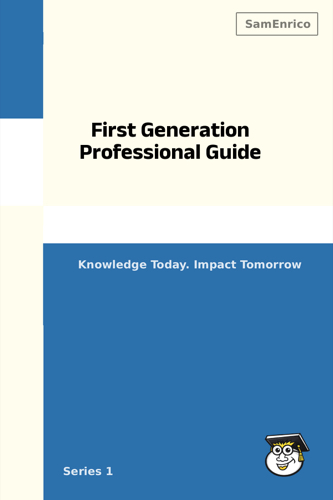
First Generation Professional Guide eBook
Navigate corporate culture without family guidance
by Marr Len
Navigate corporate culture without family guidance or social capital.
Formats
Free sample
Chapter 1: The Secret Syllabus--–- Maria arrived at 7:42 AM on a Tuesday, the first one in the office, as always. She had reviewed her presentation three times, practiced her talking points in the shower, and dressed in the navy blazer she had saved three paychecks to buy. By 10:00 AM, she watched a peer—someone who had arrived at 9:30 AM, admitted to skimming the report, and wore a wrinkled button-down—get tapped to lead the client engagement she had spent six months building. Maria's manager praised her "excellent analysis" in a private email. The other person got the promotion.She never saw it coming.
And that was the problem.Maria is not real. But her story happens every day, in every corporate office, to thousands of First-Generation Professionals (FGPs) who believe, with every fiber of their being, that hard work is the only currency that matters. They are wrong—not about the value of hard work, but about the existence of a second, invisible currency that runs in parallel: the secret syllabus of work.This chapter is your first and most important lesson. Before you can manage up, before you can negotiate a raise, before you can build a sponsor network or protect yourself from burnout, you must first understand the game you are actually playing. Right now, you think you are playing the game of "excellence." You are not.
You are playing the game of "fit," "visibility," and "unspoken rules"—and no one gave you the rulebook.The Two Curriculums Every workplace operates on two parallel tracks. Think of them as two different classes being taught in the same building, at the same time, to the same people—but only half the students know the second class exists.The Explicit Curriculum is what your job description lists, what your manager evaluates you on in writing, and what you can find in the employee handbook. It includes: hitting deadlines, producing accurate work, attending meetings, responding to emails, completing your assigned tasks. FGPs are exceptionally good at the explicit curriculum. You got here because you mastered the visible requirements of every previous stage of your life.
You studied the textbook, did the homework, and aced the exam.The Secret Syllabus is everything else. It includes: who to copy on an email and who to leave off, when to speak in a meeting and when to stay silent, how to signal ambition without arrogance, whose opinion actually matters before a decision is made, and what "culture fit" really means (hint: it is rarely about your technical skills).Here is the brutal truth that no one told Maria: the explicit curriculum gets you in the door. The secret syllabus determines whether you stay, advance, or get quietly pushed out.Drawing on Gorick Ng's foundational work in The Unspoken Rules, this chapter will map the hidden landscape that privileged peers navigate instinctively because they learned it at dinner tables, internship debriefs with parents, and networking conversations with family friends. You will learn to see what you have been missing—not as a failure, but as the first step toward mastering a game you did not even know you were playing.The Three Layers of Unspoken Expectations The secret syllabus is not one thing. It is three distinct layers of expectation, each operating by different rules and requiring different strategies.Layer 1: Productive Expectations (How to Prioritize When Everything Is Urgent)The explicit curriculum tells you your tasks.
The secret syllabus tells you the order in which to do them—and the order is rarely the one written on the task list.Privileged peers learn early that "everything is a priority" means nothing is a priority. They have been coached to ask clarifying questions that sound strategic rather than needy: "Which of these deliverables has the highest visibility with senior leadership?" or "If something has to slip, which timeline has the most flexibility?" FGPs, by contrast, often try to do everything at once, burn out, and still miss the unspoken priority because no one told them that the CEO's pet project—even if labeled "low urgency"—trumps everything else.The Unspoken Rule: Priorities are not determined by deadlines. They are determined by whose attention is on them.What You Were Never Told: When a manager says "everything is urgent," they are testing whether you will push back strategically or drown quietly. The quiet drowning is not a sign of work ethic; it is a sign of political naivety.The FGP Edge: Because you were never taught to assume priorities, you have become exceptionally good at pattern recognition. You notice what actually gets rewarded versus what gets praised.
That skill, once systematized, becomes a superpower.Actionable Tactic: At the start of every week, send your manager a ranked list of your top three priorities and ask, "Does this match your expectations?" The act of asking forces clarity. The manager who says "everything is urgent" will suddenly find a ranking when put on the spot.Layer 2: Social Expectations (How to Build Rapport Without Shared Cultural References)The explicit curriculum says that work is about work. The secret syllabus knows that work is about relationships—and relationships are built on shared cultural references that FGPs often do not have.Privileged peers bond over lacrosse, summer internships in Europe, the same MBA case studies, and knowing which fork to use at a client dinner. None of this is malicious. It is simply the shorthand of people who grew up in the same cultural universe.
FGPs, meanwhile, are often excluded from these bonding moments not because of bias (though that exists) but because of absence: they were not at those summer programs, do not know those terms, and have no frame of reference for those experiences.The Unspoken Rule: People trust people who feel familiar. Familiarity is often built on shared cultural artifacts that have nothing to do with job performance.What You Were Never Told: You do not need to fake a background you do not have. You do need to build bridges using the cultural materials you possess—your unique interests, your distinct perspective, your outsider observations that insiders cannot see.The FGP Edge: Because you cannot rely on shared privilege, you become better at genuine curiosity. You ask questions that insiders never think to ask. You notice when groupthink is happening because you were never part of the group.Actionable Tactic: Develop your "And" (drawn from John Garrett's work, which we will explore fully in Chapter 7).
You are not just "the analyst." You are the analyst and the person who runs half-marathons, and the person who volunteers at a food bank, and the person who restores vintage motorcycles. These distinct interests become your social currency. They make you memorable in ways that shared privilege never could.Layer 3: Political Expectations (Whose Opinion Actually Matters)The explicit curriculum suggests that decisions are made by the person with the highest title. The secret syllabus knows that decisions are often made in pre-meetings, hallway conversations, and email threads that you are not copied on.Privileged peers learn early to map informal power. They know that the executive assistant has more influence on the VP's schedule than the VP themselves.
They know that the quiet person in the corner of the meeting is the one whose veto matters. They know…
This is the end of the free sample. Get the eBook to keep going. Buy now
About this book
Details
- Author
- Marr Len
- Publisher
- SamEnrico
- Language
- English
- Genre
- Non-Fiction, Self-Help, First Gen
- Released
- 2026-06-06
- Pages (approx.)
- 127
- Available as
- eBook, Audiobook

Read better in the ZLOADR app
Your eBooks on your phone or tablet. Sign in with your SamEnrico account and start reading.
More by Marr Len
 Worry Loop Breaker GuideMarr Len$11.99
 The Voice Nonverbal GuideMarr Len$11.99
 Pay Raise Anger ManagementMarr Len$11.99
 Twitch Live Streaming Addiction GuideMarr Len$11.99
 The Last Broadcast: The Mysterious Transmission of S.O.S. from the Mary CelesteMarr Len$11.99
 Understanding Microgastria Short Stature DiabetesMarr Len$17.99
 Thought Leadership AI GuideMarr Len$12.99
 Blended Finance Structures GuideMarr Len$12.99
 How to Start a Ceramic Articles Used In Construction (commission Agent) Business (Beginners Guide)Marr Len$11.99
You may also like
 Hong Kong Handover 1997Dunn Johnnie$11.99
 Zumba For Postnatal Recovery CourseNeal Christian$11.99
 Zumba for BeginnersLadner Nikia$11.99
 YouTube Comment Mining GuideHumes Pandora$12.99
 Worry Box MeditationCarlin Rudy$11.99
 Workplace Stress MeditationNguyen Lynn$11.99
 Workplace Stress and Sleep RepairHawley Ivory$11.99
 Workplace Perfectionism CureDelaney Jeffry$11.99
 Workplace Injustice Anger GuideWallen Isabelle$11.99
 Work Addiction and Burnout LinkGreenwood Ester$11.99
 Women in Yoga and WellnessBeattie Galina$11.99
 Women in Stand Up ComedyChun Evangeline$11.99