
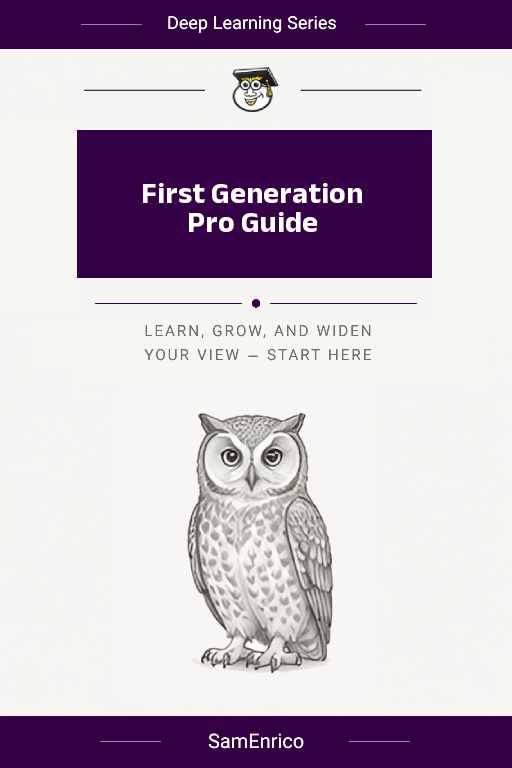
Non-FictionProfessional's Cheat SheetFirst Gen
First Generation Pro Guide eBook
Build promotion business case as first-generation
by Cope Samella
Build promotion business case as first-generation professional navigating corporate culture.
Formats
Free sample
Chapter 1: The Invisible Backpack--–- Every first-generation professional I have ever coached walks into their first “real” job carrying something invisible. It is not listed on their resume, not mentioned in their cover letter, and never discussed in orientation. But it weighs on every decision they make, every email they hesitate to send, and every meeting where they wonder whether they belong.This invisible burden is what I call the Invisible Backpack. It contains family expectations that no one else can see, survival instincts honed over years of navigating systems not designed for people like you, a deep reservoir of resourcefulness born from scarcity, and—most quietly but most powerfully—a low hum of fear that one wrong move will send you tumbling back to square one.Your colleagues from legacy backgrounds—those whose parents attended college, held professional jobs, or navigated corporate corridors before them—do not carry this same backpack. They carry something else: cultural capital.
They know, often without being told, how long an email should be, when to speak in a meeting, what “professionalism” actually looks like in practice, and how to ask for a raise without feeling greedy. They learned these things the way you learned your native language—through osmosis, not study.You, on the other hand, are learning corporate culture as a second language. And that is not a weakness. It is a different kind of strength, one that this entire book will teach you to weaponize.The metaphor of the Invisible Backpack comes from decades of research on cultural capital and first-generation achievement, but I first encountered it in the raw, unpolished stories of professionals I have mentored over fifteen years. There was Maria, a senior analyst who had never flown on an airplane until her company flew her to headquarters.
She packed three suitcases because she did not know that business travelers use carry-ons. There was James, whose mother asked him why he needed a “fancy title” when he was already making more money than anyone in his family had ever seen. There was Priya, who spent her first year silently translating every corporate acronym because no one had told her that “EOD” meant end of day and “CTA” meant call to action.Each of them was brilliant. Each of them was capable. And each of them spent precious mental energy on questions their legacy peers never had to ask.This chapter is about three things.
First, understanding what is actually inside your Invisible Backpack and why it is not a liability. Second, learning to see the Hidden Curriculum of corporate life—the unwritten rules that no one teaches but everyone expects you to know. And third, dismantling the myth that you have to choose between your home culture and your corporate culture. You do not have to leave your backpack at the door. You just have to learn which tools to take out and when.What You Are Actually Carrying Let me be specific about what the Invisible Backpack contains, because naming each item is the first step toward using it strategically.Family Expectations Your family may be proud of you.
They may also be confused by you. Sometimes both at the same time. For many first-generation professionals, family expectations pull in two contradictory directions. On one hand, your family wants you to succeed—to have the stability, the salary, the title that they never had. On the other hand, your success can feel like a departure, a rejection of the world you came from.
Every promotion can feel like a betrayal. Every new habit—using a planner, speaking differently, working late—can feel like you are becoming a stranger.I have watched first-gen professionals hide their work lives from their families to avoid this tension. They say “I just answer phones” when they manage million-dollar budgets. They downplay their achievements because they do not want to make their parents feel inadequate. This is not modesty.
It is a form of carrying weight that no one sees.Survival Instincts You have likely developed a hypervigilance that your legacy peers do not possess. You scan rooms for threats—not physical threats, but social ones. You notice when someone’s tone shifts. You remember who was excluded from a meeting. You can tell within thirty seconds whether a conversation is safe or dangerous.
This is not paranoia; it is a survival skill you learned in environments where one wrong social cue could have real consequences.The problem is that hypervigilance is exhausting. It consumes cognitive bandwidth that could otherwise go toward creative thinking, strategic planning, or simply enjoying your work. But here is the reframe that changes everything: your survival instincts also make you an exceptional reader of organizational dynamics. While your legacy peers are oblivious to the subtle power shifts happening around them, you see the matrix. That is an advantage, not a deficit.Resourcefulness When you have grown up without a safety net, you learn to solve problems with whatever is at hand.
You do not wait for perfect conditions. You do not assume someone else will fix it. You figure it out. This resourcefulness is the single most valuable asset in your Invisible Backpack, and it maps directly onto what corporate leaders call a “bias for action”—one of the key attributes of excellent companies, as documented in Tom Peters’ landmark research.Your legacy peers may be more polished, but they are often less resourceful. They have spent their lives in systems that provided clear pathways and support structures.
You have spent your life building pathways where none existed. That is not a gap to fill; it is a gift to deploy.The Fear And then there is the fear. Let us name it directly. You are afraid that you do not belong. You are afraid that someone will discover you do not know something you should know.
You are afraid that your accent, your clothes, your family background, or your education will mark you as an outsider. You are afraid that one mistake—one email sent to the wrong person, one question asked in the wrong way—will confirm every suspicion you have about yourself.This fear has a name in the research literature: imposter syndrome. But I want to be careful here. Imposter syndrome is usually framed as a psychological flaw—something wrong with you that you need to fix. That framing is not just unhelpful; it is actively misleading.
If you are a first-generation professional navigating a culture that was not built for you, feeling like an imposter is not a disorder. It is a rational response to a real situation.You are not broken. You are adapting. And adaptation is uncomfortable.In the rest of this book, I will use a different term for the specific flavor of fear that afflicts first-gen professionals. I call it Gratitude Trapping.
Gratitude Trapping is the fear that saying “no” will make you seem ungrateful for the opportunity you have been given. It is the voice that tells you to work weekends, accept unreasonable deadlines, tolerate disrespect, and never ask for more—because who are you to ask? You are lucky to be here.We will return to Gratitude Trapping throughout…
This is the end of the free sample. Get the eBook to keep going. Buy now
About this book
Details
- Author
- Cope Samella
- Publisher
- SamEnrico
- Language
- English
- Genre
- Non-Fiction, Professional's Cheat Sheet, First Gen
- Released
- 2026-05-30
- Pages (approx.)
- 144
- Available as
- eBook, Audiobook

Read better in the ZLOADR app
Your eBooks on your phone or tablet. Sign in with your SamEnrico account and start reading.
More by Cope Samella
 Sleep Meditation for EntrepreneursCope Samella$11.99
 EQ Mindfulness IntegrationCope Samella$11.99
 The Overland OrnithologistCope Samella$11.99
 The Caregiver Hope Preservation GuideCope Samella$11.99
 Deep Sea Fisherman StressCope Samella$11.99
 The Last Whispers of the Navajo Code Talkers: A Language That Won a WarCope Samella$11.99
 The Clockwork Oracle: How a 19th-Century Mechanic Predicted the FutureCope Samella$11.99
 Understanding Fitz-hugh–curtis SyndromeCope Samella$17.99
 AI Inventory Forecasting HandbookCope Samella$12.99
 Temperature ScreenerCope Samella$11.99
 How to Become a Cigarette-making-machine CatcherCope Samella$11.99
You may also like
 Hong Kong Handover 1997Dunn Johnnie$11.99
 Zumba For Postnatal Recovery CourseNeal Christian$11.99
 Zumba for BeginnersLadner Nikia$11.99
 YouTube Comment Mining GuideHumes Pandora$12.99
 Worry Box MeditationCarlin Rudy$11.99
 Workplace Stress MeditationNguyen Lynn$11.99
 Workplace Stress and Sleep RepairHawley Ivory$11.99
 Workplace Perfectionism CureDelaney Jeffry$11.99
 Workplace Injustice Anger GuideWallen Isabelle$11.99
 Work Addiction and Burnout LinkGreenwood Ester$11.99
 Women in Yoga and WellnessBeattie Galina$11.99
 Women in Stand Up ComedyChun Evangeline$11.99