
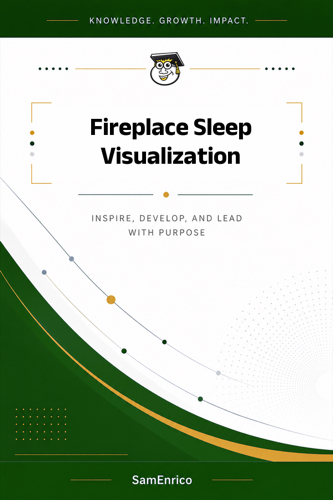
Non-FictionSelf-HelpFireplaceWarmth
Fireplace Sleep Visualization eBook
Watch imagined flames dance to create warmth and h
Watch imagined flames dance to create warmth and hypnotic relaxation.
Formats
Free sample
Chapter 1: The Extinguished Ancestor...--–- The fire has been burning for over 400,000 years. Long before the first temple, before the first wheel, before the first word was ever scratched into clay, there was the hearth. And for all those millennia, every single night, as the sun disappeared below the horizon and the world turned cold and dark, human beings gathered around that fire and did something that now, in our modern age, feels nearly impossible. They fell asleep.Not because they were more tired than we are. Not because they had fewer worries.
Not because their lives were simpler or their minds quieter. They fell asleep because the fire told their nervous systems, with absolute biological authority, that the dangerous part of the day was over. The predators had been driven back. The tribe was safe. The warmth would keep their core temperature stable through the cold hours.
The crackling would drown out the unpredictable sounds of the forest. The flickering light would guide their brain from the sharp alertness of daytime vision into the soft, unfocused gaze of twilight consciousness.The fire was not a relaxation technique. It was a signal. And that signal was so reliable, so deeply wired into the architecture of the human brain, that your ancestors did not need to learn how to respond to it. They were born already knowing.
Just as a baby knows to root for the breast and a child knows to cry out when afraid, your ancestors knew, at the level of their cells, that fire meant sleep.Somewhere along the way, we lost that knowledge.Not because we forgot it in the way you forget a phone number or a grocery list. You cannot forget something that lives in your DNA. What happened was worse. We removed the signal and then told ourselves that nothing had changed. We replaced the hearth with central heating, which provides warmth without the visual or auditory cues.
We replaced the crackle of burning wood with the oppressive silence of double-paned windows and white noise machines that sound like nothing in nature. We replaced the flickering flame with the staccato pulse of blue light from screens—a frequency that does not lull the brain toward sleep but actively stimulates it toward wakefulness.We have been living for generations in a sensory desert, and we have forgotten that deserts are not where humans evolved to sleep.This chapter is an origin story. Not of fire—fire is older than our species. But of the relationship between fire and sleep, a relationship so intimate and so ancient that it shaped the very structure of your brain. Understanding this relationship is not optional background reading.
It is the foundation upon which everything else in this book rests. Because once you understand why your nervous system is starving for cues it no longer receives, you will stop blaming yourself for your insomnia. You will stop believing that you are broken, or anxious, or "bad at sleeping." You will see, perhaps for the first time, that your difficulty falling asleep is not a disorder. It is a correct biological response to an incorrect environment.And once you see that, you can begin to fix it.The First Hearth Let us travel backward. Way, way back.The earliest definitive evidence of controlled fire use by hominins dates to approximately 400,000 years ago, at sites like Gesher Benot Ya'aqov in modern-day Israel.
But many anthropologists believe the relationship began much earlier—perhaps as early as 1.5 million years ago, when Homo erectus began to scavenge and tend natural fires long before they could create them from scratch. For the purposes of this book, the exact date matters less than the duration. However many years it has been, it has been long enough for fire to leave permanent marks on the human genome.Consider what fire gave our ancestors.First, protection. Every large predator that hunted at night—lions, leopards, hyenas, wolves—fears fire. Not the way a child fears a monster under the bed, but a deep, instinctive terror that is almost certainly as old as the predators themselves.
A predator that approached a human campfire risked burned paws, singed fur, and agonizing pain. Over thousands of generations, natural selection favored predators that avoided fire and humans who maintained it. The result was a symbiotic relationship: the fire kept the predators away, and the humans kept the fire burning.Second, warmth. The human body is a thermal engine. It operates best within a narrow range of core temperatures, roughly 97 to 99 degrees Fahrenheit.
When the environment is cold, the body must burn enormous amounts of energy just to stay alive—energy that could otherwise be used for healing, growth, reproduction, and brain function. A fire allowed our ancestors to conserve that energy, to survive winters that would otherwise have been fatal, and to expand into colder climates than any other primate.Third, digestion. This one is less obvious but no less important. Cooking food with fire made it dramatically easier to digest, which meant that less energy was spent on the gut and more energy was available for the brain. The anthropologist Richard Wrangham has argued that the shift to cooked food was the key evolutionary event that allowed the human brain to grow to its current size.
Without fire, there would be no you reading this book. Not in your present form.Fourth, social bonding. The hearth was the original campfire story. It was where knowledge was transmitted, where conflicts were resolved, where mating pairs formed, where children learned what it meant to be human. The fire did not just keep the body warm; it kept the social fabric intact.
And a tribe that cohered around the hearth was a tribe that survived.All of these benefits—protection, warmth, digestion, social bonding—converged on a single daily event: sleep. When the fire was burning, it was safe to close your eyes. When the fire was burning, you would not freeze. When the fire was burning, your well-fed body could devote its resources to cellular repair and memory consolidation. When the fire was burning, you were not alone.The fire was the original sleep signal.
And your brain has not forgotten.The Architecture of Safety To understand why the fire signal is so powerful, you need to know a little bit about the autonomic nervous system. Do not let the term intimidate you. The autonomic nervous system is simply the part of your nervous system that runs automatically, without your conscious control. It has two main branches.The sympathetic branch is often called "fight or flight." It activates when you are under threat. Your heart rate increases.
Your blood pressure rises. Digestion slows or stops. Your pupils dilate. Your body releases cortisol and adrenaline. The sympathetic branch is essential for survival—it allows you to run from danger, fight off an attacker, or perform under pressure.
But it is not compatible with sleep. You cannot be in fight-or-flight mode and drift off peacefully. The two states are mutually exclusive.The parasympathetic branch is often called "rest and digest." It activates when you are safe. Your heart rate slows. Your blood pressure drops.
Digestion resumes. Your pupils constrict. Your body releases acetylcholine and other calming neurotransmitters. The parasympathetic branch is the gateway to…
This is the end of the free sample. Get the eBook to keep going. Buy now
About this book
Details
- Author
- Littlefield Kimberley
- Publisher
- SamEnrico
- Language
- English
- Genre
- Non-Fiction, Self-Help, Fireplace, Warmth
- Released
- 2026-06-09
- Pages (approx.)
- 145
- Available as
- eBook, Audiobook

Read better in the ZLOADR app
Your eBooks on your phone or tablet. Sign in with your SamEnrico account and start reading.
More by Littlefield Kimberley
 Comparison in Chronic IllnessLittlefield Kimberley$11.99
 Pelvic Floor Laser TherapyLittlefield Kimberley$11.99
 The Reject Diet Mentality GuideLittlefield Kimberley$11.99
 Slow Eating Pace LongevityLittlefield Kimberley$11.99
 Ashoka's Redemption: The Blood of Kalinga (261 BC)Littlefield Kimberley$11.99
 Elephant TrainingLittlefield Kimberley$11.99
 Non Resident LLC Audit DefenseLittlefield Kimberley$12.99
 Nairobi Startup EventsLittlefield Kimberley$12.99
 The Breeder's Guide to Dartmoor HorsesLittlefield Kimberley$11.99
 How to Become a Light-fixture ServicerLittlefield Kimberley$11.99
You may also like
 Hong Kong Handover 1997Dunn Johnnie$11.99
 Zumba For Postnatal Recovery CourseNeal Christian$11.99
 Zumba for BeginnersLadner Nikia$11.99
 YouTube Comment Mining GuideHumes Pandora$12.99
 Worry Box MeditationCarlin Rudy$11.99
 Workplace Stress MeditationNguyen Lynn$11.99
 Workplace Stress and Sleep RepairHawley Ivory$11.99
 Workplace Perfectionism CureDelaney Jeffry$11.99
 Workplace Injustice Anger GuideWallen Isabelle$11.99
 Work Addiction and Burnout LinkGreenwood Ester$11.99
 Women in Yoga and WellnessBeattie Galina$11.99
 Women in Stand Up ComedyChun Evangeline$11.99