
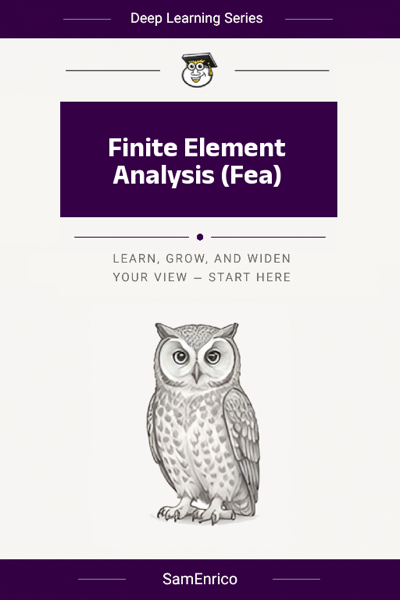
Non-FictionInformativeEducational
Finite Element Analysis (Fea)
A Coursebook on Finite Element Analysis (Fea)
A Coursebook on Finite Element Analysis (Fea)
Formats
About this book
Free sample
Chapter 1: The Mesh That Changed Everything– In the spring of 1943, a German-born mathematician named Richard Courant was working on a problem that seemed purely theoretical: how to approximate the behavior of a twisted shaft using piecewise polynomial functions on small triangular domains. He had no idea that his pencil-and-paper exercise would, thirty years later, become the foundation of a revolution in engineering design. Today, the finite element method (FEM) is the third pillar of computational engineering, standing alongside theoretical analysis and physical testing. It is used to design aircraft that do not break, cars that do not crush, artificial hips that do not wear out, and microchips that do not overheat. Every time you board an airplane, drive over a bridge, or pick up a smartphone, finite element analysis (FEA) has almost certainly been used to ensure that product is safe, reliable, and optimized.
This chapter answers the three questions every student asks at the beginning of an FEA course: What is it? Why do we need it? And how does it work?The Engineering Problem: Why Exact Solutions Fail Most engineering students cut their teeth on elegant, closed-form solutions. You learned that a simply supported beam under a point load has a maximum deflection of PL³/48EI. You learned that the stress in a thin-walled pressure vessel is pr/t.
You learned that the temperature distribution in a cooling fin follows an exponential decay. These analytical solutions are beautiful. They are also, for most real-world problems, completely useless.Consider the wing of a commercial airliner. Its geometry is not a simple beam. It has ribs, spars, skin panels, fuel tanks, and mounting points for engines and landing gear.
The material is not a single isotropic alloy—it is a composite of aluminum, titanium, and carbon fiber in some areas, and aluminum alone in others. The loads are not a single point force—they are aerodynamic pressure distributions that vary with altitude, speed, and angle of attack. The boundary conditions are not simply "fixed at the root"—the wing flexes, twists, and interacts with the fuselage in ways that change as the wing…
This is the end of the free sample. Get the eBook to keep going. Buy now
Contents
- Chapter 1
- Chapter 2
- Chapter 3
- Chapter 4
- Chapter 5
- Chapter 6
- Chapter 7
- Chapter 8
- Chapter 9
- Chapter 10
- Chapter 11
- Chapter 12
Details
- Author
- Vanhorn Lyndsay
- Publisher
- SamEnrico
- Language
- English
- Genre
- Non-Fiction, Informative, Educational
- Released
- 2026-05-08
- Pages (approx.)
- 153
- Available as
- eBook, Audiobook

Read better in the ZLOADR app
Your eBooks on your phone or tablet. Sign in with your SamEnrico account and start reading.
More by Vanhorn Lyndsay
 Calorie Density Formula GuideVanhorn Lyndsay$11.99
 Middle Manager Priority GuideVanhorn Lyndsay$11.99
 Parental Anger Support Group GuideVanhorn Lyndsay$11.99
 Inner Child Healing GuideVanhorn Lyndsay$11.99
 Franchising Your Local Brand Across Borders Diplomatic ChannelsVanhorn Lyndsay$11.99
 The Oracle of Omaha: How Warren Buffett Outsmarted the Market in 1987Vanhorn Lyndsay$11.99
 The Lady Who Tamed Chance: Florence Nightingale and the Birth of Medical StatisticsVanhorn Lyndsay$11.99
 Ultimate Handbook Guide to Soweto : (South Africa) Travel GuideVanhorn Lyndsay$11.99
 Charity Registration RenewalVanhorn Lyndsay$12.99
 Community Content CalendarVanhorn Lyndsay$12.99
 Understanding Deafness Craniofacial SyndromeVanhorn Lyndsay$17.99
You may also like
 Hong Kong Handover 1997Dunn Johnnie$11.99
 Zumba For Postnatal Recovery CourseNeal Christian$11.99
 Zumba for BeginnersLadner Nikia$11.99
 YouTube Comment Mining GuideHumes Pandora$12.99
 Worry Box MeditationCarlin Rudy$11.99
 Workplace Stress MeditationNguyen Lynn$11.99
 Workplace Stress and Sleep RepairHawley Ivory$11.99
 Workplace Perfectionism CureDelaney Jeffry$11.99
 Workplace Injustice Anger GuideWallen Isabelle$11.99
 Work Addiction and Burnout LinkGreenwood Ester$11.99
 Women in Yoga and WellnessBeattie Galina$11.99
 Women in Stand Up ComedyChun Evangeline$11.99