
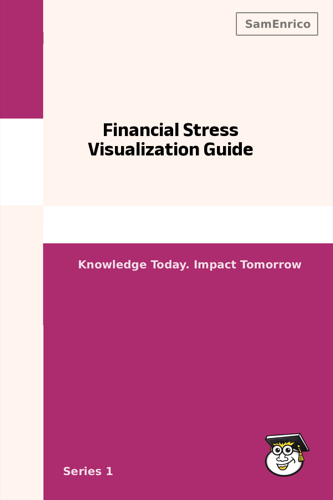
Non-FictionSelf-Help / Visualization
Financial Stress Visualization Guide eBook
Teaches mental imagery techniques to reduce money
by Oneal Gussie
Teaches mental imagery techniques to reduce money anxiety and build financial confidence.
Formats
Free sample
Chapter 1: The Lizard in Your Wallet--–- The envelope sits on your kitchen counter. White. Innocent. Unopened. Your coffee grows cold beside it.
You've walked past it eleven times in the last hour. Each time, your stomach tightens. Your pulse notches higher. You tell yourself you'll open it after this next email, after this load of laundry, after you finish this sentence. Hours pass.
The envelope remains sealed. The anxiety remains unnamable.This is not a failure of willpower. It is not laziness. It is not a character flaw you inherited from a spendthrift parent or a sign that you lack "financial discipline." What you are experiencing is your brain doing exactly what it evolved to do: protect you from a threat. The problem is that your brain cannot tell the difference between a saber-toothed tiger and a credit card statement.Welcome to the biology of financial anxiety.The Million-Year-Old Alarm System Deep inside your skull, tucked behind your eyes and slightly to the left and right, sits a pair of almond-shaped clusters of neurons called the amygdala.
The word comes from the Greek for "almond," which is charmingly understated for a structure that has the power to hijack your entire nervous system in less than a second.The amygdala is your brain's smoke detector. It does not think. It does not reason. It does not pause to ask whether the thing you're seeing is actually dangerous or merely unfamiliar. The amygdala reacts.
It scans your environment constantly, unconsciously, looking for anything that deviates from expected safety. When it finds something—a sudden loud noise, a looming shape, an unexpected number on a screen—it sounds the alarm. Within milliseconds, your sympathetic nervous system floods your body with cortisol and adrenaline. Your heart rate doubles. Your breathing becomes shallow.
Blood rushes away from your digestive system and toward your large muscle groups. Your pupils dilate. Your peripheral vision narrows.Congratulations. You are now ready to fight a tiger or run from a bear.This system worked beautifully for your ancestors on the savannah. A rustle in the grass might be a predator.
The amygdala sounds the alarm. You run first and ask questions later. The ones who paused to wonder whether the rustle was just the wind were removed from the gene pool. You are descended from the jumpy ones, the anxious ones, the ones who assumed the worst and survived because of it.But here is the problem. You do not live on the savannah.
The predators in your life do not have fangs or claws. They have due dates and interest rates. Yet your amygdala, which has not received a software update in approximately 200,000 years, treats your credit card bill exactly the same way it would treat a lion.The Neuroscience of the Unopened Envelope Let me show you what happens inside your skull the moment you glance at that envelope on the kitchen counter.First, your visual cortex processes the shape and color. Nothing threatening there. But then your hippocampus—the memory center of your brain—retrieves every past experience associated with envelopes that look like this.
The time you opened one and discovered a $400 surprise medical bill. The time your partner asked, "What's that?" and a fight followed. The time you had to transfer money from savings and felt the hot flush of shame.The amygdala does not distinguish between the memory of pain and the prediction of pain. To your brain, remembering last year's unexpected expense is neurologically similar to experiencing it again in real time.So the alarm sounds. Your body prepares for battle.
And now you are standing in your kitchen, breathing shallowly, staring at a piece of paper, unable to turn it over. You are not weak. You are not broken. You are the owner of a brain that is trying to save your life from a threat that does not require saving.This is what I call the Financial Lizard. It lives in the oldest part of your brain, the part you share with reptiles and rodents.
It does not understand compound interest. It does not care about your long-term goals. It only knows one thing: the unopened envelope might be dangerous, and danger must be avoided.The tragedy is that avoidance is exactly the wrong strategy. Every time you walk past that envelope, you teach your amygdala that the envelope is worth avoiding. The next time, the alarm sounds a little louder.
The avoidance feels a little more justified. You are, without knowing it, training your own brain to be more anxious about money.Why "Just Calm Down" Doesn't Work If you have ever been told to "just relax" about money, you know how useless that advice is. You cannot talk your way out of a biological response any more than you can tell a sunburn to stop hurting. The amygdala does not speak English. It does not respond to logic.
You cannot reason with a smoke detector while the alarm is blaring.Let me prove this to you. Imagine someone offers you a million dollars to stop feeling anxious about money right now. Could you do it? Of course not. Anxiety is not a choice you are making.
It is a response your nervous system is having. The part of your brain that understands money—your prefrontal cortex, the "executive" center behind your forehead—is actually less active during moments of financial stress. Blood flow is literally redirected away from the thinking parts of your brain and toward the survival parts.This is why otherwise intelligent, capable people make disastrous financial decisions when they are anxious. They are not stupid. They are not irresponsible.
They are operating with a significantly reduced cognitive bandwidth because their brain has decided that survival is more important than math.A landmark study from Harvard economist Sendhil Mullainathan and Princeton psychologist Eldar Shafir demonstrated this phenomenon across multiple populations. They studied sugarcane farmers in India who receive a single large payment at harvest time. Before harvest, when money is scarce, the same farmers performed significantly worse on cognitive tests than they did after harvest, when money was abundant. The farmers did not get smarter after harvest. They simply had more cognitive room because their brains had stopped screaming about survival.You are those farmers.
When your amygdala is sounding the alarm, you lose approximately thirteen IQ points. Not permanently. Not because you are incapable. But because your brain has priorities, and those priorities do not include your credit score.The Seven Physical Signs of Financial Lizard Activation Before you can calm your nervous system, you need to recognize when it has been hijacked. The Financial Lizard is sneaky.
It does not announce itself. It simply makes you feel vaguely terrible and convinced that looking at your money will make things worse.Here are the seven most common physical signs that your amygdala has sounded the alarm in response to a financial trigger. Read through this list. Check the ones that sound familiar.1. Chest tightness or a sense of pressure.
Not a heart attack—though it can feel alarmingly similar—but a physical constriction that makes it hard to take a full breath.2. Shallow, rapid breathing. You…
This is the end of the free sample. Get the eBook to keep going. Buy now
About this book
Details
- Author
- Oneal Gussie
- Publisher
- SamEnrico
- Language
- English
- Genre
- Non-Fiction, Self-Help / Visualization
- Released
- 2026-06-06
- Pages (approx.)
- 139
- Available as
- eBook, Audiobook

Read better in the ZLOADR app
Your eBooks on your phone or tablet. Sign in with your SamEnrico account and start reading.
More by Oneal Gussie
 Testosterone for Women GuideOneal Gussie$11.99
 HIIT Work To Rest RatiosOneal Gussie$11.99
 Food Addiction and Bariatric Surgery FailureOneal Gussie$11.99
 Fairuz: The Voice of Lebanon’s Soul and the Rise of Arab Pop (2000s-Present)Oneal Gussie$11.99
 How to Produce AbsintheOneal Gussie$11.99
 How to Start a Non-alcoholic Beverages (retail) Business (Beginners Guide)Oneal Gussie$11.99
 Global Team Slack GuideOneal Gussie$12.99
 Procurement and Vendor Management SystemsOneal Gussie$11.99
You may also like
 Hong Kong Handover 1997Dunn Johnnie$11.99
 Zumba For Postnatal Recovery CourseNeal Christian$11.99
 Zumba for BeginnersLadner Nikia$11.99
 YouTube Comment Mining GuideHumes Pandora$12.99
 Worry Box MeditationCarlin Rudy$11.99
 Workplace Stress MeditationNguyen Lynn$11.99
 Workplace Stress and Sleep RepairHawley Ivory$11.99
 Workplace Perfectionism CureDelaney Jeffry$11.99
 Workplace Injustice Anger GuideWallen Isabelle$11.99
 Work Addiction and Burnout LinkGreenwood Ester$11.99
 Women in Yoga and WellnessBeattie Galina$11.99
 Women in Stand Up ComedyChun Evangeline$11.99