
Non-FictionSelf-HelpFinancial Innovation
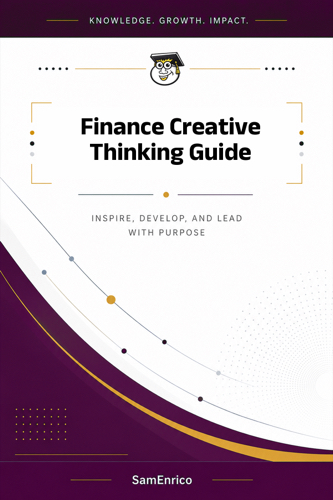
Finance Creative Thinking Guide eBook
Find innovative funding and cost saving strategies
by Lo Maryrose
Find innovative funding and cost saving strategies using this practical creativity workbook.
Formats
Free sample
Chapter 1: The Abundance Loop--–- It was 3:47 on a Tuesday afternoon when the founder of a promising tech startup realized he had exactly fourteen days of payroll left. No investors were returning his calls. His largest client had just delayed payment by sixty days. And his co-founder had quietly updated their Linked In profile to "open to work."He did not need a lecture on discounted cash flow models. He did not need a pep talk about "hustle culture." He needed a way to think about money that he had never been taught.
He needed to escape what psychologists call the scarcity trap.This chapter is about why smart, capable, creative people become financially frozen when they can least afford it. And more importantly, it is about how to break that freeze using a counterintuitive mental model called the Abundance Loop.The Scarcity Trap In 1998, the hedge fund Long Term Capital Management employed two Nobel Prize-winning economists and a team of MIT-trained quants. They had more collective brainpower than most small countries. When the Russian government defaulted on its debt, these geniuses did not respond with brilliant, creative trades. They froze.
They sold assets at panic prices. They doubled down on losing positions. Within four months, they lost four billion dollars.The problem was not a lack of intelligence. The problem was a lack of psychological bandwidth.The Scarcity Trap is a cognitive state triggered when people perceive that a critical resource—money, time, or social connection—is running out. In this state, the brain's processing power shrinks by the equivalent of thirteen IQ points.
That is the difference between "superior intelligence" and "average." You become more impulsive, less future-oriented, and dramatically worse at solving novel problems.This is not a character flaw. It is a biological fact. When the brain detects scarcity, it releases cortisol, the stress hormone. Cortisol narrows your attention to immediate threats. It is excellent for escaping a predator.
It is terrible for creative financial thinking.Consider the following experiment conducted at a shopping mall in New Jersey. Researchers gave participants a simple problem: "Your car needs a four-hundred-dollar repair. You can either pay now or take out a high-interest loan. What do you do?" When participants were told the repair was real and due tomorrow, their performance on subsequent cognitive tests dropped by the equivalent of losing an entire night of sleep. Their working memory—the ability to hold multiple variables in your head simultaneously—collapsed.The experiment was repeated with people whose household income was below the poverty line.
Their test scores dropped even further. Not because they were less intelligent, but because scarcity was not a hypothetical exercise for them. It was the air they breathed. Their brains were already exhausted from managing scarcity in every other domain.This is the first and most dangerous inconsistency in how most finance books approach the topic. They assume that the reader is rational, calm, and has unlimited cognitive bandwidth.
They present spreadsheets and models as if the problem is a lack of information. But information is not what you need when your brain is flooded with cortisol. You need a different relationship with constraints.The Abundance Loop The opposite of the Scarcity Trap is not wealth. It is a cognitive framework called the Abundance Loop. This framework was first observed in a study of jazz musicians.
When jazz improvisers were told they had "unlimited time" to compose a solo, their performances were rated as less creative, more repetitive, and less emotionally engaging than when they were told they had "only thirty seconds."Constraints did not hurt their creativity. Constraints triggered it.The Abundance Loop works like this. Instead of asking "What do I lack?", you ask "What outcome do I want, and what do I already have that can produce it?" Instead of seeing a constraint as a wall, you see it as a parameter. Parameters define the playground. Without parameters, there is no game, only vague anxiety.The loop has three stages.Stage one: Identify the constraint.
Not as a complaint, but as a fact. "I have no cash for a logo designer." That is the constraint. Do not fight it. Do not lament it. Accept it as the starting line.Stage two: Define the outcome independent of the constraint.
What does "logo designer" actually get you? Not a logo. A logo is just a file. The outcome is: a visual identity that attracts customers and builds trust. That is the real goal.Stage three: Inventory what you already have that could produce that outcome.
Do you have a free design tool like Canva? Do you have a friend with an eye for design? Do you have a customer who would trade feedback for a discount? Do you have a competitor whose logo you could study and improve upon?The loop is "abundance" because it reveals that you almost always have more resources than you think. They are just not in the form of cash.The research backing this is not motivational fluff.
In a study of entrepreneurs who survived the 2008 financial crisis, researchers found that the single best predictor of survival was not the amount of cash on hand before the crash. It was the founder's score on a "resourcefulness inventory"—a test of how many non-cash solutions they could generate for a given problem. The most resourceful founders were seven times more likely to still be in business two years later, regardless of starting capital.The Four Abundance Subtypes This book will introduce four specific subtypes of abundance. They are introduced here because they will appear repeatedly in later chapters. Each subtype requires a different creative move.Resource Abundance is the discovery that you own underutilized assets.
You have empty office space. You have idle machinery. You have a dormant email list. You have skills that other people value. Chapter Three is entirely devoted to turning these into currency.Capital Abundance is the recognition that your customers are carrying money you have not yet asked for.
They will pay before you build. They will pay a subscription. They will pay a deposit. Chapter Five teaches the mechanics of customer-funded business models.Social Abundance is the understanding that your community—your email list, your social media followers, your local business network—is a hidden pool of capital. They invest in stories and missions, not just financial returns.
Chapter Nine covers crowdfunding and community capital.Relational Abundance is the strategic use of redundancy and backup relationships. A second supplier. A backup freelancer. A partner for shared resources. These do not cost cash, but they cost attention.
Appendix B explores low-cash risk hedging using relational abundance.Do not try to use all four at once. That is a common mistake. The scarcity brain wants to grab every tool simultaneously. The Abundance Loop asks you to pick one subtype that matches your current constraint.The $10 Challenge Every chapter in this book contains a workbook activity. This is not a passive reading experience.
The activities are the book. If you skip them, you will understand the concepts intellectually but you will not rewire your scarcity brain. The brain rewires through action, not through reading.The $10 Challenge is…
This is the end of the free sample. Get the eBook to keep going. Buy now
About this book
Details
- Author
- Lo Maryrose
- Publisher
- SamEnrico
- Language
- English
- Genre
- Non-Fiction, Self-Help, Financial Innovation
- Released
- 2026-06-06
- Pages (approx.)
- 142
- Available as
- eBook, Audiobook

Read better in the ZLOADR app
Your eBooks on your phone or tablet. Sign in with your SamEnrico account and start reading.
More by Lo Maryrose
 Beginner Mindfulness for AnxietyLo Maryrose$11.99
 Trade War Logistics ImpactLo Maryrose$11.99
 The Ambiguous Grief GuideLo Maryrose$11.99
 The Blue Zone Whole Grains GuideLo Maryrose$11.99
 Golden Shadows: The Untold Tale of the First Indigenous Olympic ChampionLo Maryrose$11.99
 Cardamom HarvestingLo Maryrose$11.99
 Tail Spend Management GuideLo Maryrose$12.99
 Customer Payment AI GuideLo Maryrose$12.99
 How to Start a Petro-chemical Industry Machinery (other Than Plant) Business (Beginners Guide)Lo Maryrose$11.99
 Understanding Steroid Dehydrogenase Deficiency Dental AnomaliesLo Maryrose$17.99
You may also like
 Hong Kong Handover 1997Dunn Johnnie$11.99
 Zumba For Postnatal Recovery CourseNeal Christian$11.99
 Zumba for BeginnersLadner Nikia$11.99
 YouTube Comment Mining GuideHumes Pandora$12.99
 Worry Box MeditationCarlin Rudy$11.99
 Workplace Stress MeditationNguyen Lynn$11.99
 Workplace Stress and Sleep RepairHawley Ivory$11.99
 Workplace Perfectionism CureDelaney Jeffry$11.99
 Workplace Injustice Anger GuideWallen Isabelle$11.99
 Work Addiction and Burnout LinkGreenwood Ester$11.99
 Women in Yoga and WellnessBeattie Galina$11.99
 Women in Stand Up ComedyChun Evangeline$11.99