
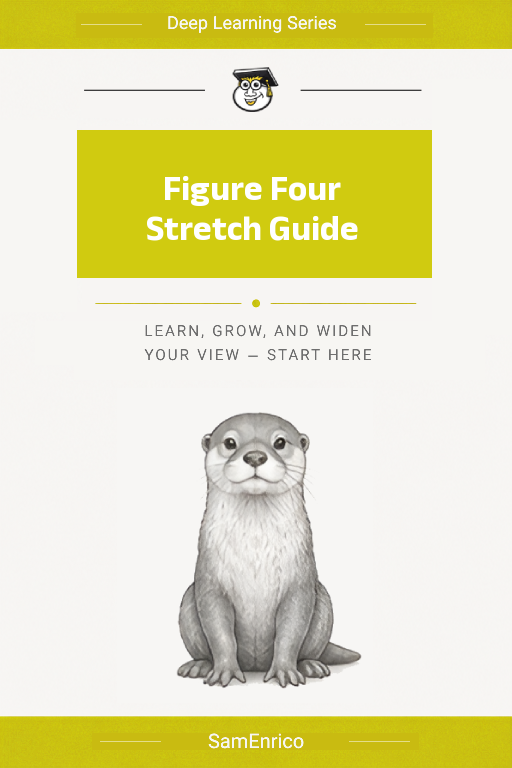
Figure Four Stretch Guide eBook
Cross ankle over opposite knee to release outer hi
Cross ankle over opposite knee to release outer hip and glute tension while seated.
Formats
Free sample
Chapter 1: The Sitting Killer--–- Every morning, Janet did the same thing. She would swing her legs out of bed, plant her feet on the floor, and wince. Not a dramatic cry of pain. Just a quiet, resigned wince that had become as routine as her first sip of coffee. The ache lived deep in her right buttock, a dull throb that sometimes shot a finger of electricity down the back of her thigh.
She told herself it was just age. She was forty-seven. Her mother had back problems. This was simply what happened.What Janet didn't know was that her body was sending her a message she had been ignoring for nearly a decade. The message wasn't about age.
It wasn't about bad luck or bad genes. The message was about a single, silent killer that had been tightening its grip on her hips, her back, and her future with every passing hour.The killer was her chair.Janet worked as a customer service manager, which meant she sat for eight to ten hours per day. She sat during her forty-five-minute commute each way. She sat at dinner. She sat on the couch watching television until she fell asleep, then woke up and sat again.
By conservative estimate, Janet was spending fourteen hours of every waking day in a seated position. Her hips hadn't aged badly. They had been slowly, systematically, and completely imprisoned.This book exists because Janet’s story is not unusual. It is, in fact, the modern human condition. And the Figure Four stretch—a single, deceptively simple position that targets the deepest, most neglected muscles of your hip—is the key that unlocks that prison.Before we get to the stretch itself, you need to understand what has happened to your body.
You need to see the enemy. And the enemy, as you are about to learn, is not your age, your genetics, or your level of fitness. The enemy is the chair.The Most Dangerous Invention in Human History Let us be clear about something immediately: chairs are not inherently evil. A chair is a tool. The problem is not the existence of chairs.
The problem is what we have done with them.For 99 percent of human evolutionary history, there were no chairs. Our ancestors squatted, knelt, sat on the ground, or stood. Their hips moved through their full range of motion every single day because survival demanded it. The human hip joint evolved over millions of years to handle walking, running, climbing, squatting, lunging, and rotating. It did not evolve to hold a fixed, flexed position for ten hours per day.The first chairs appeared in ancient Egypt, and they were status symbols—thrones for the powerful, not furniture for the masses.
The ancient Greeks and Romans used benches and stools, but prolonged sitting was still the province of the elite. For most of human history, sitting for long periods was rare enough that it didn't create widespread health problems.Then came the Industrial Revolution, the office job, the automobile, and the television. By the 1950s, sitting had become the default human posture in developed nations. By the 1990s, we were sitting more than we were standing, walking, or moving in any meaningful way. And by the 2020s, the average American adult was sitting for more than twelve hours per day.To put that number in perspective: if you sleep eight hours, you are now sitting for every single remaining waking hour except the time it takes to walk to the bathroom, the kitchen, and your car.
Your body has become a chair-shaped organism.The chair has killed more human mobility than any injury, disease, or genetic condition in history. And it has done so quietly, gradually, and with the full cooperation of a society that has normalized the very behavior that is destroying us.What Happens to a Muscle That Never Moves To understand why the Figure Four stretch is so desperately needed, you must first understand what happens to any muscle that is held in a fixed position for hours, days, months, and years.Muscles are not static ropes. They are dynamic, living tissues that constantly remodel themselves based on the demands placed upon them. This process is called mechanotransduction—a fancy way of saying that your muscles literally change their structure in response to how you use them. Use a muscle through its full range of motion, and it stays long, elastic, and healthy.
Hold a muscle in a shortened position for thousands of hours, and it adapts by becoming permanently shorter.This is not a matter of willpower. You cannot think your way out of this adaptation any more than you can think your way out of growing calluses on your hands from manual labor. Your body is efficient. If you spend your life with your hips bent at ninety degrees, your body will assume that this is your normal posture. It will shorten the muscles on the front of your hips (the hip flexors) and tighten the muscles on the back and sides of your hips (the glutes and deep rotators) to stabilize you in that position.This is the adaptive shortening response, and it is the single most important concept you will learn in this entire book.Consider what happens to the gluteal muscles during sitting.
Your gluteus maximus, the largest muscle in your body, is designed to extend your hip—to push you forward when you walk, to stand you up from a squat, to propel you up stairs. But when you sit, your gluteus maximus is in a stretched position across the back of your hip, and it is doing absolutely nothing. No force generation. No blood flow. No neural activation.
It is simply being squashed between your pelvis and the chair.Your body, being efficient, notices that this massive muscle is not being used. It responds by downregulating the neural drive to that muscle. In plain English: your brain starts forgetting how to fire your glutes. This is called gluteal amnesia, and it is exactly as bad as it sounds.Meanwhile, the smaller, deeper muscles of your hip—the piriformis, the gemelli, the obturators, the quadratus femoris—are being held in a shortened, internally rotated position hour after hour. These muscles are the deep hip rotators, and they are the primary targets of the Figure Four stretch.
While your gluteus maximus is being stretched into uselessness, these deep muscles are being compressed into knots.The result is a perfect storm. Your large, powerful glutes forget how to work. Your small, deep rotators become chronically tight. And your lower back and knees, which are supposed to be supported by a functioning hip complex, are left to pick up the slack. They were never designed for this job, and they will eventually fail.The Domino Effect: From Your Hip to Your Head The human body is not a collection of independent parts.
It is a chain of interconnected segments, each one influencing the ones above and below. When one link in the chain becomes dysfunctional, the others must compensate. This is the kinetic chain, and understanding it is the key to understanding why a tight hip…
This is the end of the free sample. Get the eBook to keep going. Buy now
About this book
Details
- Author
- Cullen Casandra
- Publisher
- SamEnrico
- Language
- English
- Genre
- Non-Fiction, Mental Wealth
- Released
- 2026-06-01
- Pages (approx.)
- 146
- Available as
- eBook, Audiobook

Read better in the ZLOADR app
Your eBooks on your phone or tablet. Sign in with your SamEnrico account and start reading.
More by Cullen Casandra
 Renting in Retirement Done RightCullen Casandra$11.99
 Hospice Nurse Stress ManagementCullen Casandra$11.99
 Playdate Parent ConversationCullen Casandra$11.99
 Active Listening for BartendersCullen Casandra$11.99
 The Second Vehicle AgeCullen Casandra$11.99
 Social Anxiety and ADHDCullen Casandra$11.99
 Personal Branding for ManagersCullen Casandra$11.99
 Remote Work Batch ProcessingCullen Casandra$11.99
 The Last Telegram: The Silent Heroes of the Great WarCullen Casandra$11.99
 The Spice Kings of London: How the East India Company Built a Global EmpireCullen Casandra$11.99
 Service Providers Guide to International ConsultantsCullen Casandra$11.99
 How to Produce Wasp, Bee and Hornet KillerCullen Casandra$11.99
You may also like
 Hong Kong Handover 1997Dunn Johnnie$11.99
 Zumba For Postnatal Recovery CourseNeal Christian$11.99
 Zumba for BeginnersLadner Nikia$11.99
 YouTube Comment Mining GuideHumes Pandora$12.99
 Worry Box MeditationCarlin Rudy$11.99
 Workplace Stress MeditationNguyen Lynn$11.99
 Workplace Stress and Sleep RepairHawley Ivory$11.99
 Workplace Perfectionism CureDelaney Jeffry$11.99
 Workplace Injustice Anger GuideWallen Isabelle$11.99
 Work Addiction and Burnout LinkGreenwood Ester$11.99
 Women in Yoga and WellnessBeattie Galina$11.99
 Women in Stand Up ComedyChun Evangeline$11.99