
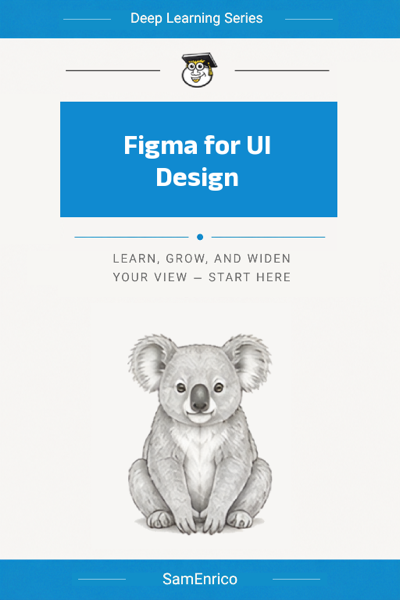
Non-FictionInformativeEducational
Figma for UI Design eBook
A Coursebook on Figma for UI Design
by Leone Olevia
A Coursebook on Figma for UI Design
Formats
Free sample
Chapter 1: Why Apps Fail...--Every year, over 15,000 new mobile applications are released across the i OS and Android app stores. The overwhelming majority of them – somewhere between 60 and 80 percent – will be downloaded fewer than one thousand times. Most will never be used a second time. A stunning number will be deleted within 24 hours of installation. And yet, almost every single one of those failed apps had something in common: they looked fine.
The colors were okay. The buttons were round. The screens loaded quickly enough. So why did they fail?The answer is uncomfortable for most new designers to hear, but you need to hear it now, at the very beginning of this book. Apps do not fail because they are ugly.
Apps fail because nobody thought hard enough about who would use them, why, and under what circumstances. Apps fail because designers opened Figma – or Sketch, or Adobe XD – and immediately started dragging rectangles onto a canvas without first asking a single question about the human being on the other side of the screen. Apps fail because visual design was prioritized over user experience.This chapter is not about Figma. Not yet. You will open Figma later in this chapter, but first you need to understand something more important than any tool.
This chapter is about why most digital products fail, and how you – by learning to think like a UX researcher – will build one that does not. You will learn the fundamental distinction between User Experience (UX) and User Interface (UI). You will learn the Design Thinking framework and the Double Diamond model, two professional methodologies that separate amateurs from practitioners. And you will use Fig Jam – Figma's collaborative whiteboarding tool – to create your first three real design deliverables: an Empathy Map, a User Persona, and a Competitive Matrix. By the end of this chapter, you will not have built a beautiful app.
But you will have done the thinking that makes beautiful apps possible.The UX vs. UI Distinction: Why Most Designers Get It Backwards Before you write a single line of text or choose a single color, you need to understand a distinction that will define your entire career. User Interface design is the layer of pixels that users see and touch – the buttons, the typography, the spacing, the animations, the shadows, the rounded corners. User Experience design is everything underneath, behind, and before those pixels – the research, the structure, the logic, the flow, the psychology, the testing, the iteration. UI is the skin.
UX is the skeleton. Both are necessary. But one cannot exist without the other, and the order of operations matters enormously.Here is the mistake that kills most products: designers start with UI. They open Figma, pick a beautiful color palette from a dribbble shot they saved three years ago, choose an elegant font pairing (Inter and Inter, because why complicate things?), and begin dragging rectangles onto a phone-sized frame. They build a login screen that looks like every other login screen.
They build a home screen with a hero image and three feature cards. They build a profile screen with an avatar circle and some placeholder text. And when they present this design to stakeholders, everyone nods and says, "Looks great."But then the product launches. And users cannot figure out how to reset their password. Or they abandon their cart because the checkout flow requires five screens when it should require two.
Or they open the app once, cannot find what they came for, and never return. The design looked great, but it did not work for the humans using it.UX is the discipline of ensuring that a product works for its users. It begins with research: who are these people? What do they need? What frustrates them about existing solutions?
Then it moves to structure: how should the information be organized? What is the simplest path from Point A to Point B? Then it moves to testing: does this actually work when real people try to use it? Only after all of that – the research, the structure, the testing – does UX hand off to UI for the visual polish. UI makes things beautiful.
UX makes things usable. And if something is not usable, its beauty does not matter.Consider two apps you use every day. Your banking app is probably not the most beautiful app on your phone. Its colors might be conservative. Its typography might be boring.
But you keep it because you can check your balance, transfer money, and deposit a check in under sixty seconds. That is UX. Meanwhile, you have probably downloaded a beautifully designed app – maybe a weather app with stunning animations, or a journaling app with lovely illustrations – and then deleted it a week later because it was simply too confusing to use regularly. That is UI without UX.Throughout this book, you will learn both disciplines. But the order is intentional.
Part One (Chapters 1 and 2) is pure UX: research, flows, and wireframes. Part Two (Chapters 3 through 5) introduces UI: colors, typography, grids, components. Part Three (Chapters 6 through 9) brings them together with prototyping and design systems. And Part Four (Chapters 10 through 12) focuses on delivery. You are learning to think like a UX professional first, then like a UI professional second.
That order is not arbitrary – it is the order used by every mature design team at every major technology company.The Double Diamond: A Framework for Not Getting Lost Professional designers do not guess their way through projects. They follow frameworks – repeatable processes that have been tested and refined across thousands of products. The most widely adopted framework in modern UX design is the Double Diamond, created by the UK Design Council in 2005 and now taught in every serious UX program worldwide.The Double Diamond has four phases: Discover, Define, Develop, Deliver. The shape comes from two diamonds – two periods of divergence (opening up, exploring broadly) followed by convergence (narrowing down, making specific decisions). In the first diamond, you figure out what problem you are solving.
In the second diamond, you figure out how to solve it.Phase 1: Discover (Divergent thinking). This is where you do not know what you do not know. You conduct user interviews. You observe people in their natural environments. You look at competitors.
You gather data without judgment. The goal is to understand the problem space as broadly as possible. In this chapter, you will enter the Discover phase by creating an Empathy Map and a Competitive Matrix – two tools for gathering insights without jumping to solutions.Phase 2: Define (Convergent thinking). After you have gathered raw material, you need to make sense of it. You synthesize your research into themes, insights, and problem statements.
You create User Personas that represent your target audience. You write a single-sentence problem statement that everyone on your team can agree on. In this chapter, you will enter the Define phase by creating a User Persona and articulating a clear problem statement for your course project.Phase 3: Develop (Divergent thinking again). Now that you know what problem you are solving, you generate as many potential solutions as possible. This is brainstorming, sketching, ideating.
Good designers generate dozens of ideas before picking one. In Chapter 2, you will enter the Develop phase by creating…
This is the end of the free sample. Get the eBook to keep going. Buy now
About this book
Details
- Author
- Leone Olevia
- Publisher
- SamEnrico
- Language
- English
- Genre
- Non-Fiction, Informative, Educational
- Released
- 2026-05-11
- Pages (approx.)
- 156
- Available as
- eBook, Audiobook

Read better in the ZLOADR app
Your eBooks on your phone or tablet. Sign in with your SamEnrico account and start reading.
More by Leone Olevia
 ADHD Student Academic GuideLeone Olevia$11.99
 Teen Phobia TreatmentLeone Olevia$11.99
 Deep Sea Fisherman Stress GuideLeone Olevia$11.99
 Research Proposal Data Security PlanLeone Olevia$11.99
 Metta For Difficult PeopleLeone Olevia$11.99
 Exchange Rate Pass ThroughLeone Olevia$11.99
 Operations Talent FlowsLeone Olevia$11.99
 Parent Respite Care GuideLeone Olevia$11.99
 Markiplier SpaceLeone Olevia$11.99
 The Mamas & The Papas: California Dreamin’ Made RealLeone Olevia$11.99
 The Hollow Echo of the Black SeptemberLeone Olevia$11.99
 The Calculus of Genius: Benjamin Banneker and the Birth of American SurveyingLeone Olevia$11.99
You may also like
 Hong Kong Handover 1997Dunn Johnnie$11.99
 Zumba For Postnatal Recovery CourseNeal Christian$11.99
 Zumba for BeginnersLadner Nikia$11.99
 YouTube Comment Mining GuideHumes Pandora$12.99
 Worry Box MeditationCarlin Rudy$11.99
 Workplace Stress MeditationNguyen Lynn$11.99
 Workplace Stress and Sleep RepairHawley Ivory$11.99
 Workplace Perfectionism CureDelaney Jeffry$11.99
 Workplace Injustice Anger GuideWallen Isabelle$11.99
 Work Addiction and Burnout LinkGreenwood Ester$11.99
 Women in Yoga and WellnessBeattie Galina$11.99
 Women in Stand Up ComedyChun Evangeline$11.99