
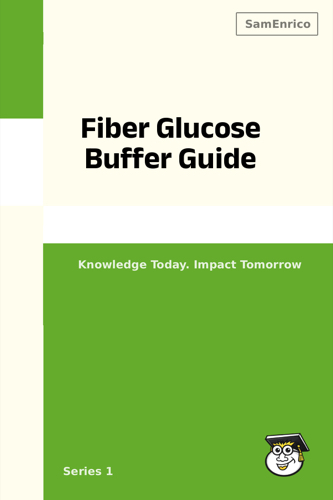
Fiber Glucose Buffer Guide eBook
Eats fiber first to slow sugar absorption.
by Sosa Tisha
Eats fiber first to slow sugar absorption.
Formats
Free sample
Chapter 1: The Silent Epidemic...--For thirty-seven years, I believed I was eating well.Every morning, like clockwork, I sat down to a bowl of oatmeal made with rolled oats, a generous drizzle of raw honey, a sliced banana, and a handful of blueberries. It was breakfast perfection—or so I thought. The oats were whole grain. The honey was natural. The fruit was, well, fruit.
I patted myself on the back for avoiding the sugary cereals and pastries that my coworkers grabbed from the office cafeteria. I was a health-conscious person, and my breakfast proved it.And yet, every day around 10:30 AM, something strange happened. My energy would fall off a cliff. My concentration would blur into a foggy haze. My mood would sour for no apparent reason.
I would find myself snapping at colleagues over trivial email requests. By 11:00 AM, I was ravenously hungry—not in a gentle, stomach-rumbling way, but in a desperate, hand-shaking, "I-need-a-doughnut-now" way. I told myself this was normal. Everyone gets the mid-morning slump, right? Everyone feels tired after lunch.
Everyone craves sugar at 3 PM.Wrong.What I did not know—what millions of people do not know—is that I was riding a glucose roller coaster every single day. And that oatmeal breakfast, the one I believed was so virtuous, was actually the first and steepest hill on that ride.The Breakfast That Spiked Me Higher Than a Candy Bar Let me show you what was actually happening inside my body on those mornings. When you eat a bowl of oatmeal with honey and banana, the carbohydrates are broken down into glucose (simple sugar) very rapidly. The rolled oats, despite being "whole grain," have a surprisingly high glycemic index. The honey is almost pure glucose and fructose.
The banana, especially if it is ripe with brown spots, is packed with sugar. Within thirty minutes of that first bite, my blood glucose was spiking from a healthy baseline of around 85 mg/d L to over 170 mg/d L.To put that number in perspective, a clinical diagnosis of diabetes requires a blood sugar reading of 126 mg/d L or higher after an eight-hour fast. I was hitting 170 mg/d L after breakfast. And I was not diabetic. I was not even prediabetic.
I was a metabolically healthy person by every standard medical test—except I was secretly spiking my blood sugar to diabetic levels for two to three hours every single day.Here is the part that still haunts me: I could not feel the spike. The spike itself feels like nothing. It is the crash that you feel. That foggy, irritable, desperate hunger around 10:30 AM? That was my blood sugar plummeting from 170 mg/d L down to maybe 65 or 70 mg/d L—below the normal baseline.
The crash triggers a cascade of stress hormones: cortisol and adrenaline. These hormones make you feel anxious, shaky, irritable, and hungry. They also make you crave more sugar, because your body, sensing a dangerous low, screams for a rapid source of glucose.So I would eat a "healthy" snack—maybe a granola bar or a piece of fruit—and the entire cycle would repeat itself. Lunch would spike me again. The afternoon crash would hit.
Dinner would spike me. The evening crash would leave me too tired to exercise. I was trapped in a biochemical loop that I did not even know existed.Here is the most disturbing part: When I finally put a continuous glucose monitor on my arm and saw my own data, I discovered that my "healthy" oatmeal breakfast spiked my blood sugar higher and faster than a Snickers bar. I tested it myself. Same morning, same time, same conditions.
One day: oatmeal with honey and banana. Peak glucose: 178 mg/d L. Another day: Snickers bar alone. Peak glucose: 152 mg/d L. The oatmeal was worse.
The oatmeal was worse, and I had been eating it for more than a decade, believing I was being good to my body.The Lake That Looks Safe But Has Hidden Trenches This is the central problem that this book exists to solve. Most people—including most doctors—think about blood sugar in terms of averages. Your fasting glucose is tested after you have not eaten for eight to twelve hours. Your hemoglobin A1c measures your average blood sugar over the past two to three months. These are useful tests, but they hide a dangerous truth: the peaks and valleys.Imagine a lake that has an average depth of ten feet.
That sounds safe for swimming, right? But what if that same lake had hidden trenches that were fifty feet deep? The average would still be ten feet, but those trenches would drown you. Your A1c and fasting glucose are the average depth of the lake. Your post-meal glucose spikes are the hidden trenches.
And they are drowning your metabolism slowly, silently, day after day.The medical establishment has known about the dangers of post-meal spikes for decades, but the message has not reached the public. A normal fasting glucose is below 100 mg/d L. A normal A1c is below 5.7 percent. But a growing body of research shows that even people with "normal" numbers can have dangerous post-meal spikes that damage blood vessels, promote inflammation, accelerate aging, and increase the risk of dementia, heart disease, and metabolic dysfunction.Consider this landmark finding from a 2018 study published in the journal Neurobiology of Aging. Researchers followed more than 5,000 older adults for over a decade.
They found that higher glucose levels—even within the "normal" range—were associated with a smaller hippocampus, the brain region critical for memory. In other words, your blood sugar does not need to be in the diabetic range to be slowly damaging your brain. It just needs to spike.Another study from Stanford University put continuous glucose monitors on healthy, non-diabetic people and made a shocking discovery: More than 80 percent of them had significant post-meal glucose spikes that they could not feel. These were not sick people. These were athletes, office workers, parents, and retirees who thought their metabolism was fine.
Their bodies were silently suffering.The Three Hidden Spikes That Almost Everyone Misses In my years of researching and testing the principles in this book, I have identified three common situations that produce glucose spikes in almost everyone—spikes that people never feel and never connect to their symptoms.Spike Number One: The "Healthy" Breakfast. This is the oatmeal trap I just described. But it is not just oatmeal. It is smoothie bowls made with mango and pineapple. It is whole grain toast with honey.
It is fruit-on-the-bottom yogurt. It is granola. It is "healthy" cereal. Anything that combines rapid-digesting carbohydrates with minimal protein, fat, or fiber will spike your glucose. A 2020 study comparing breakfast meals found that people who ate a high-carb "healthy" breakfast had glucose spikes that were 60 percent higher than people who ate eggs and vegetables—even though both breakfasts had the same number of calories.Spike Number Two: The "Invisible" Carbs.
These are foods you do not think of as carbs. Salad dressing. Barbecue sauce. Ketchup. Teriyaki sauce.
Many of these condiments contain massive amounts of hidden sugar. Two tablespoons of a typical barbecue sauce contains approximately 12…
This is the end of the free sample. Get the eBook to keep going. Buy now
About this book
Details
- Author
- Sosa Tisha
- Publisher
- SamEnrico
- Language
- English
- Genre
- Non-Fiction, Health & Wellness, Fiber
- Released
- 2026-06-08
- Pages (approx.)
- 134
- Available as
- eBook, Audiobook

Read better in the ZLOADR app
Your eBooks on your phone or tablet. Sign in with your SamEnrico account and start reading.
More by Sosa Tisha
 Self Hypnosis For Anxiety Trance GuideSosa Tisha$11.99
 Body Image Journal PromptsSosa Tisha$11.99
 Musician Dream Journal MethodSosa Tisha$11.99
 Rohingya Boat EscapeSosa Tisha$11.99
 Recall Data Analytics GuideSosa Tisha$11.99
 Estonian Health Tech ExpansionSosa Tisha$11.99Estonian Health Tech ExpansionSosa Tisha$11.99
 London Pop Up Footfall AnalysisSosa Tisha$11.99
 Pete Buttigieg Mayor PeteSosa Tisha$11.99
 Neon Mirage: The AI That Predicted the 2008 CrashSosa Tisha$11.99
 The Silent Majority Speaks: How a Single Protest Ignited a RevolutionSosa Tisha$11.99
 The Last Pharaoh's DebtSosa Tisha$11.99
You may also like
 Acacia Fiber Prebiotic GuideShelley Chere$11.99
 Psyllium Husk MicrobiomeCranford Ryan$11.99
 Partially Hydrolyzed Guar GumRiggins Stephan$11.99
 FODMAP Fiber Sources GuideSwitzer Truman$11.99
 Fiber First Weight Loss PlanLassiter Jackqueline$11.99
 Fiber Insulin Resistance LinkMilliken Hollis$11.99
 IBS Fiber Supplement GuidePrimavera Lesli$11.99
 The Fiber Rich Weight GuideCatalano Gerald$11.99
 Psyllium Fiber GuideViera Edward$11.99
 Fiber Supplement GuidePagan Bettina$11.99