
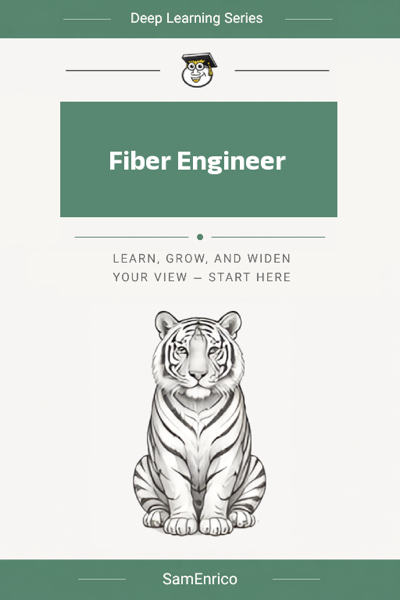
Non-FictionInformativeEducational
Fiber Engineer eBook
A Coursebook on Fiber Engineer
A Coursebook on Fiber Engineer
Formats
Free sample
Chapter 1: The 2 AM Call...--–- The phone rang at 2:17 AM on a Tuesday. Not the gentle buzz of a text message, but the violent, insistent rattle of an emergency line. On the other end, a data center manager named Elena spoke in that clipped, controlled voice people use when they are trying very hard not to panic. “We’ve lost the link between Ashburn and Sterling. Forty thousand transactions per minute.
The trading desks are blind. My monitoring says the fiber is down, but the OTDR trace looks like a Jackson Pollock painting. Can you be here in thirty minutes?”This is how it begins for every fiber engineer. Not with a textbook equation or a pristine lab setup, but with a crisis, a dark screen, and a customer losing money by the second. The problem Elena described—a link that should have worked, that had worked for years, suddenly failing with an unreadable OTDR trace—is exactly the kind of puzzle that separates engineers who know fiber from engineers who truly understand it.
By the end of this book, you will be the person Elena calls at 2 AM. You will walk into that data center, look at the same bewildering trace, and say, “It’s a dirty connector on panel 7B. Give me twelve minutes and a click cleaner.” And you will be right.This chapter establishes the foundation for everything that follows. It answers three essential questions: Why does fiber optics dominate modern communications? What are the different worlds a fiber engineer inhabits?
And how do you stay alive while working in those worlds? If you skip this chapter, you might still learn to splice glass and read OTDR traces. But you will lack the context that turns technical skill into engineering judgment. And judgment, not speed, is what makes you the person everyone calls at 2 AM.The Copper Ceiling: Why We Left Electricity Behind To understand why fiber optics matters, you must first understand what it replaced. Copper cabling—twisted pair (Ethernet), coaxial (cable TV), and various shielded variants—dominated telecommunications for over a century.
And for most of that time, it worked perfectly well. A voice call requires about 64 kilobits per second. A 1990s web page loaded happily over a 56k modem. Copper could handle that.But then the internet happened. Video happened.
Cloud happened. Streaming 4K video requires 25 megabits per second—four hundred times the bandwidth of a voice call. A data center moving petabytes between server racks needs 100, 200, even 800 gigabits per second. Copper hits a wall at roughly 10 gigabits per second over 100 meters. Beyond that, three fundamental problems emerge.First, attenuation.
Electrical signals lose strength as they travel through copper. The resistance of the wire converts signal energy into heat. At 10 gigabits per second, a standard Cat6a cable loses half its signal power every 50 meters. Push to 40 gigabits, and the usable distance shrinks to 30 meters. This is not a materials problem waiting for better copper—it is a fundamental physics limit.
Higher frequencies (which carry more data) experience more resistance due to the skin effect, where signals ride only on the outer surface of the conductor. Double the frequency, and you roughly double the attenuation.Second, electromagnetic interference. An electrical signal is, by definition, a changing electromagnetic field. That field radiates outward from the cable, interfering with nearby cables. Worse, external fields—from power lines, fluorescent lights, radio transmitters, even the motors in elevators—induce noise into the copper conductor.
Shielding helps but adds weight, cost, and complexity. In a data center with thousands of cables bundled together, crosstalk becomes a nightmare. Engineers spend as much time managing interference as they do transmitting signals.Third, grounding and safety. Copper requires a complete electrical circuit. Both ends of the cable must share a common ground reference.
If they do not—if the ground potential differs between building A and building B, which is common in industrial sites or across separate electrical services—current flows through the shield or ground wire. This creates hum, noise, and in extreme cases, fire hazards or equipment damage. Lightning strikes near a copper cable can induce kilovolts, destroying everything connected.Fiber optics solves all three problems simultaneously. Glass does not conduct electricity, so there is no resistance attenuation (the loss comes from scattering and absorption, not heating). Glass is an insulator, so electromagnetic fields do not affect it, and it does not radiate.
No ground loops, no lightning susceptibility, no crosstalk. And the bandwidth? A single strand of single-mode fiber can carry, in laboratory conditions, over 100 terabits per second. That is enough to stream every movie ever made, simultaneously, with bandwidth to spare.But fiber introduces its own challenges. Light is fussy.
It leaks from microscopic bends. It scatters off impurities. It refuses to enter a connector that is dusty or scratched. And when it breaks, you cannot simply twist the wires together and wrap them in electrical tape. You need specialized tools, meticulous technique, and a deep understanding of what is happening inside that glass.This book teaches you that understanding.
Not as abstract physics, but as practical, field-tested knowledge.The Five Worlds of the Fiber Engineer Fiber optics is not one discipline. It is five overlapping disciplines, each with its own constraints, standards, and failure modes. The engineer who excels in a data center may struggle on a telco long-haul route. The FTTH specialist may never touch a Raman amplifier. By understanding all five domains, you become versatile enough to work anywhere and wise enough to know what you do not yet know.Long-Haul Telecom (The Backbone)This is what most people imagine when they hear “fiber optics”: undersea cables crossing oceans, terrestrial routes stretching thousands of kilometers from city to city, the literal backbone of the internet.
Long-haul links operate at the lowest loss window (1550nm) and use dense wavelength division multiplexing (DWDM) to pack 80 or more channels onto a single fiber. Amplifiers (EDFAs and Raman) sit every 80 to 120 kilometers to boost the signal. Dispersion must be carefully managed because chromatic dispersion accumulates over hundreds of kilometers.The long-haul engineer cares about different things than a data center engineer. Splice loss must be below 0.02d B, not 0.05d B. Polarization mode dispersion (PMD) matters because a few picoseconds of differential delay over 1000km blurs pulses.
Nonlinear effects—self-phase modulation, four-wave mixing—become significant at the high powers needed to span amplifier distances. And redundancy is absolute: a cut on a major terrestrial route affects millions of users.Metro Rings (The Connective Tissue)Metro networks circle cities, connecting central offices, carrier hotels, and major enterprise buildings. Distances range from 10 to 100 kilometers. Metro links use both CWDM (cheaper, wider spacing, unamplified) and DWDM (denser, amplified). The metro engineer juggles more diverse traffic—legacy SONET/SDH, Gigabit Ethernet, video distribution, mobile backhaul—often over the same fiber using different wavelengths.Metro presents unique challenges.
Fiber paths are rarely dedicated; a single cable may carry dozens of wavelengths for different customers. Connector counts are higher because signals patch through multiple central offices. Testing must be thorough but fast, because metro outages affect business customers who notice downtime immediately and invoice aggressively.Data Center Interconnects (The Speed Domain)Data centers are the…
This is the end of the free sample. Get the eBook to keep going. Buy now
About this book
Details
- Author
- Ledesma Noella
- Publisher
- SamEnrico
- Language
- English
- Genre
- Non-Fiction, Informative, Educational
- Released
- 2026-06-02
- Pages (approx.)
- 146
- Available as
- eBook, Audiobook

Read better in the ZLOADR app
Your eBooks on your phone or tablet. Sign in with your SamEnrico account and start reading.
More by Ledesma Noella
 Mindfulness Meditation HabitLedesma Noella$11.99
 The Cigarette Stain Reversal GuideLedesma Noella$11.99
 Grade Pressure ManagementLedesma Noella$11.99
 Financial Stress and Emergency FundLedesma Noella$11.99
 The Bakezan: Japan's Shape-Shifting Ogre of the MountainsLedesma Noella$11.99
 Input Output Tables EconomicsLedesma Noella$12.99
 How to Start a Blank Diskettes Business (Beginners Guide)Ledesma Noella$11.99
 How to Produce an Auto Steering SystemLedesma Noella$11.99
You may also like
 Hong Kong Handover 1997Dunn Johnnie$11.99
 Zumba For Postnatal Recovery CourseNeal Christian$11.99
 Zumba for BeginnersLadner Nikia$11.99
 YouTube Comment Mining GuideHumes Pandora$12.99
 Worry Box MeditationCarlin Rudy$11.99
 Workplace Stress MeditationNguyen Lynn$11.99
 Workplace Stress and Sleep RepairHawley Ivory$11.99
 Workplace Perfectionism CureDelaney Jeffry$11.99
 Workplace Injustice Anger GuideWallen Isabelle$11.99
 Work Addiction and Burnout LinkGreenwood Ester$11.99
 Women in Yoga and WellnessBeattie Galina$11.99
 Women in Stand Up ComedyChun Evangeline$11.99