
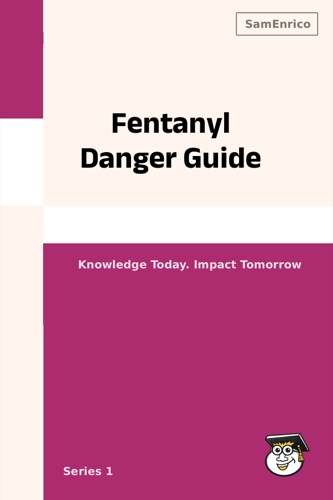
Fentanyl Danger Guide Audiobook
Avoid accidental overdose from street drug contami
Avoid accidental overdose from street drug contamination.
Formats
Free sample
Chapter 1: The Grain of Salt–- In 2017, a 19-year-old college sophomore named Chloe bought what she thought was a single Percocet pill from a classmate. She had taken Percocet before, after a wisdom tooth surgery, and nothing bad had happened. She crushed the pill, snorted a small line—less than half of what she usually took—and leaned back on her dorm room bed. Fifteen minutes later, her roommate found her blue-faced, making a sound like snoring mixed with gargling. The paramedics arrived after the roommate spent three minutes arguing with the 911 dispatcher about whether an ambulance was really necessary.
They gave Chloe two doses of Narcan. She survived. The pill she took contained the equivalent of 12 lethal doses of fentanyl. The grain of salt-sized speck that killed her breathing was invisible to the naked eye. This chapter is about why that grain of salt exists, how it got into her pill, and why the drug you think you know is not the drug that will kill you.The Three Eras of Street Drugs To understand why fentanyl has turned the street supply into a minefield, you have to understand how we got here.
The history of non-medical drug use in America can be divided into three distinct eras, and the transitions between them were not gradual. They were explosions.Era One: Plant-Based Opioids (1800s–1990s)For most of human history, opioids came from plants. The poppy plant Papaver somniferum produces morphine and codeine naturally. If you wanted to get high from an opioid in 1850, you chewed poppy pods or drank laudanum (alcohol mixed with morphine). If you wanted to do the same in 1950, you bought heroin that was synthesized from morphine but still ultimately derived from poppies grown in Turkey, Afghanistan, or Southeast Asia.The plant-based era had a critical feature that kept users relatively safe: dosage was limited by biology.
A poppy plant only produces so much morphine. To get a kilogram of pure heroin, you need hundreds of kilograms of poppy straw. This natural ceiling meant that street drugs had a maximum potency. You could not accidentally make heroin ten times stronger without processing ten times more plant material, which was expensive and logistically difficult.Plant-based opioids also had predictable pharmacokinetics. Morphine and codeine are water-soluble, not fat-soluble.
They enter the bloodstream quickly, do not accumulate in tissues, and leave the body within 24 hours. Withdrawal from plant-based…
This is the end of the free sample. Get the Audiobook to keep going. Buy now
About this book
Details
- Author
- Gossett Mariann
- Publisher
- SamEnrico
- Language
- English
- Genre
- Non-Fiction, Self-Help, Fentanyl
- Released
- 2026-06-07
- Pages (approx.)
- 140
- Available as
- eBook, Audiobook

Listen in the VoxFlicks app
Audiobooks and audio dramas wherever you go. Sign in with your SamEnrico account and press play.
More by Gossett Mariann
 Paleo Smoothies Without FruitGossett Mariann$11.99
 Body Recomp For BeginnersGossett Mariann$11.99
 Leading Overland Myanmar To LaosGossett Mariann$11.99
 The Swiss Vanguard: Blood and Gold in the Italian WarsGossett Mariann$11.99
 JazzGossett Mariann$11.99
 Escalation Clause Contract Pricing WorkbookGossett Mariann$12.99
 How to Produce Candle SnuffersGossett Mariann$11.99
 How to Start a Agricultural College Business (Beginners Guide)Gossett Mariann$11.99
You may also like
 Hong Kong Handover 1997Dunn Johnnie$11.99
 Zumba For Postnatal Recovery CourseNeal Christian$11.99
 Zumba for BeginnersLadner Nikia$11.99
 YouTube Comment Mining GuideHumes Pandora$12.99
 Worry Box MeditationCarlin Rudy$11.99
 Workplace Stress MeditationNguyen Lynn$11.99
 Workplace Stress and Sleep RepairHawley Ivory$11.99
 Workplace Perfectionism CureDelaney Jeffry$11.99
 Workplace Injustice Anger GuideWallen Isabelle$11.99
 Work Addiction and Burnout LinkGreenwood Ester$11.99
 Women in Yoga and WellnessBeattie Galina$11.99
 Women in Stand Up ComedyChun Evangeline$11.99