
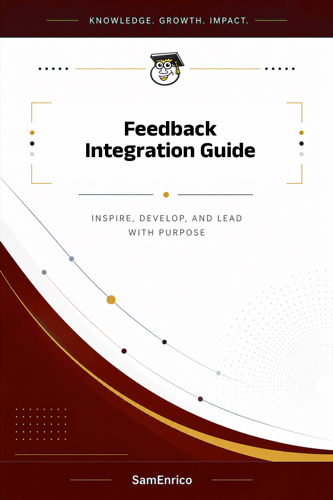
Feedback Integration Guide eBook
Stop dismissing praise and start accepting complim
by Sam Kennith
Stop dismissing praise and start accepting compliments as valid data about your abilities.
Formats
Free sample
Chapter 1: The Negativity Trap--–- You have just finished a presentation at work. Fifteen people were in the room. Fourteen of them told you it was excellent, insightful, and well-organized. One person said your third slide was confusing and that you spoke too quickly during the Q&A. It is now eleven o'clock at night.
You are lying in bed, staring at the ceiling. Which feedback are you replaying?If you are like 94 percent of the human beings who have been studied in this exact scenario, you are not thinking about the fourteen compliments. You are dissecting the one critique. You are replaying the confused look on that one person's face. You are rehearsing what you should have said during the Q&A.
The fourteen people who praised you might as well have been furniture. Their words entered your ears and dissolved like smoke.This is not a personality flaw. It is not low self-esteem. It is not imposter syndrome, though those things can make it worse. This is a fundamental feature of the human brain, a survival mechanism that kept your ancestors alive on the savanna but now keeps you awake at night over a Power Point slide.
Scientists call it the negativity bias. In plain language, it means your brain treats one piece of bad news as more real, more urgent, and more memorable than ten pieces of good news.The negativity bias was an excellent idea three hundred thousand years ago. Your ancestor who ignored the rustling bush because the last nine rustling bushes were just the wind eventually got eaten by the tiger. Your ancestor who assumed every rustle was a threat survived. The brain that over-weighted negative information passed its genes forward.
The brain that treated positive information as equally important did not. You are the descendant of hyper-vigilant pessimists, and you carry their neural wiring in your skull.But here is the problem. You no longer live on the savanna. The tiger is gone. In its place is a quarterly performance review.
In its place is a partner who says "you look nice tonight." In its place is a boss who says "that was a brilliant solution." Your brain, still wired for survival, treats that critical comment in the review as a tiger. It treats the compliment from your partner as the wind. It treats the praise from your boss as background noise.And so you dismiss praise. You deflect it. You explain it away.
"Oh, they were just being nice." "Oh, anyone could have done it." "Oh, that was luck." These phrases come out of your mouth automatically, like a reflex. You think you are being modest. You think you are being humble. You are being neither. You are being a bad scientist.The Birth of the Feedback Gap Let me define a term that will appear throughout this book: the Feedback Gap.
The Feedback Gap is the systematic discrepancy between the positive feedback you actually receive and the positive feedback you actually integrate. You receive fourteen compliments. You remember zero of them as usable data about your abilities. You receive one criticism. You treat it as a complete and accurate assessment of your worth.
That is the gap.Most books about feedback try to close the gap from the wrong side. They teach managers how to give better feedback. They teach leaders how to be more constructive. They teach parents how to praise their children effectively. These are worthy goals, but they miss the point entirely.
The problem is not that the world is giving you bad praise. The problem is that you are a terrible receiver. You are drowning in data and refusing to drink.Consider the following. A study published in the Journal of Personality and Social Psychology asked participants to recall critical feedback and positive feedback from the same sources. The participants could recall the critical feedback with far greater detail, accuracy, and emotional intensity.
When asked to describe the positive feedback, their accounts were vague and generic. When asked to describe the critical feedback, they could quote it almost verbatim. The researchers called this the "asymmetry of recall." I call it a professional liability.If you are making career decisions based on an incomplete dataset, you are not being prudent. You are being irrational. Imagine a doctor who only looked at your blood work when it showed abnormalities and ignored all the normal results.
You would not call that doctor thorough. You would call that doctor dangerous. You are that doctor with your own abilities.The Three Kinds of Praise You Are Probably Confusing Before we go further, we need to make a distinction that will save you enormous confusion later. Not all praise is the same. In fact, most people lump three completely different types of feedback into one category called "compliments," and then treat them all with the same reflexive dismissal.
This is a category error, and it is making you miserable.The first type is Appreciation. Appreciation is about valuing a person. "Thank you for being such a kind teammate." "I really appreciate having you on this project." "You're a good friend." Appreciation is relationship maintenance. It is the social glue that holds teams and families together. It contains almost no data about your specific abilities.
If someone says "I appreciate you," they are telling you that you matter to them. They are not telling you what you did well. That is fine. Appreciation does not need to be actionable. It needs to be accepted.The second type is Evaluation.
Evaluation is about ranking or rating you against a standard. "You are a top performer." "You exceeded expectations." "You are in the ninety-fifth percentile." Evaluation triggers the fear of future expectations more than any other type of praise. When your brain hears evaluation, it thinks: "If I accept this ranking, I must maintain it forever." That is exhausting. That is why so many people deflect evaluative praise. They are not being humble.
They are being sensible about their energy levels.The third type is Coaching-oriented praise. This is the gold. This is the type of praise that contains actual data about your abilities. Coaching-oriented praise names a specific behavior and implies that repeating that behavior would be useful. "The way you structured that email with the bullet points and the bolded summary made it easy for me to respond quickly." "When you stayed calm during the client meltdown and just listened for ten minutes, that changed the whole dynamic." "I noticed that you asked everyone for their opinion before you gave yours, and the meeting was more productive than usual."Coaching-oriented praise is actionable.
It tells you what to do more of. But here is the problem: most people never hear it, because most people never ask for it. They receive vague appreciation or anxiety-provoking evaluation, and they dismiss it all as "just a compliment." They never dig for the coaching-oriented gold underneath.The Week of Witnessing I want you to run an experiment. It will take seven days. It will change how you see your own life.For the next seven days, carry a small notebook.
It can be a physical notebook, a notes app on your phone, or a voice memo folder. Every time someone…
This is the end of the free sample. Get the eBook to keep going. Buy now
About this book
Details
- Author
- Sam Kennith
- Publisher
- SamEnrico
- Language
- English
- Genre
- Non-Fiction, Self-Help
- Released
- 2026-06-10
- Pages (approx.)
- 130
- Available as
- eBook, Audiobook

Read better in the ZLOADR app
Your eBooks on your phone or tablet. Sign in with your SamEnrico account and start reading.
More by Sam Kennith
 Dolphin Swim CompanionSam Kennith$11.99
 Growth Equity TermsSam Kennith$11.99Growth Equity TermsSam Kennith$11.99
 The Road WarriorSam Kennith$11.99
 Caregiver Communication SkillsSam Kennith$11.99
 Trance for Chemotherapy Side EffectsSam Kennith$11.99
 Pet Loss For Pet SittersSam Kennith$11.99
 Fibromyalgia Pain Management GuideSam Kennith$11.99
 Tenant Communication GuideSam Kennith$11.99
 The Deluge Unleashed: Sobieski's Charge at Vienna (1683)Sam Kennith$11.99
 The Silk Road Skies: How a Forgotten Aviator Conquered Central Asia’s Deadliest AirspaceSam Kennith$11.99
 The Last Dance of the Dream Team: 1996 Olympics and the Birth of Global BasketballSam Kennith$11.99
You may also like
 Workplace Stress MeditationNguyen Lynn$11.99
 Volcano Monitoring ScientistCox Alexis$11.99
 The Tech Professional NetAguiar Nevada$11.99
 The Morning Metta RitualCanales Anya$11.99
 The Chunking Memory TechniqueClanton Hyacinth$11.99
 The Beginner Mistake FixAmmons Cassondra$11.99
 Surrendering to What IsGrimm Reatha$11.99
 Self Hypnosis for Fear of FireBillups Eli$11.99
 Road Rage for Professional DriversBrackett Janise$11.99
 Psychiatric Ward Nurse StressDunning Wyatt$11.99
 Observation vs Evaluation NVCTimmons Alda$11.99
 Networking for Nonprofit ProfessionalsPoole Jesse$11.99