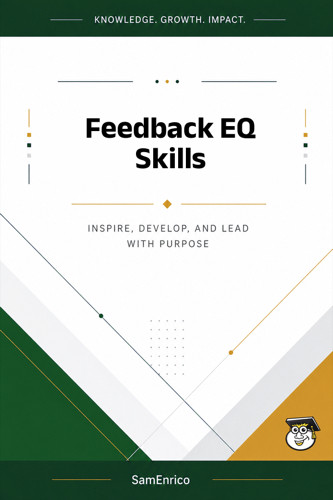
Feedback EQ Skills eBook
undefined
by Knutson Leo
undefined
Formats
Free sample
Chapter 1: The Feedback Autopsy--–- It happens in less than a second. One moment you are listening, perhaps even leaning in with genuine curiosity. The next moment, your chest tightens, your face flushes, and you are no longer hearing a word the other person is saying. You are not being stubborn or difficult. You are not weak-willed or arrogant.
You are, quite simply, having a biological event.This chapter will take you inside that event. You will learn why your brain treats criticism like a physical threat, how to tell the difference between disagreeing with feedback and feeling personally endangered by it, and most importantly, you will learn a technique called the Feedback Autopsy—a structured after-action review that will forever change how you process criticism. By the end of this chapter, you will understand that your defensiveness is not a character flaw. It is a reflex. And reflexes can be rewired.The Moment Everything Changes Let us start with a story.
Not a hypothetical one, but a composite drawn from hundreds of real conversations with managers, executives, and individual contributors across every industry.Sarah had been a marketing director for three years. She was good at her job—consistently top quartile in performance reviews, praised by her peers, trusted by her leadership. During her annual review, her boss, David, said something she did not expect. After forty-five minutes of positive feedback about campaign performance and team culture, David paused, looked at his notes, and said: "Sarah, I want to talk about your presentation style in executive meetings. Sometimes, you come across as dismissive when others ask clarifying questions.
It is something I would like you to work on."In the second after David said those words, Sarah experienced something she would later describe as "falling into a hole." Her vision narrowed. She felt heat spreading from her chest up her neck. She stopped breathing normally. And for the next several seconds—she would later estimate ten to fifteen seconds—she heard nothing David said. She saw his mouth moving.
She registered that he was still speaking. But the content of his words was gone, replaced by a roaring internal monologue: Dismissive? I am the most patient person on that team. He has no idea what he is talking about. Does he even watch the same meetings I do?When David finished, Sarah smiled tightly and said, "Okay, thank you for the feedback." She remembered nothing else from the meeting.
She walked to her car, sat in the driver's seat, and cried. Not because David was cruel—he was not. Not because the feedback was inaccurate—she would later realize there was a kernel of truth in it. She cried because her body had betrayed her. She had wanted to be open.
She had wanted to listen. And instead, she had vanished inside her own head while her boss was trying to help her grow.If you have ever had a moment like Sarah's—and if you are human, you have—you know the shame that follows. You replay the conversation, wishing you had responded differently. You wonder why you cannot just take feedback like a rational adult. You may have even concluded that there is something fundamentally wrong with you.There is not.
You just did not know what was happening inside your skull.The Neuroscience of Feeling Criticized To understand why Sarah froze—and why you have frozen, fought, or fled in similar moments—we need to take a brief tour of your brain. Do not worry. This will not be a tedious anatomy lesson. You only need to know about three parts.First, there is your prefrontal cortex. This is the rational, thinking part of your brain.
It is responsible for planning, reasoning, impulse control, and what psychologists call "executive function." When you are calm and regulated, your prefrontal cortex is in charge. It helps you consider multiple perspectives, weigh evidence, and respond thoughtfully. This is the part of your brain you want driving the car during a feedback conversation.Second, there is your amygdala. This is a small, almond-shaped cluster of neurons deep in your brain's limbic system. Its job is to scan for threats.
Thousands of years ago, the amygdala was essential for survival—it detected predators, identified hostile tribesmen, and triggered the fight-or-flight response that kept your ancestors alive. The amygdala does not think. It reacts. And it reacts fast—much faster than your prefrontal cortex. By the time your rational brain has registered a stimulus, your amygdala has already decided whether to fight, flee, or freeze.Third, there is your insula.
This region processes internal body sensations—your heartbeat, your breathing rate, the temperature of your skin. When your amygdala detects a threat, it signals your insula, which then creates the physical sensations you experience as emotion: racing heart, shallow breath, flushed skin, tight chest.Here is what happened to Sarah. When David said the word "dismissive," her amygdala—operating on incomplete information and ancient programming—categorized that word as a threat. Not a mild threat. A survival threat.
Why? Because human beings are social animals. For your ancestors, being rejected by the tribe was a death sentence. You could not survive alone on the savanna. Social rejection literally meant death.
Your brain has not updated its software in tens of thousands of years. So when your boss says something that feels like criticism, your amygdala treats it the same way it would treat a lion charging at you.The result is an amygdala hijack—a term coined by psychologist Daniel Goleman. In a hijack, your amygdala floods your body with cortisol and adrenaline. Your heart rate increases. Your breathing becomes shallow.
Blood rushes to your large muscles, preparing you to fight or run. Your prefrontal cortex, meanwhile, is partially shut down. Blood flow decreases to the rational parts of your brain. This is why Sarah could not think clearly. This is why she could not remember what David said.
Her brain had literally rerouted resources away from thinking and toward surviving.This is not a metaphor. It is biology.The Two Triggers: Truth and Identity Not all criticism triggers a hijack. Some feedback you can hear easily, even appreciate. The difference lies in what the feedback triggers in you. Based on the research in Stone and Heen's Thanks for the Feedback, we can distinguish between two kinds of triggers.Truth Triggers occur when you disagree with the content of the feedback.
Someone says, "You missed the deadline," and you respond, "No, I did not—I submitted it on Tuesday." That is a Truth Trigger. You are disputing the facts. Truth Triggers can cause frustration, but they rarely cause a full amygdala hijack because they do not threaten your sense of self. You are simply correcting a factual error.Identity Triggers occur when the feedback threatens who you are as a person. Someone says, "You are dismissive," and you hear, "You are a bad person." Someone says, "Your presentation lacked clarity," and you hear, "You are stupid." Someone says, "You need to improve your leadership style," and you hear, "You are a failure as a manager." Identity Triggers are the ones that cause hijacks.…
This is the end of the free sample. Get the eBook to keep going. Buy now
About this book
Details
- Author
- Knutson Leo
- Publisher
- SamEnrico
- Language
- English
- Genre
- Non-Fiction, Self-Help / Feedback
- Released
- 2026-06-06
- Pages (approx.)
- 146
- Available as
- eBook, Audiobook

Read better in the ZLOADR app
Your eBooks on your phone or tablet. Sign in with your SamEnrico account and start reading.
More by Knutson Leo
 Diazepam Alcohol Detox GuideKnutson Leo$11.99
 Self Esteem Narcissistic AbuseKnutson Leo$11.99
 Personal Brand Ghostwriter GuideKnutson Leo$11.99
 Familial Advanced Sleep PhaseKnutson Leo$11.99
 DBT Trigger Coping SkillsKnutson Leo$11.99
 Working Memory For EngineersKnutson Leo$11.99
 Employment Leave InsuranceKnutson Leo$11.99
 The Last Broadcast of Radio Free EuropeKnutson Leo$11.99
 The Nautical Warriors of the Great Zimbabwe: Mastering the Indian OceanKnutson Leo$11.99
 American Foxhound: Scent-driven & ActiveKnutson Leo$11.99
 JEE Common Mistakes AnalysisKnutson Leo$12.99
 Price Matching Inflation StrategyKnutson Leo$12.99