
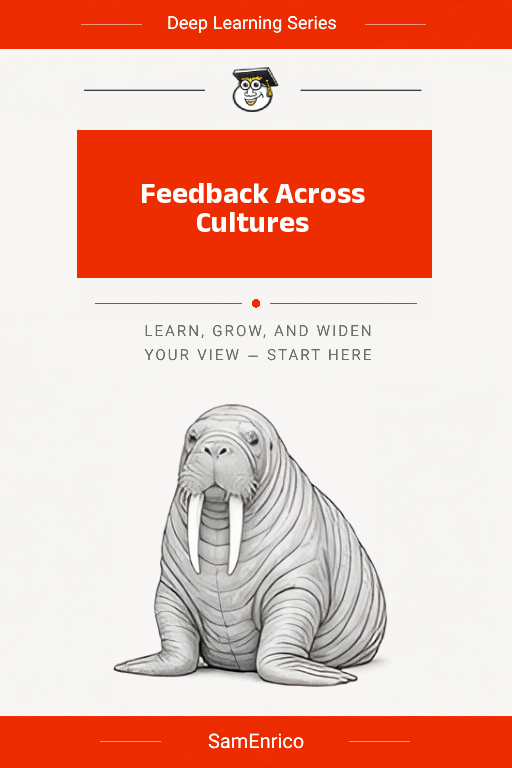
Non-FictionProfessional's Cheat SheetFeedback
Feedback Across Cultures
Deliver constructive feedback to junior colleagues
by Wilhelm Tuan
Deliver constructive feedback to junior colleagues from cultures with different face-saving norms.
Formats
About this book
Free sample
Chapter 1: The Smile That Lied--–- The conference room in Osaka was glass-walled, modern, and immaculate. Sarah, a senior product manager from Chicago, had flown fourteen hours to meet her Japanese junior colleague, Kenji. He had missed a critical deadline, and Sarah believed in radical candor. She smiled warmly, leaned forward, and said, “Kenji, I need to be direct with you. Your delay cost us credibility with the client.
You need to prioritize better next time.”Kenji nodded. He smiled. He said, “Thank you for your feedback. I will try harder.”Sarah felt relieved. She had done her job.
She had been clear, kind, and constructive. Three weeks later, Kenji submitted his resignation. His exit interview said only: “I could not meet my manager’s expectations.”Sarah was devastated—and utterly confused. She had tried to help. What went wrong?This is the feedback paradox.
In cross-cultural workplaces, the very act of trying to improve someone’s performance can destroy their confidence, silence their voice, and drive them out of the organization. Not because the feedback was wrong, and not because the recipient was weak, but because the cultural assumptions embedded in the feedback clashed with the face-saving norms of the recipient. Sarah thought she was being honest. Kenji heard public humiliation. She thought she was offering a path to improvement.
He heard a permanent judgment on his character.This book is for every leader who has ever been bewildered by a junior colleague’s silence, withdrawal, or sudden resignation after what seemed like a perfectly professional conversation. It is for managers in global tech firms, multinational manufacturers, international NGOs, and remote teams spanning six time zones. It is for anyone who must deliver constructive criticism to someone from a culture where “saving face” is not an optional nicety but a survival mechanism.In this chapter, we will dissect the feedback paradox. We will define “face” not as ego or fragility, but as social currency—a concept as real and valuable as money. We will introduce the low-context vs.
high-context divide that explains why one person’s “directness” is another person’s “aggression.” And we will begin the work of shifting…
This is the end of the free sample. Get the eBook to keep going. Buy now
Contents
- Chapter 1
- Chapter 2
- Chapter 3
- Chapter 4
- Chapter 5
- Chapter 6
- Chapter 7
- Chapter 8
- Chapter 9
- Chapter 10
- Chapter 11
- Chapter 12
Details
- Author
- Wilhelm Tuan
- Publisher
- SamEnrico
- Language
- English
- Genre
- Non-Fiction, Professional's Cheat Sheet, Feedback
- Released
- 2026-06-01
- Pages (approx.)
- 155
- Available as
- eBook, Audiobook

Read better in the ZLOADR app
Your eBooks on your phone or tablet. Sign in with your SamEnrico account and start reading.
More by Wilhelm Tuan
 Product Review Request EmailWilhelm Tuan$11.99
 Potassium Power HandbookWilhelm Tuan$11.99
 Self Hypnosis For Forgiveness WorkbookWilhelm Tuan$11.99
 Major Peg System HandbookWilhelm Tuan$11.99
 Recurring Dream Timeline GuideWilhelm Tuan$11.99
 The Last Pharaoh's Shadow: Exile in the SandsWilhelm Tuan$11.99
 The Lost Voyagers: A Mid-Century Indian Ocean Survival EpicWilhelm Tuan$11.99
 Understanding Epithelial-myoepithelial CarcinomaWilhelm Tuan$17.99
 House Sitting Snowbird GuideWilhelm Tuan$12.99
 Lead DeveloperWilhelm Tuan$11.99
 How to Become a Motorcycle AssemblerWilhelm Tuan$11.99
You may also like
 Hong Kong Handover 1997Dunn Johnnie$11.99
 Zumba For Postnatal Recovery CourseNeal Christian$11.99
 Zumba for BeginnersLadner Nikia$11.99
 YouTube Comment Mining GuideHumes Pandora$12.99
 Worry Box MeditationCarlin Rudy$11.99
 Workplace Stress MeditationNguyen Lynn$11.99
 Workplace Stress and Sleep RepairHawley Ivory$11.99
 Workplace Perfectionism CureDelaney Jeffry$11.99
 Workplace Injustice Anger GuideWallen Isabelle$11.99
 Work Addiction and Burnout LinkGreenwood Ester$11.99
 Women in Yoga and WellnessBeattie Galina$11.99
 Women in Stand Up ComedyChun Evangeline$11.99