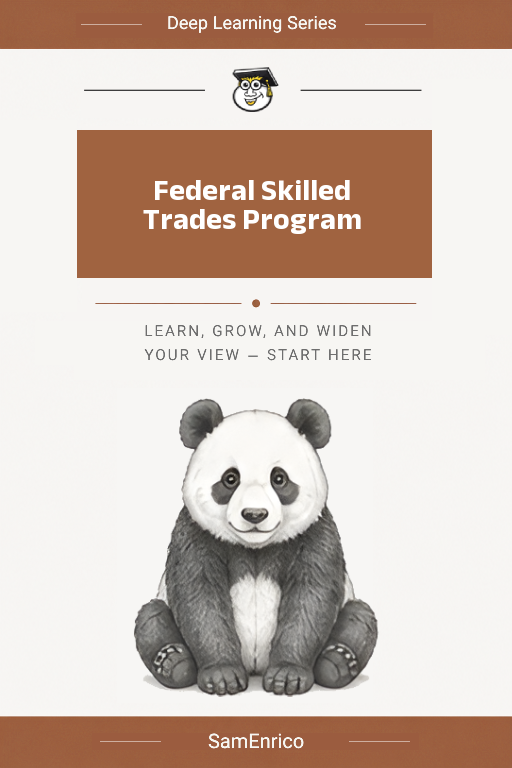
Federal Skilled Trades Program eBook
Apply for Express Entry through FSTP with trade ce
by Snead Sondra
Apply for Express Entry through FSTP with trade certification and Canadian work experience.
Formats
Free sample
Chapter 1: The Welder Who Beat the Banker--–- When Miguel Sanchez, a 34-year-old welder from Guadalajara, Mexico, submitted his Express Entry profile in 2025, his Comprehensive Ranking System score was 199. His cousin, Carlos, who held a Master’s degree in Business Administration from a respected Spanish university, had a score of 452. By every conventional measure, Carlos should have received his invitation to apply for Canadian permanent residence first. He did not. Miguel landed in Calgary eight months later.
Carlos is still waiting. This is not a story about luck. It is a story about understanding which door to knock on.If you are reading this book, you likely fall into one of three categories. First, you are a skilled tradesperson—a welder, electrician, plumber, carpenter, heavy-duty mechanic, truck driver, cook, or butcher—who has spent years perfecting your craft. Second, you have heard that Canada wants immigrants but you have also heard that you need a university degree to qualify.
Third, you are confused by the alphabet soup of Canadian immigration: Express Entry, CRS, LMIA, NOC, PNP, ITA, CEC, FSWP, FSTP. You are not alone. The Canadian immigration system is deliberately complex, but complexity is not the same as impossibility.This book exists because one specific pathway within that system is systematically overlooked: the Federal Skilled Trades Program, or FSTP. While hundreds of thousands of applicants chase the general Express Entry pool, competing for diminishing invitations with scores above 480, tradespeople with scores as low as 250 to 400 are receiving invitations through dedicated category-based draws that occur every four to eight weeks during active periods. The FSTP is not a consolation prize for people who could not get a degree.
It is a recognition by the Canadian government that a licensed tradesperson is often more valuable to the economy than a general business graduate.This chapter will fundamentally shift how you view yourself as an immigrant. You will learn why Canada’s immigration system prioritizes skilled trades, how the FSTP compares to other Express Entry programs, what category-based draws mean for your chances, and why your work boots are worth more than a framed diploma on someone else’s wall. By the end of this chapter, you will understand that the Federal Skilled Trades Program is not a back door—it is the front door for a growing segment of the global workforce.The Great Misconception: Degrees Are Not the Only Currency For decades, the dominant narrative in global immigration has been that university education is the golden ticket. Countries like Canada, Australia, and the United Kingdom have historically favored applicants with bachelor’s degrees, master’s degrees, and doctorates. This created a self-perpetuating belief: if you want to immigrate, you need a degree.
If you do not have a degree, you cannot compete.That belief is now dangerously outdated.Canada’s economy has changed dramatically over the past ten years. The country faces a severe shortage of skilled tradespeople across virtually every sector. According to Build Force Canada, the construction industry alone needs to recruit over 300,000 new workers by 2030, and nearly half of those positions are in skilled trades. The Canadian Trucking Alliance estimates a shortage of 55,000 truck drivers. Restaurants across the country cannot find enough cooks and chefs.
Hospitals cannot find enough maintenance tradespeople. Resource extraction industries in Alberta, Saskatchewan, and Newfoundland cannot find enough heavy-duty mechanics.When the government faces a shortage of lawyers, it can wait. When the government faces a shortage of welders who can repair pipelines, it cannot wait. Pipelines leak. Construction projects stop.
Supply chains break. This is not theoretical. In 2023, a major infrastructure project in Toronto was delayed by nine months solely because the contractor could not find enough certified electricians. The economic cost of that delay was estimated at over $40 million.Immigration, Refugees and Citizenship Canada (IRCC) responded to this reality by redesigning the Express Entry system. In 2022, legislative changes gave the immigration minister the authority to conduct category-based draws targeting specific occupations.
The first category announced was healthcare. The second was skilled trades. As of 2025, IRCC continues to hold dedicated draws for trades occupations approximately every four to eight weeks, with specific focus on NOC groups 72, 73, 82, 83, 92, 93, plus cooks (6320) and chefs (62200).These draws have fundamentally different dynamics than general Express Entry draws. In a general draw, IRCC invites the highest-scoring applicants regardless of occupation. That typically means a cutoff score of 480 or higher.
In a trades-specific draw, the cutoff score is often between 250 and 400. To put that in perspective: a 25-year-old welder with no Canadian work experience, a high school diploma, and a valid job offer in Alberta can easily score over 400 points. That same applicant would never receive an invitation in a general draw.This is the hidden reality that Miguel understood and Carlos did not. Miguel did not have a degree. He had a welding certification from a Mexican technical institute, five years of experience, and a brother who had already moved to Edmonton.
Carlos had a master’s degree, but his field—international business—was oversaturated. Every general draw, Carlos competed against thousands of other business graduates from around the world. Miguel competed against a much smaller pool of trades applicants. The math was brutally simple: fewer competitors, lower cutoff scores, faster invitation.The Three Doors of Express Entry: FSWP, CEC, and FSTPTo understand why the FSTP is your best option, you must first understand how it fits within the broader Express Entry system. Express Entry is not a single immigration program.
It is an application management system that contains three separate economic immigration programs. When you create an Express Entry profile, you are automatically considered for all three programs for which you are eligible. However, your eligibility for each program depends on different criteria.The Federal Skilled Worker Program (FSWP) is the oldest and most well-known of the three. It was designed for professionals with university education, often in fields like engineering, medicine, information technology, and business. To qualify for FSWP, you need a minimum of one year of continuous full-time skilled work experience, but you also need to score at least 67 points on a separate six-factor grid that awards points for education, language ability, work experience, age, arranged employment, and adaptability.
In practice, this means FSWP applicants almost always have a bachelor’s degree or higher. The CRS scores required for FSWP applicants in general draws are consistently above 480.The Canadian Experience Class (CEC) is designed specifically for people who have already worked in Canada on a valid work permit. If you have 12 months of skilled work experience in Canada within the three years before applying, you may qualify for CEC. The advantage of CEC is that it has no education requirement and typically processes faster than FSWP—as low as six months for 80 percent of applicants, though trades applications can take eight to ten months. The disadvantage is that you cannot use CEC unless you have already found a way to work in Canada.
For offshore applicants without Canadian experience, CEC is not an option.The Federal Skilled Trades Program (FSTP) is the third program and the focus of this book. It was created in 2013 specifically to address labor shortages in skilled trades. The eligibility requirements are fundamentally…
This is the end of the free sample. Get the eBook to keep going. Buy now
About this book
Details
- Author
- Snead Sondra
- Publisher
- SamEnrico
- Language
- English
- Genre
- Non-Fiction, Student's Shortcut, Trades Pathway
- Released
- 2026-05-30
- Pages (approx.)
- 155
- Available as
- eBook, Audiobook

Read better in the ZLOADR app
Your eBooks on your phone or tablet. Sign in with your SamEnrico account and start reading.
More by Snead Sondra
 South Korean Green Tax Credits GuideSnead Sondra$11.99
 Men's Cardiac MRI InterpretationSnead Sondra$11.99
 TM Health Insurance CoverageSnead Sondra$11.99
 The Ferber Method ExplainedSnead Sondra$11.99
 Innocence Project Oklahoma CasesSnead Sondra$11.99
 The Vanishing of the D.B. Cooper Heist: A Cold Case UnlockedSnead Sondra$11.99
 Nefertiti's Urban Revolution: The Lost Blueprint of AmarnaSnead Sondra$11.99
 YoyoSnead Sondra$11.99
 Understanding Chromosome 17 TrisomySnead Sondra$17.99
 PDP For New ManagersSnead Sondra$12.99
 How to Become a Camera RepairerSnead Sondra$11.99