
Non-FictionStartup GuideFake DoorIntent Testing
Fake Door Testing Technique eBook
Place fake buy button or signup form on landing pa
Measures interest with non functional product listings.
Formats
Free sample
Chapter 1: The $3 Million Button--–- I still remember the exact moment I realized I had wasted three months of my life and $40,000 of investor money on a feature that exactly zero people wanted. It was 3:47 PM on a Tuesday, and I was staring at an analytics dashboard that looked like a flatline on a heart monitor. The feature—a beautifully engineered "smart scheduling assistant" for our Saa S product—had been live for six weeks. We had promoted it in email newsletters, blog posts, and social media. We had built onboarding tooltips to guide users to it.
And in forty-two days, exactly three people had clicked the button. None of them had used it twice.The sickening feeling wasn't just the money. It was the meetings. The debates. The late nights arguing about font sizes and loading states.
The moment I had proudly demoed it to the board, certain they would see the genius of my vision. They had nodded politely. Then they had asked the question I should have asked myself before writing a single line of code: "Did anyone actually ask for this?"I had lied. I said yes. The truth was that the idea had come from a late-night conversation with a co-founder who thought it "felt like the future." That feeling had cost us forty thousand dollars and three months of engineering time that could have been spent on literally anything else.This book is the book I wish someone had handed me the day before I wrote that first line of code.The Lie You Have Been Sold There is a myth that permeates every startup accelerator, every product management blog, and every boardroom in the technology industry.
It is a seductive myth, comforting in its simplicity, and it is absolutely destroying your company's potential. The myth goes like this:If you build a great product, customers will come.The corollary is even more dangerous: If customers don't come, your product wasn't great enough.Neither statement is true. The history of technology is littered with exquisitely engineered products that failed spectacularly because nobody wanted them. Google Glass was a technological marvel—augmented reality, voice commands, a camera on your face—that consumers rejected so thoroughly that the product became a cultural punchline. Microsoft's Zune had better hardware than the i Pod, a better screen, and a subscription model that seemed visionary.
It sold fewer than two million units while the i Pod sold hundreds of millions. Segway was supposed to revolutionize urban transportation; its inventor predicted it would be as big as the personal computer. Today, Segways are mostly used by mall security guards and tour groups in Las Vegas.These were not bad products. They were well-built, well-funded, and backed by brilliant engineers and executives. What they lacked was evidence that anyone actually wanted them before the factories started humming.The most expensive word in business is not "layoff" or "lawsuit." It is "assume." Every time you assume you know what customers want, you are gambling with your company's future.
And the house always wins.The $100 Alternative Now consider a different story. In 2007, a young entrepreneur named Drew Houston had a problem. He kept forgetting his USB drive, which meant he couldn't access his files when he moved between computers. He had an idea for a solution: a folder that synchronized automatically across the internet. But he didn't know if anyone else would pay for such a thing.Instead of building the product, Houston did something that seemed almost laughably simple.
He recorded a three-minute video demonstrating a product that did not yet exist. The video showed a folder that magically synced files between computers. When the folder icon wiggled, a checkmark appeared, and the file was "there." The video was rough, the audio was poor, and the product was entirely fake—a mockup created with screen recording software and video editing.Houston posted the video to Hacker News, a community of tech enthusiasts. Within twenty-four hours, thousands of people had watched it. Thousands more had clicked the "Sign up for beta access" button at the bottom of the page.
That button was also fake—it simply collected email addresses. But by the time the video had been viewed fifty thousand times, Houston had a list of seventy-five thousand people who had raised their hands and said, "I want this."The product was Dropbox. Today it is worth over ten billion dollars.Houston spent exactly zero dollars on engineering before he knew if anyone wanted what he was building. He spent an afternoon recording a video. That video was his fake door.This is the central insight of this book: You can measure customer intent before you build anything.
You can place a button, a signup form, or a pricing table on a landing page, drive traffic to it, and watch what people do. If they click, you have evidence. If they don't, you have saved yourself months of wasted effort. And you can do all of this in forty-eight hours for less than the cost of a decent dinner.Defining the Fake Door Let me be precise about what we are discussing in this book. A Fake Door is a call-to-action—a button, a form, a pricing table, or a link—that promises a product, feature, or service that does not yet exist.
When a user interacts with that door, they are not able to complete the transaction. Instead, they are shown a message explaining that the product is coming soon, that the team is testing demand, or that they can join a waitlist.The Fake Door is a hypothesis test, not a deception. The distinction is critical and will be explored in depth in the next chapter. For now, understand that the goal is not to trick users into believing something false. The goal is to measure their behavior in a controlled, ethical way that reveals their genuine interest.There is a related technique called the Wizard of Oz test, named after the famous scene where a small man behind a curtain pretends to be a powerful wizard.
In a Wizard of Oz test, the user believes they are interacting with an automated system, but a human is actually fulfilling their requests behind the scenes. For example, a landing page that promises "AI-generated marketing copy" might actually send user inputs to a human copywriter who manually types the response.The Fake Door and the Wizard of Oz serve different purposes. The Fake Door measures intent—do users want this enough to click a button or submit an email? The Wizard of Oz measures delivery—can you actually satisfy demand, even if manually? The Fake Door comes first.
Only after you have evidence of intent should you consider building a Wizard of Oz to test delivery.This book focuses primarily on the Fake Door because it is faster, cheaper, and more scalable. You can test ten ideas in the time it takes to build one Wizard of Oz. And you should. Most ideas deserve to die quickly. The Fake Door is the merciful executioner.The Anatomy of a Fake Door Test Every Fake Door test follows the same five-step structure.
You will see variations of this structure throughout the book, but the core remains constant.Step 1: State the hypothesis. What…
This is the end of the free sample. Get the eBook to keep going. Buy now
About this book
Details
- Author
- Cabrera Maile
- Publisher
- SamEnrico
- Language
- English
- Genre
- Non-Fiction, Startup Guide, Fake Door, Intent Testing, Business Brief, Experimentation
- Released
- 2026-06-01
- Pages (approx.)
- 149
- Available as
- eBook, Audiobook

Read better in the ZLOADR app
Your eBooks on your phone or tablet. Sign in with your SamEnrico account and start reading.
More by Cabrera Maile
 The Sleep Sack vs Blanket GuideCabrera Maile$11.99
 German Skilled Labor ShortageCabrera Maile$11.99
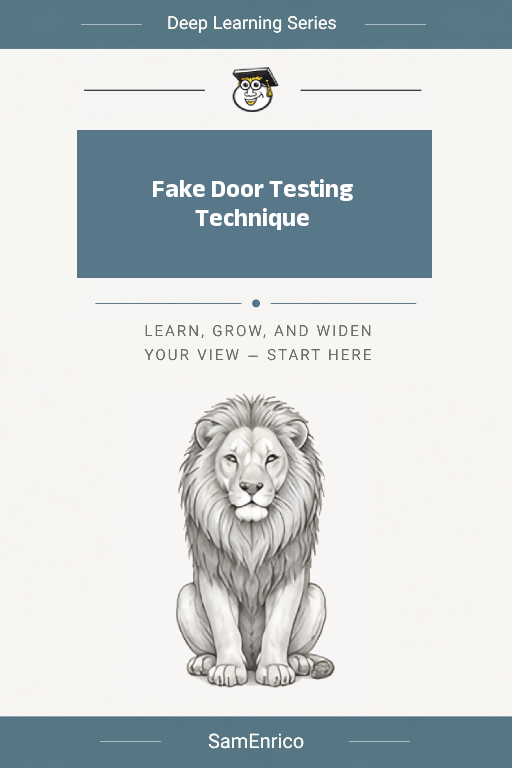 Fake Door Testing TechniqueCabrera Maile$12.99
 Workplace Stress Reduction for Night ShiftCabrera Maile$11.99
 Cross Functional Collaboration ManualCabrera Maile$11.99
 Calisthenics Male Physique GuideCabrera Maile$11.99
 The Last Dance: The Untold Story of the 1998 Chicago Bulls' Final Trade DeadlineCabrera Maile$11.99
 Codex Reborn: The AI That Rewrote HistoryCabrera Maile$11.99
 How to Become a Cable MaintainerCabrera Maile$11.99
 Logo Design in One DayCabrera Maile$12.99
 Understanding Chromosome 3Cabrera Maile$17.99
 Installation EngineerCabrera Maile$11.99
You may also like
 Hong Kong Handover 1997Dunn Johnnie$11.99
 Zumba For Postnatal Recovery CourseNeal Christian$11.99
 Zumba for BeginnersLadner Nikia$11.99
 YouTube Comment Mining GuideHumes Pandora$12.99
 Worry Box MeditationCarlin Rudy$11.99
 Workplace Stress MeditationNguyen Lynn$11.99
 Workplace Stress and Sleep RepairHawley Ivory$11.99
 Workplace Perfectionism CureDelaney Jeffry$11.99
 Workplace Injustice Anger GuideWallen Isabelle$11.99
 Work Addiction and Burnout LinkGreenwood Ester$11.99
 Women in Yoga and WellnessBeattie Galina$11.99
 Women in Stand Up ComedyChun Evangeline$11.99