
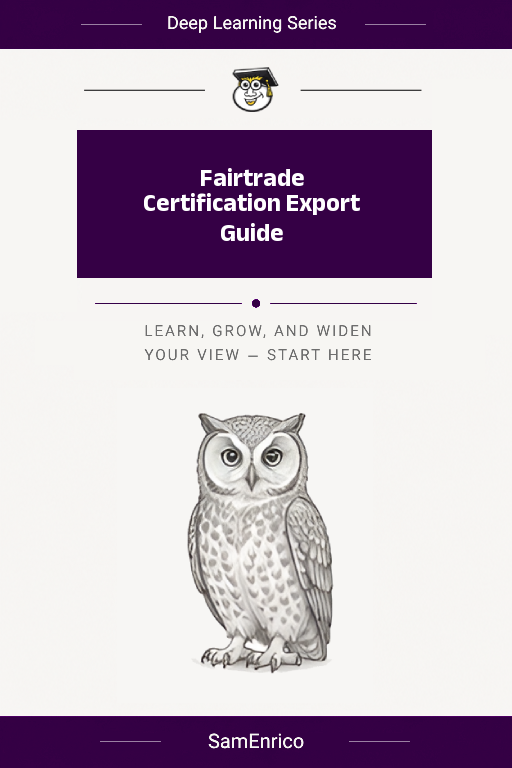
Non-FictionBusiness BriefFairtrade
Fairtrade Certification Export Guide eBook
Meet minimum price and premium requirements for co
Meet minimum price and premium requirements for coffee, cocoa, bananas, and cotton exports to Europe.
Formats
Free sample
Chapter 1: The €100 Billion Wake-Up Call--The coffee farmer in Peru who lost half his harvest to an unexpected frost last year still managed to sell everything he grew at a profit. The cocoa cooperative in Ghana that watched global prices collapse to a ten-year low never once considered abandoning their fields. The banana producer in Costa Rica facing new European regulations that would bankrupt most farms instead invested in cleaner irrigation and higher wages. And the cotton farmer in India, competing against massive subsidized agribusinesses, now commands prices that make his children the first in the family to attend university.What do these four producers have in common that their non-certified neighbors do not? The answer is not better soil, more rain, or cheaper labor.
The answer is a blue and green label that most European consumers recognize instantly but most exporters still underestimate: Fairtrade certification.This book exists because the gap between what Fairtrade offers and what most producers actually know about accessing those benefits remains enormous. Thousands of coffee, cocoa, banana, and cotton producers around the world hold Fairtrade certification or are eligible to obtain it. Yet the majority never fully leverage the two most powerful tools the system provides—the Minimum Price guarantee and the Fairtrade Premium—because they do not understand how to negotiate them, document them, or use them strategically. Even worse, many producers pursue certification without understanding the European market they intend to enter, wasting time and money on requirements that do not matter while missing the ones that do.This chapter establishes the foundation for everything that follows. By the time you finish these pages, you will understand why European buyers are desperate for reliable Fairtrade suppliers, how recent regulatory changes have made certification nearly mandatory for market access, and exactly how this book will walk you through every step of becoming not just certified but truly competitive.The Silent Crisis That Fairtrade Solves Let us start with a number that should shock you: between 2020 and 2024, the average price volatility for unprocessed coffee on the global market exceeded forty percent year over year.
Cocoa experienced even wilder swings, with prices ranging from less than two thousand dollars per ton to over ten thousand dollars per ton in a single eighteen-month period. Bananas, often considered a stable commodity, saw price collapses that pushed smallholder farmers below the cost of production in three of the last five years. Cotton, heavily influenced by subsidy programs in wealthy nations, remains one of the most manipulated commodity markets on earth.For a farmer in Uganda growing robusta coffee, a thirty percent drop in global prices is not an abstract economic indicator. It is the difference between sending children to school and pulling them out to work the fields. It is the difference between buying fertilizer to maintain soil health and watching yields decline year after year.
It is the difference between maintaining shade trees for climate resilience and cutting them down for firewood to survive.Fairtrade was designed specifically to solve this crisis. The certification system, now operating in more than seventy countries and involving approximately two million farmers and workers, guarantees a Minimum Price that acts as a safety net when commodity markets crash. That price is not arbitrary. Fairtrade International calculates it based on the actual cost of sustainable production—labor, inputs, environmental compliance, and a buffer for risk. When the New York Coffee C-market price dropped to 1.20perpoundinrecentyears,Fairtradebuyersstillpaid1.20 per pound in recent years, Fairtrade buyers still paid 1.20perpoundinrecentyears,Fairtradebuyersstillpaid1.80 per pound to certified producers.
When the market surged to 2.50,thosesamebuyerspaid2.50, those same buyers paid 2.50,thosesamebuyerspaid2.50 plus the premium. The producer loses nothing during upswings and loses everything during downturns without the certification.But the Minimum Price is only half of the equation. On top of every sale, Fairtrade buyers pay an additional sum called the Fairtrade Premium. In 2022 alone, this premium channeled €210 million directly to producer organizations. Coffee farmers earned €95.6 million of that total, the highest of any commodity.
Crucially, this premium is not controlled by buyers, governments, or Fairtrade International. It is controlled democratically by the farmers and workers themselves. They decide whether to build a school, equip a health clinic, install clean water systems, purchase processing equipment, or fund agricultural training. The one thing they cannot do is distribute the premium as cash to individuals—a restriction that ensures collective benefit rather than temporary relief.The results of this system are measurable and documented. Cooperatives that actively manage their premium funds report higher retention rates among young farmers.
Communities that invested in processing equipment capture more value from their crops. Producer organizations that used premiums for training and certification diversification consistently earn higher total incomes than those that treat certification as merely a compliance exercise.Yet despite these clear benefits, the majority of certified producer organizations never fully optimize their Fairtrade engagement. Why? The answer lies in three gaps that this book exists to close.The Three Gaps That Keep Producers from Prosperity The first gap is knowledge. Most producers understand that Fairtrade pays a minimum price and a premium, but they do not understand how those numbers are calculated, how to verify that buyers are complying, or how to negotiate terms above the minimum.
They accept whatever price the buyer offers, assuming the certification guarantees fairness. It does not. Fairtrade guarantees a floor. What happens above that floor is entirely negotiable, and most producers leave substantial money on the table because they lack basic negotiation frameworks.The second gap is documentation. Fairtrade requires rigorous traceability, labor records, environmental compliance, and democratic governance documentation.
Yet most producer organizations treat these requirements as burdens rather than assets. A cooperative with excellent traceability records can command higher prices from buyers who need to prove supply chain integrity for European regulations. A farm with complete labor documentation can access premium markets that non-certified competitors cannot enter. Documentation is not just a compliance cost; it is a competitive advantage that most producers fail to leverage.The third gap is market access. Even with certification, many producers struggle to find European buyers who will pay Fairtrade terms.
They do not know how to use the Fairtrade customer search tool, how to build sourcing plans that buyers trust, or how to market their impact stories. They rely on spot markets and intermediaries rather than building long-term contracts that provide stability and predictable income. The result is certified products sold at non-certified prices, which defeats the entire purpose of certification.This book closes all three gaps. Each chapter addresses a specific challenge, provides actionable tools, and builds toward a complete exporter toolkit. But before you can negotiate better terms, document effectively, or find premium buyers, you need to understand the market you are entering.
That understanding begins with European consumers and the regulatory environment that shapes their choices.The European Consumer: Why Germany, France, and the Netherlands Lead If you ask a coffee farmer in Colombia who buys Fairtrade products, she might say "Europeans." But not all Europeans are the same. Consumer behavior varies dramatically across the European Union, and understanding these differences can mean the difference between a successful export strategy and wasted effort.Germany represents the largest Fairtrade market in…
This is the end of the free sample. Get the eBook to keep going. Buy now
About this book
Details
- Author
- Curran Idalia
- Publisher
- SamEnrico
- Language
- English
- Genre
- Non-Fiction, Business Brief, Fairtrade
- Released
- 2026-06-01
- Pages (approx.)
- 153
- Available as
- eBook, Audiobook

Read better in the ZLOADR app
Your eBooks on your phone or tablet. Sign in with your SamEnrico account and start reading.
More by Curran Idalia
 Senior Housing Occupancy RatesCurran Idalia$11.99
 Conflict and Self Worth GuideCurran Idalia$11.99
 Franchising Your Local Brand Across Borders Pandemic PreparednessCurran Idalia$11.99
 Caregiver Burnout CoupleCurran Idalia$11.99
 Alcoholism Recovery for VeteransCurran Idalia$11.99
 Invoice And Payment Tracking GuideCurran Idalia$11.99
 Weekly HIIT Schedule GuideCurran Idalia$11.99
 Retail Worker Food AddictionCurran Idalia$11.99
 The Silent Killer of Jutland: The Torpedo's Deadly EvolutionCurran Idalia$11.99
 The Clockwork Cosmos: Galileo, Kepler, and the Birth of Modern AstronomyCurran Idalia$11.99
 How to Produce Stairs and Stair PartsCurran Idalia$11.99
 How to Become a Print InspectorCurran Idalia$11.99
You may also like
 Hong Kong Handover 1997Dunn Johnnie$11.99
 Zumba For Postnatal Recovery CourseNeal Christian$11.99
 Zumba for BeginnersLadner Nikia$11.99
 YouTube Comment Mining GuideHumes Pandora$12.99
 Worry Box MeditationCarlin Rudy$11.99
 Workplace Stress MeditationNguyen Lynn$11.99
 Workplace Stress and Sleep RepairHawley Ivory$11.99
 Workplace Perfectionism CureDelaney Jeffry$11.99
 Workplace Injustice Anger GuideWallen Isabelle$11.99
 Work Addiction and Burnout LinkGreenwood Ester$11.99
 Women in Yoga and WellnessBeattie Galina$11.99
 Women in Stand Up ComedyChun Evangeline$11.99