
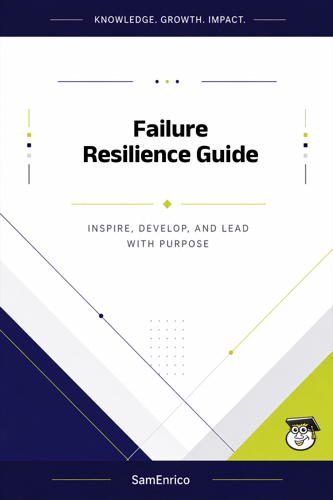
Non-FictionSelf-Help / Failure
Failure Resilience Guide eBook
undefined
by Aponte Kit
undefined
Formats
Free sample
Chapter 1: The Failure Resume--–- Most people spend their lives trying to build a perfect record. They choose safe careers, avoid ambitious goals, and stay in relationships that no longer serve them—all to dodge the sting of public failure. They tell themselves they are being strategic, but beneath that rationalization lives a quiet terror: that one significant failure will expose them as frauds. This chapter exists to shatter that illusion. Drawing from John C.
Maxwell's Failing Forward and Ryan Holiday's The Obstacle is the Way, we will reframe failure not as the enemy of success but as its most demanding teacher. You will learn the critical difference between a temporary setback and a permanent defeat. You will discover why your comfort zone is actually a danger zone. And you will create your first and most powerful tool: the Failure Resume—a document that rewires your brain's relationship with risk, shame, and growth. By the end of this chapter, you will stop asking, "How do I avoid failure?" and start asking, "What is my next failure trying to teach me?"The Culture of Failure Phobia We live in an age of unprecedented failure avoidance.
Parents hire admissions consultants to engineer perfect college applications. Corporations hold endless pre-meetings to ensure no idea reaches a senior leader without unanimous approval. Entrepreneurs spend months perfecting products that no customer has ever been asked about. The common thread is not wisdom. It is fear—so pervasive and invisible that we mistake it for prudence.Consider the evidence.
Psychologists have documented that modern students are more afraid of receiving a B than previous generations were of failing a course entirely. A large-scale study of workplace behavior found that over half of employees would rather hide a mistake than share it, even when sharing could prevent the same error from costing their company millions. In one telling experiment, venture capitalists admitted they would rather fund a mediocre startup with a flawless founder than a brilliant startup whose founder had a single public failure on their record. The message is unmistakable: failure has become unforgivable.But this cultural sickness has a cure, and the cure begins with a single question: What if nearly everything you believe about failure is backward?The Great Paradox: Why Winners Often Learn Nothing Here is a truth that successful people rarely admit: winning teaches almost nothing of value. When you succeed, the feedback loop is hopelessly muddy.
Did you win because of your brilliant strategy? Because of luck? Because your competitor made an unforced error? Because the market shifted in your favor at exactly the right moment? Success provides no clear answers.
It only confirms what you already wanted to believe—that you are capable, smart, and deserving.Failure, by contrast, is brutally honest. When you fail, the feedback is unmistakable. Something you assumed turned out to be false. Some skill you lacked became painfully visible. Some risk you underestimated materialized.
Failure does not flatter you. It does not protect your ego. It simply shows you the gap between where you are and where you need to be.This is the failure paradox: the very thing we spend our lives avoiding is the thing that makes us better. The executive who has never lost a major account has no idea how to handle rejection. The athlete who has never been cut from a team has no resilience for the inevitable slump.
The artist who has never been rejected by a gallery has no muscle for the ninety-nine noes that precede every yes. Winning produces brittle confidence, easily shattered by the first real challenge. Failure produces durable wisdom, forged in the fire of actual experience.Thomas Edison understood this intuitively. When his factory burned to the ground, destroying years of prototypes and research, he reportedly told his son, "Go get your mother and all her friends. They'll never see a fire like this again." When a reporter asked about the loss, Edison said, "Thank goodness we got rid of all that junk.
Now we can start fresh." Edison was not immune to pain or grief. But he had trained himself to see failure as information, not as identity. The fire was not a catastrophe. It was a very dramatic data point.Setback Versus Defeat: The Distinction That Changes Everything One of the most important distinctions in this entire book is the difference between a setback and a defeat. These words are often used interchangeably, but they point to radically different realities.
Understanding the difference is the first step toward genuine resilience.A setback is temporary. It is an event that interrupts your progress but does not end your journey. You lose a client. You fail an exam. Your manuscript is rejected.
Your proposal is ignored. These are setbacks. They hurt. They may hurt terribly. But they do not define you, and they do not end your story.
Every successful person you admire has a long trail of setbacks behind them. The question is not whether you will experience setbacks—you absolutely will. The question is whether you will treat them as data or as doom.A defeat, by contrast, is permanent. A defeat occurs only when you stop trying. When you decide that the setback means you are incapable, unworthy, or doomed.
When you close the laptop, delete the file, and never try again. Defeat is not an event. Defeat is a decision. And here is the liberating truth: you are the only person who can declare a defeat. No external event can force you to stop.
Only you can quit.This distinction is not motivational fluff. It is a practical tool for reframing every failure you will ever face. When something goes wrong, pause and ask yourself: Is this a setback or a defeat? The answer is almost always a setback—unless you decide otherwise. And once you recognize that you hold the power to declare defeat, you can choose to hold that power in reserve.
You can choose to treat every failure as a setback, which means every failure becomes a learning opportunity rather than an ending.The Danger Zone: Why Comfort Is a Trap The modern self-help industry has done enormous damage with its celebration of the "comfort zone." We are told to find our comfort zone, expand our comfort zone, protect our comfort zone. But this language is dangerously misleading. The comfort zone is not a safe harbor. It is a danger zone—a place where skills atrophy, resilience decays, and small problems eventually become catastrophes.Consider what happens when you stay in your comfort zone. You stop facing novel challenges, so your brain stops building new neural pathways.
You stop receiving negative feedback, so your blind spots grow unchecked. You stop practicing recovery from failure, so when failure inevitably arrives (and it always does), you have no muscle for handling it. The result is not safety. It is fragility. People who have never failed are not strong.
They are brittle. And brittle things do not bend when pressure comes; they shatter.The research on this is clear and consistent. Psychologists have studied a condition they call "failure deprivation"—growing up without meaningful setbacks—and found that it produces adults who cannot…
This is the end of the free sample. Get the eBook to keep going. Buy now
About this book
Details
- Author
- Aponte Kit
- Publisher
- SamEnrico
- Language
- English
- Genre
- Non-Fiction, Self-Help / Failure
- Released
- 2026-06-07
- Pages (approx.)
- 134
- Available as
- eBook, Audiobook

Read better in the ZLOADR app
Your eBooks on your phone or tablet. Sign in with your SamEnrico account and start reading.
More by Aponte Kit
 The Neurodivergent Teen GuideAponte Kit$11.99
 Medical Bill Financial Stress GuideAponte Kit$11.99
 Travel Blogger Wanderlust EnvyAponte Kit$11.99
 Senior Adult ImmunizationAponte Kit$11.99
 Carson Award NamesakesAponte Kit$11.99
 The Comparison Sibling WoundAponte Kit$11.99
 Love Has Won EscapeAponte Kit$11.99
 Entrepreneur Imposter SyndromeAponte Kit$11.99
 The Ottoman Astronomer and the Relativity Prelude: A Forgotten Genius in the Age of EnlightenmentAponte Kit$11.99
 Frozen Echoes: The Vanishing of the Northwind ExpeditionAponte Kit$11.99
 Fionn mac Cumhaill: The Giant Who Shaped IrelandAponte Kit$11.99
 Customer Support Systems for DropshippingAponte Kit$11.99
You may also like
 Hong Kong Handover 1997Dunn Johnnie$11.99
 Zumba For Postnatal Recovery CourseNeal Christian$11.99
 Zumba for BeginnersLadner Nikia$11.99
 YouTube Comment Mining GuideHumes Pandora$12.99
 Worry Box MeditationCarlin Rudy$11.99
 Workplace Stress MeditationNguyen Lynn$11.99
 Workplace Stress and Sleep RepairHawley Ivory$11.99
 Workplace Perfectionism CureDelaney Jeffry$11.99
 Workplace Injustice Anger GuideWallen Isabelle$11.99
 Work Addiction and Burnout LinkGreenwood Ester$11.99
 Women in Yoga and WellnessBeattie Galina$11.99
 Women in Stand Up ComedyChun Evangeline$11.99