
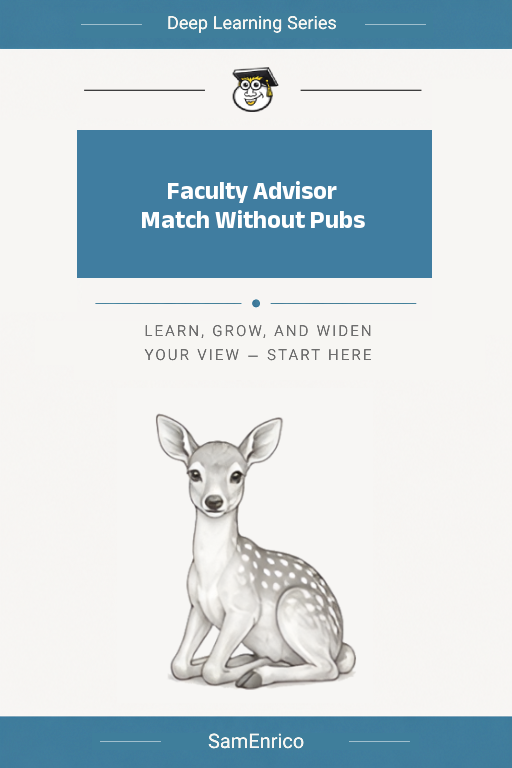
Non-FictionStudent's ShortcutAdvisor Matching
Faculty Advisor Match Without Pubs eBook
Identify potential supervisors who value research
by Self Aiko
Identify potential supervisors who value research fit over publication records and demonstrate genuine intellectual alignment.
Formats
Free sample
Chapter 1: The Publication Mirage--The first time someone asked me for my publication record, I was twenty-three years old, standing in a fluorescent-lit hallway outside a professor’s office, clutching a CV that felt thinner than my chances of getting in. I had spent two years on a research question about antibiotic resistance that led nowhere. My experiments failed. My hypotheses collapsed. My advisor at the time said, kindly but firmly, “You don’t have anything to show for this.”He was right, by the standard metrics.
I had zero first-author papers. Zero middle-author papers. Zero conference proceedings. Zero preprints. I had a drawer full of lab notebooks documenting dead ends, a head full of questions that no one had asked before, and a creeping sense that I had wasted everyone’s time.The professor behind the door was a famous microbiologist.
Her lab had produced seventeen papers in the last three years. Her students went on to tenure-track jobs at R1 universities. Her Google Scholar profile was a monument to productivity. I had emailed her two weeks earlier, and her graduate coordinator had scheduled a fifteen-minute “preliminary chat.” I knew what that meant: she wanted to see if I was worth the investment.I sat down. She looked at my CV for about eight seconds.
Then she said, “You have no publications.”It wasn’t a question.“No,” I said. “But I’ve been working on—”“I need students who can hit the ground running,” she interrupted. “My lab runs on grants. Grants require preliminary data. Preliminary data come from students who already know how to produce.
Do you understand?”I understood. I also understood that I would never work with her, and that this was probably a gift.But for the next six months, I carried that conversation like a stone in my chest. Every time I looked at a faculty directory, I heard her voice: You have no publications. Every time I drafted an email, I deleted it because I couldn’t figure out how to apologize for my empty bibliography. Every time a well-meaning mentor said, “Just apply anyway,” I wanted to scream: To whom?This book is for everyone who has ever sat in that fluorescent hallway.The Lie You’ve Been Sold Let me be direct: the belief that you cannot find a great faculty advisor without a publication record is not merely inaccurate.
It is a lie—a structural, historically contingent, institutionally reproduced lie that benefits a small number of hyper-productive labs at the expense of everyone else, including the students who would make the best researchers if given half a chance.How did we get here?The story begins in the decades after World War II, when the American research university underwent a dramatic transformation. Federal funding for science exploded. The National Science Foundation was created in 1950. The National Institutes of Health’s budget grew from 4millionin1947toover4 million in 1947 to over 4millionin1947toover400 million by 1960. Suddenly, universities had money to hire faculty, build labs, and train graduate students at an unprecedented scale.But with money came the need for accountability.
How do you decide which labs get funded? How do you compare a chemist at Harvard to a biologist at Berkeley? The answer, borrowed from bibliometrics, was the journal impact factor—a metric created by Eugene Garfield in the 1970s as a library management tool to help librarians decide which journals to subscribe to. Garfield never intended it to evaluate individual scientists. He said so repeatedly.
“Impact factors are not meant to assess the quality of a researcher’s work,” he wrote in 1998. “They are a property of journals, not people.”It didn’t matter. By the 1990s, impact factors and publication counts had become the currency of academic evaluation. Hiring committees used them. Tenure committees used them.
Grant reviewers used them. And graduate admissions committees—never the most creative thinkers—used them too.The logic seemed reasonable on its face: students who have published papers must be good at research. But this logic contains a fatal flaw. It confuses output with learning, productivity with potential, and conformity to publishable norms with intellectual creativity.Let me show you what I mean.The Productive Lab vs. The Educational Lab Not all laboratories are the same.
They look similar from the outside—the same bench space, the same graduate students hunched over the same equipment, the same posters on the same walls. But they operate according to fundamentally different philosophies.I call these two types Productive Labs and Educational Labs. Understanding the difference is the single most important step in finding an advisor who will value your mind over your CV.The Productive Lab The productive lab is optimized for one thing: generating papers. Everything else is secondary. The principal investigator (PI) runs the lab like a small business, with clear deliverables, tight deadlines, and an implicit contract: you produce, or you leave.In a productive lab, research questions are chosen not for their intrinsic interest or potential for paradigm shifts, but for their feasibility.
Can this experiment be completed in six months? Will the results be publishable even if they are incremental? Is there a clear path from hypothesis to paper that minimizes the risk of null results?The division of labor in a productive lab resembles an assembly line. One student handles the cell culture. Another runs the western blots.
A third does the statistical analysis. The PI writes the grants and edits the manuscripts. Everyone has a role, and the roles are narrow. This is efficient. It also means that students in productive labs often graduate with impressive publication records and very little understanding of how to design a project from scratch.Here is the key insight: productive labs are not better than educational labs.
They are simply different. They serve a different purpose. They attract a different kind of student. But the academic reward system has elevated the productive lab to the gold standard, treating publication counts as the only metric that matters.The problem is that productive labs are also the most likely to reject students without publication records. Why?
Because they are optimized for output. A student who needs to learn how to run experiments, troubleshoot protocols, and analyze data is a cost, not an asset. The productive lab wants students who can start producing on day one.The Educational Lab The educational lab is optimized for student development. Research is still the primary activity, but it serves a pedagogical purpose. The PI asks different questions: What does this student need to learn?
How can I structure this project to maximize their growth? What happens if they fail—will they recover stronger?In an educational lab, research questions are chosen for their intellectual richness, not just their feasibility. The PI might encourage a student to pursue a risky idea even if it has a high chance of failure, because the process of pursuing it—the literature review, the experimental design, the troubleshooting, the graceful acceptance of null results—is itself educational.The division of labor is flatter. Students are expected to learn multiple techniques. Postdocs mentor graduate students.
Graduate students mentor undergraduates. The PI meets with students individually to discuss not just data but thinking—how the student approaches…
This is the end of the free sample. Get the eBook to keep going. Buy now
About this book
Details
- Author
- Self Aiko
- Publisher
- SamEnrico
- Language
- English
- Genre
- Non-Fiction, Student's Shortcut, Advisor Matching
- Released
- 2026-06-01
- Pages (approx.)
- 140
- Available as
- eBook, Audiobook

Read better in the ZLOADR app
Your eBooks on your phone or tablet. Sign in with your SamEnrico account and start reading.
More by Self Aiko
 Body Language For Introverts CourseSelf Aiko$11.99
 Parenting with Disability GuideSelf Aiko$11.99
 The Emotional Spending LinkSelf Aiko$11.99
 Survey Longitudinal Analysis Using AISelf Aiko$11.99
 Just Right OCD Subtype GuideSelf Aiko$11.99
 Silicon Whisperers: How Tech Lobbyists Reshaped the WorldSelf Aiko$11.99
 Blood of the Standing Stones: The Druid’s Last OracleSelf Aiko$11.99
 Understanding CamptobrachydactylySelf Aiko$17.99
 French University Master GuideSelf Aiko$12.99
 Banking LawSelf Aiko$11.99
 How to Start a Construction of Outdoor Sports Facilities (except Buildings) Business (Beginners GuidSelf Aiko$11.99
You may also like
 Hong Kong Handover 1997Dunn Johnnie$11.99
 Zumba For Postnatal Recovery CourseNeal Christian$11.99
 Zumba for BeginnersLadner Nikia$11.99
 YouTube Comment Mining GuideHumes Pandora$12.99
 Worry Box MeditationCarlin Rudy$11.99
 Workplace Stress MeditationNguyen Lynn$11.99
 Workplace Stress and Sleep RepairHawley Ivory$11.99
 Workplace Perfectionism CureDelaney Jeffry$11.99
 Workplace Injustice Anger GuideWallen Isabelle$11.99
 Work Addiction and Burnout LinkGreenwood Ester$11.99
 Women in Yoga and WellnessBeattie Galina$11.99
 Women in Stand Up ComedyChun Evangeline$11.99