
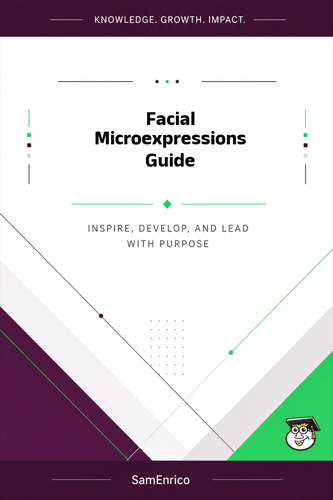
Facial Microexpressions Guide eBook
Teaches recognizing seven universal emotions in sp
by Dexter Paris
Teaches recognizing seven universal emotions in split second facial movements.
Formats
Free sample
Chapter 1: The Half-Second Tell--You have already missed over two hundred emotional truths today.Not because you are unobservant. Not because you lack empathy. But because your brain was never trained to see what happens in the space between a stimulus and a response—that narrow window, roughly one twenty-fifth of a second, where the face speaks before the mind can censor it. By the time you finish this page, someone near you will suppress an emotion. A flash of irritation at a phone notification.
A flicker of fear at a memory. A microsecond of contempt at something someone just said. You will miss every single one.This book exists to change that.The Lie of the Poker Face There is a persistent myth, reinforced by decades of movies and bad advice, that some people can maintain a perfect "poker face"—a neutral expression that reveals nothing. The myth suggests that with enough willpower, training, or emotional detachment, a person can become unreadable. This is false.
Not exaggerated. Not oversimplified. False.Here is what the research actually shows: the human face contains forty-three muscles connected directly to the brain's limbic system—the ancient, emotional core that operates below conscious awareness. Before your prefrontal cortex (the rational, decision-making part of your brain) can decide to hide an emotion, your facial muscles have already begun to move. The delay between emotional trigger and conscious suppression is approximately one twenty-fifth to one fifteenth of a second.
In that window, the truth appears.Paul Ekman, the pioneering psychologist who spent decades decoding the face, called these "microexpressions." They are not smaller versions of regular expressions. They are full emotional expressions, compressed into a fraction of a second, involuntarily generated by the brain's oldest circuits. You cannot stop them from happening. You can only learn to see them.Consider what this means. Every person you have ever interacted with—your partner, your boss, your teenager, your client, the stranger on the subway—has flashed you dozens of microexpressions.
You have missed nearly all of them. Not because you are deficient, but because no one taught you how to look.A Murder Solved by a Fraction of a Second In 1984, a young woman named Mary was found murdered in her apartment in Southern California. The investigation stalled for months. Witnesses were interviewed. Suspects were cleared.
Then a detective named John Yarbrough, who had recently attended a training on facial expression analysis, decided to re-interview the prime suspect—a man named John who had been Mary's neighbor.During the interview, John answered every question calmly. His words were consistent. His alibi held up. But when Yarbrough asked, "Did you go into Mary's apartment that night?" John's face moved for one twenty-fifth of a second. His brows lowered and drew together.
His upper eyelids tightened. His lips pressed into a thin line. Then, immediately, his face returned to neutral.Yarbrough had just witnessed a microexpression of anger.Not guilt. Not fear. Not deception.
Anger. The Othello Error—named for Shakespeare's tragic hero who saw his wife's fear and assumed it meant guilt—would have been to interpret that flash as an admission. Yarbrough did not. He noted it, stayed calm, and changed his line of questioning. Three hours later, John confessed.
The microexpression had not been a lie detector. It had been a signal—a crack in the facade that Yarbrough knew how to follow.This story illustrates the first and most important principle of this book: microexpressions tell you what someone feels, not why they feel it. The difference between these two things is the difference between wisdom and paranoia, between connection and accusation, between using this skill to build trust and using it to destroy relationships.The Seven Faces Everyone Makes Before we go further, you need to know what you are looking for. Across every culture, every language, every age group, and every background, the same seven emotions produce the same facial muscle movements. This is not a theory.
It has been tested in Papua New Guinea with tribes who had never seen a photograph or a foreigner. It has been tested with blind athletes who have never seen another human face. It has been tested with infants as young as six weeks old. The seven universal emotions are:Anger: The face of boundary violation. Brows lowered and drawn together.
Eyes tightened or glaring. Lips pressed or jaw clenched.Sadness: The face of loss and surrender. Inner brows raised and pulled together. Lip corners pulled down. Often a slight pout.Fear: The face of threat detection.
Brows raised and pulled together (a unique combination). Upper eyelids raised. Lips stretched horizontally.Joy: The face of genuine happiness. Cheeks raised (creating crow's feet). Lip corners pulled up symmetrically.Surprise: The face of unexpected input.
Brows raised and arched. Eyes widened. Jaw dropped.Disgust: The face of aversion. Nose wrinkled. Upper lip raised.Contempt: The face of superiority.
One-sided lip raise. Often called the "half-smirk."That is it. Every other emotional expression you have ever seen is either a combination of these seven, a macroexpression (the longer, social version we show on purpose), or a subtle expression (a smaller, lower-intensity version). The seven are the alphabet. Everything else is a sentence.The Taxonomy You Need to Know To read faces accurately, you need three categories.
Most books confuse them. This book will not.Macroexpressions are the faces we show on purpose. They last between half a second and four seconds. They are social, often voluntary, and heavily filtered by cultural display rules (the unspoken codes that say when it is acceptable to show emotion). The smile you give a coworker you do not like?
A macroexpression. The nod of understanding you do not actually feel? A macroexpression. These are useful for navigating social life, but they are not reliable sources of truth.Microexpressions are involuntary. They last exactly one twenty-fifth to one fifteenth of a second—faster than conscious awareness, slower than a camera shutter.
They are the face's automatic response to an emotional trigger, occurring before suppression is possible. They cannot be faked. (You can try. Film yourself attempting to produce a microexpression on command. You will fail.
The timing is wrong, the muscle combinations are wrong, and the result looks staged.) Microexpressions are the primary focus of this book.Subtle expressions are small, low-intensity versions of full emotions. They may last longer than microexpressions (up to half a second) but involve fewer muscle movements. A slight droop of the lip corners when someone hears disappointing news. A tiny brow raise when they hear something unexpected. These are the "whispers" of the face—easier to see than microexpressions, harder to fake than macroexpressions.
In digital communication (Zoom, Teams, low-resolution video), subtle expressions are what you will actually see. We will cover them extensively.Why You Have Been Blind If microexpressions are universal and involuntary, why does almost everyone miss them? The answer lies in how your brain processes visual information.Your visual system has two primary pathways. The parvocellular pathway processes fine detail, color, and high-resolution information. It is slow, deliberate, and conscious.
The magnocellular pathway processes motion, contrast, and low-resolution information. It is fast, automatic, and largely unconscious. Microexpressions are designed—by evolution…
This is the end of the free sample. Get the eBook to keep going. Buy now
About this book
Details
- Author
- Dexter Paris
- Publisher
- SamEnrico
- Language
- English
- Genre
- Non-Fiction, Self-Help, Emotional Intelligence
- Released
- 2026-06-08
- Pages (approx.)
- 143
- Available as
- eBook, Audiobook

Read better in the ZLOADR app
Your eBooks on your phone or tablet. Sign in with your SamEnrico account and start reading.
More by Dexter Paris
 Atomic Habits For CreativityDexter Paris$11.99
 Teamster Boss Hoffa Enemies List ExposedDexter Paris$11.99
 The Guilt Audit ProtocolDexter Paris$11.99
 Commercial Tourniquet BrandsDexter Paris$11.99
 Remote Work AutomationDexter Paris$11.99
 Pre Bed Routine GuideDexter Paris$11.99
 Patreon Patron Tier ComparisonDexter Paris$11.99
 The Tokyo Express: Japan's Corporate Highway of Fraud (1980s-1990s)Dexter Paris$11.99
 Pandora's Curiosity: The First Human's Fatal GiftDexter Paris$11.99
 How to Produce WallpapersDexter Paris$11.99
 How to Become a Roof FitterDexter Paris$11.99
 Nigeria VAT for Startups GuideDexter Paris$12.99
You may also like
 I Statements for AssertivenessEstrada Molly$11.99
 Water Recurring Dream GuideKoontz Bibi$11.99
 The Empathy WorkbookNaranjo Patrica$11.99
 Sustained Emotional Balance GuideMoran Dana$11.99
 NVC Feelings And Needs Inventory WorkbookHeck Anjanette$11.99
 Letting Go of Resentment GuideDudley Vinnie$11.99
 The Emotional Intelligence WorkbookHager Shalonda$11.99
 Emotional Resilience at WorkRoyal Jasper$11.99
 Meth Addiction Emotional Sobriety CourseMckee Verlie$11.99
 Emotional Triggers During TalksTalbot Ming$11.99
 Emotional Regulation in SobrietyKeane Creola$11.99
 Emotional Dream TrackingRoney Evelynn$11.99