
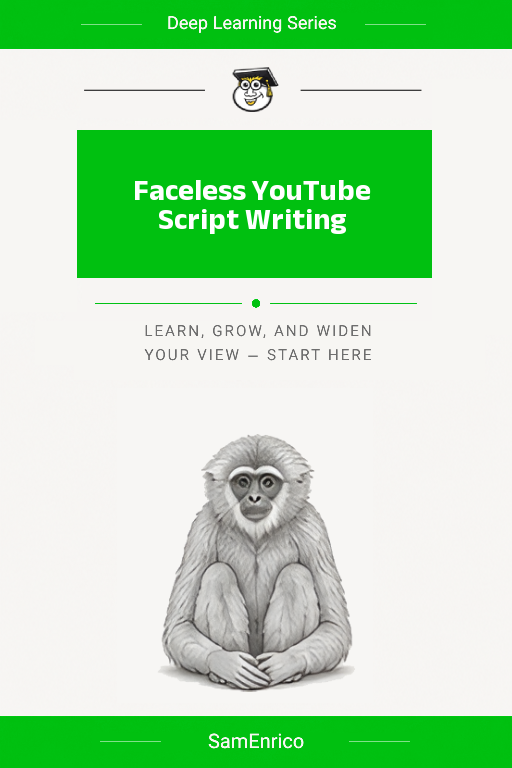
Non-FictionSide Hustle Architect
Faceless YouTube Script Writing eBook
Write engaging scripts for stock footage videos us
Write engaging scripts for stock footage videos using ChatGPT, research hooks, and retention-focused structures.
Formats
Free sample
Chapter 1: The Destination Paradox...--–- Most new You Tube creators sit down to write a script the same way they’d tell a story to a friend. They start at the beginning. They introduce the topic. They set the scene. They build up slowly, carefully, chronologically.
And then they wonder why 70 percent of viewers click away in the first two minutes.This is the single most expensive mistake in faceless You Tube scriptwriting—and it’s almost invisible. You don’t know you’re making it because it feels like the logical way to write. Beginning, middle, end. That’s how stories work, right?Wrong. Not for You Tube.
Not for faceless content. And definitely not for an audience that has fourteen tabs open, a phone in their hand, and a thumb hovering over the “skip” button.The way human beings consume video on You Tube is fundamentally different from how they read a book, watch a movie, or listen to a podcast. On You Tube, the viewer has total control. They can leave at any millisecond. There is no contractual obligation to finish.
There is no teacher grading them. There is no social pressure to stay. They are one slightly boring sentence away from disappearing into a cat video.That reality demands a completely different approach to scriptwriting—one that most creators never learn because they’re too busy copying what “successful” channels look like on the surface instead of reverse-engineering how those scripts are actually constructed.This chapter introduces the single most counterintuitive but powerful technique in faceless You Tube scriptwriting: The Destination Paradox. You will write the ending of your video before you write anything else. Not a rough idea.
Not a vague direction. The actual final sentences that will land in the viewer’s ears at the ten-minute mark. And you will write them first, before the hook, before the introduction, before any research or B-roll planning.This is not how your brain wants to work. Your brain wants to explore, discover, and build toward a conclusion naturally. That instinct is the enemy of retention.The Problem With “Beginning, Middle, End”Let’s run a small experiment.
Imagine you’re watching a faceless documentary video about how a obscure Japanese convenience store chain became a billion-dollar company. The script starts like this:“In 1974, a small grocery store in Tokyo’s Koto district made a decision that would change retail forever. The owner, Masatoshi Ito, had just returned from a trip to the United States where he’d seen something unusual—a store that stayed open 24 hours. At the time, this was considered impossible in Japan. But Ito had an idea…”What’s wrong with this opening?
On the surface, nothing. It’s well-written. It sets a scene. It introduces a character. It creates mild curiosity.
But here’s what the viewer’s brain is actually doing in the first fifteen seconds: asking “Why should I care?”The problem with chronological storytelling on You Tube is that the viewer has no contract with you yet. They don’t know if the payoff is worth the journey. You’re asking them to invest time and attention without giving them any reason to believe the destination matters.Now imagine the same video opens like this:*“By the end of this video, you’ll understand exactly how a single 24-hour convenience store grew into a sixty-billion-dollar empire—and why the founder’s biggest mistake in 1974 was actually the key to everything.”*This version does something the first version cannot. It gives the viewer a destination. They now know what they’re getting.
They can decide, in under five seconds, whether that destination is worth ten minutes of their life. And if they stay, they’re not watching blindly—they’re watching with a mental checklist, waiting for the promise to be fulfilled.That is the core insight of the Destination Paradox: Viewers will only commit to a journey if they trust the destination is worth reaching. And the only way to earn that trust is to show them the destination first.Every great speech, every great sales letter, every great piece of persuasive writing follows this rule. You state your conclusion upfront, then spend the rest of your time proving it. You Tube scripts are no different—except the stakes are higher because the “back” button is one click away.The Two-Pass Method: How to Build Scripts That Don’t Lose Viewers The Destination Paradox is not just a mindset shift.
It’s a specific workflow that I call the Two-Pass Method. This method resolves the apparent contradiction between “write the ending first” and “the hook is the most important part.” Both are true, and they work together when you use the right sequence.Pass One: The Destination Sentence Before you research, before you open Chat GPT, before you think about B-roll or music or voiceover—you write a single sentence. This is your Destination Sentence.The Destination Sentence has a specific, unchangeable structure:“By the end of this video, the viewer will [specific outcome].”The outcome must be:Specific: Not “learn about stoicism” but “understand how to apply stoic principles to a workplace conflict”Tangible: Something the viewer can point to, do, or repeat to someone else Single: One thing, not three things or five steps Here are examples of Destination Sentences for different niches:True Crime: “By the end of this video, the viewer will understand why the police missed the single most important piece of evidence for six weeks.”Finance: “By the end of this video, the viewer will know exactly which three tax deductions they’ve been missing as a freelancer.”Motivational: “By the end of this video, the viewer will be able to identify the one belief that has been silently killing their progress.”History: “By the end of this video, the viewer will understand how a typo in a 1942 memo changed the course of World War II.”Notice what these sentences do not say. They do not say “learn about” or “get an overview of” or “discover the fascinating story of.” Those phrases are weak because they don’t promise a transformation. They promise information.
Information is cheap. Transformation is valuable.Your Destination Sentence is your anchor. Every single sentence you write after this point will either serve the destination or get deleted. There is no middle ground.Pass Two: The Promise Hook Now you have your destination. You know exactly where the viewer will be at the end of the video.
Your second step is to craft a hook that explicitly promises that destination.The Promise Hook is not the same as a “clickbait” title. Clickbait promises something the video doesn’t deliver. The Promise Hook delivers exactly what it promises—but it delivers it in a way that creates immediate curiosity.The formula for a Promise Hook is simple: State the problem, state the solution, and then tell the viewer that the solution is what they’ll get.Example using the finance Destination Sentence above:“Most freelancers leave thousands of dollars on the table every year because they don’t know about three specific tax deductions. I’m going to show you exactly what they are—and exactly how to claim…
This is the end of the free sample. Get the eBook to keep going. Buy now
About this book
Details
- Author
- Harding Mickey
- Publisher
- SamEnrico
- Language
- English
- Genre
- Non-Fiction, Side Hustle Architect
- Released
- 2026-05-29
- Pages (approx.)
- 142
- Available as
- eBook, Audiobook

Read better in the ZLOADR app
Your eBooks on your phone or tablet. Sign in with your SamEnrico account and start reading.
More by Harding Mickey
 Sleep Meditation for AutismHarding Mickey$11.99
 Francis of Assisi Order FoundationHarding Mickey$11.99
 Burnout Support Group GuideHarding Mickey$11.99
 Keto Coffee Bulletproof GuideHarding Mickey$11.99
 The Beethoven Deaf ComposerHarding Mickey$11.99
 The Phantom of the Royal Road: Europe's Last Stagecoach BanditsHarding Mickey$11.99
 Agile vs Waterfall StartupsHarding Mickey$12.99
 Tax SpecialistHarding Mickey$11.99
 Learn to Play the Toba, TowlaHarding Mickey$11.99
 How to Become a Line InspectorHarding Mickey$11.99
You may also like
 Hong Kong Handover 1997Dunn Johnnie$11.99
 Zumba For Postnatal Recovery CourseNeal Christian$11.99
 Zumba for BeginnersLadner Nikia$11.99
 YouTube Comment Mining GuideHumes Pandora$12.99
 Worry Box MeditationCarlin Rudy$11.99
 Workplace Stress MeditationNguyen Lynn$11.99
 Workplace Stress and Sleep RepairHawley Ivory$11.99
 Workplace Perfectionism CureDelaney Jeffry$11.99
 Workplace Injustice Anger GuideWallen Isabelle$11.99
 Work Addiction and Burnout LinkGreenwood Ester$11.99
 Women in Yoga and WellnessBeattie Galina$11.99
 Women in Stand Up ComedyChun Evangeline$11.99