
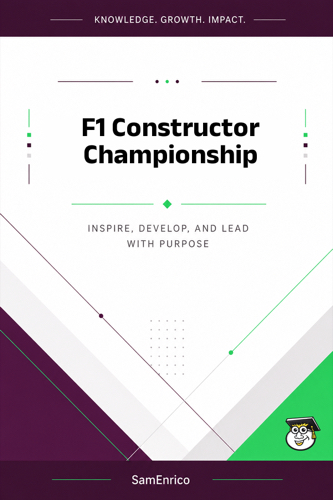
Non-FictionBiographyConstructors
F1 Constructor Championship eBook
Score points for team title alongside drivers.
Score points for team title alongside drivers.
Formats
Free sample
Chapter 1: The Invisible Ledger...–- The radio message comes first. Always. Before the podium champagne, before the podium interviews, before the driver even knows he has won, the first voice in his ear is not the cheering of the crowd. It is the Team Principal, reading numbers. "P1.
Constructor points confirmed. Good work."This is the moment the television cameras never show. The moment when a multi-million dollar season is reduced to a single, cold calculation: how many points did we just add to the column that actually pays the bills?On the final lap of the 2024 Abu Dhabi Grand Prix, while the winning driver performed his donuts and the broadcasters prepared their "championship glory" montages, three separate pit walls were running the same silent calculation. Mc Laren, Ferrari, and Red Bull—each had engineers hunched over laptops, refreshing spreadsheets that did not track lap times. They tracked money.
A 7th-place finish for a team’s second driver, barely noticed by the commentary team, had just been logged. Somewhere in a glass-walled office in Woking, a chief financial officer exhaled. The difference between finishing the season in 2nd versus 3rd in the Constructors’ Championship was not a matter of pride. It was a matter of survival.This chapter destroys the most persistent myth in Formula 1: that the Constructors’ Championship is the "boring" trophy, the consolation prize for factories that couldn't produce a world champion driver. In truth, the Drivers' Championship is a story.
The Constructors' Championship is a balance sheet. And in the modern era of cost caps, sliding-scale testing restrictions, and nine-figure prize money distributions, that balance sheet determines who lives, who dies, and who merely survives to fight another season.The Consolation Prize Myth Ask a casual fan who won the 2021 Formula 1 season, and they will say Max Verstappen. They would be correct—for the Drivers' Championship. Ask the same fan which team won the 2021 season, and many will hesitate. The answer is Mercedes.
But most fans cannot name the Constructor champion for any given year without looking it up. This is not an accident of memory. It is a deliberate narrative choice by the sport's broadcasters, who have spent decades selling the romance of the individual driver over the industrial reality of the team.The myth runs deep: the Constructors' Championship is what happens when your driver didn't win. It is the runner-up prize. The participation trophy for factories.
But this myth collapses under the slightest financial scrutiny.Consider the 2024 season. The difference between finishing 9th and 10th in the Constructors’ standings was approximately $10 million in direct prize money distribution, plus an additional $5-7 million in travel subsidies, entry fee reductions, and FOM (Formula One Management) bonus payments. That is not a consolation prize. That is the difference between hiring an additional 20 engineers or laying off 30. That is the difference between a new wind tunnel program or a season of stagnation.
That is the difference, for a team like Haas or Williams, between survival and administration.The Drivers’ Championship pays the driver's bonus. The Constructors’ Championship pays the factory's rent.A Brief History of Scoring: From Six to Twenty To understand why the Constructors’ Championship has become the sport’s most ruthless financial instrument, one must understand how the scoring system has evolved. The modern fan is accustomed to 25 points for a win, 18 for second, 15 for third, and so on down to a single point for 10th place. This system, introduced in 2010, was designed to reward consistency and depth—to make every position from 1st to 10th matter.But before 1991, the system was radically different. From 1960 to 1990, only the top six finishers scored points: 9, 6, 4, 3, 2, 1.
A driver could finish 7th in every race of a 16-race season and score zero points. A constructor could field two cars, see both finish 7th and 8th every weekend, and walk away with nothing. The Constructors’ Championship in that era was an afterthought—a secondary tally calculated by the FIA almost as an administrative courtesy.The shift began in 1991, when the system expanded to award points down to 6th place (10, 6, 4, 3, 2, 1). Then in 2003, the system changed again: 10, 8, 6, 5, 4, 3, 2, 1 down to 8th place. Finally, in 2010, the current 25-point system was introduced, expanding the points-paying positions to 10th place.Each expansion was met with resistance from traditionalists who argued that "only winners deserve points." Each expansion was followed by a predictable outcome: the midfield teams fought harder, invested more, and the Constructors’ standings became tighter, more competitive, and more financially consequential.The 2021 introduction of the Sprint format added another layer.
Sprint races (8 points for 1st down to 1 point for 8th) meant that a team could now score points on Saturday and Sunday. A single mistake—a crash in Sprint qualifying—could cost a constructor points in two separate sessions, compounding the damage. By 2024, a constructor could theoretically score 59 points across a single weekend (25 for the GP win, 8 for the Sprint win, 25 for the other driver finishing 2nd in the GP, and 1 for the other driver finishing 8th in the Sprint). The ceiling had risen. So had the cost of failure.The Mathematics of Survival: P1 to P20The chapter’s key concept—P1 to P20: Every position has a price—requires a clear distinction between two different financial models: the point value of a finishing position and the prize money value.Point value is simple: 25 points for 1st, 18 for 2nd, 15 for 3rd, 12 for 4th, 10 for 5th, 8 for 6th, 6 for 7th, 4 for 8th, 2 for 9th, 1 for 10th.
Positions 11 through 20 pay zero points. The marginal point difference between positions is not linear. The jump from 1st to 2nd is a 7-point swing. The jump from 9th to 10th is a 1-point swing. This non-linear distribution rewards the sharp end of the grid disproportionately.Prize money value is more complex.
The Formula One Group distributes approximately $1 billion annually to the ten constructors, divided into several "columns":Column 1 (Historical Bonus): Paid to teams that have been in the sport for a certain period (Ferrari receives a substantial legacy payment).Column 2 (Performance Bonus): Distributed based on Constructors’ standings. This is where the P9 vs. P10 difference becomes stark.Column 3 (Loyalty Bonus): Based on consecutive seasons of participation.Column 4 (Constructor Bonus): A flat payment to all teams.For a midfield team like Haas or Williams, the Column 2 performance bonus is the primary lever they can actually influence. And the difference between finishing 9th and 10th in Column 2 is approximately $10 million. That is not a per-point figure.
It is a *lump-sum gap between finishing positions*. A single point that moves a team from 10th to 9th is worth $10 million. A point that moves a team from 8th to 7th is worth less, because the prize money curve flattens at the upper midfield. A point scored by a championship-contending team (say, Ferrari moving from 2nd to 1st) is worth tens of millions more—but those teams are rarely fighting for single points.The chapter includes a simplified table (fully detailed in the Appendix):Constructors’ Position Approximate Column 2 Prize Money Marginal Gain from Previous Position1st$140 million-2nd$115 million$25 million3rd$95 million$20 million4th$80 million$15 million5th$68 million$12 million6th$58 million$10 million7th$49 million$9 million8th$41 million$8 million9th$34 million$7 million10th$24 million$10 million Note the anomaly: the jump from 10th to 9th is $10 million…
This is the end of the free sample. Get the eBook to keep going. Buy now
About this book
Details
- Author
- Patton Sherri
- Publisher
- SamEnrico
- Language
- English
- Genre
- Non-Fiction, Biography, Constructors
- Released
- 2026-06-09
- Pages (approx.)
- 134
- Available as
- eBook, Audiobook

Read better in the ZLOADR app
Your eBooks on your phone or tablet. Sign in with your SamEnrico account and start reading.
More by Patton Sherri
 Hippocampus Sleep ReplayPatton Sherri$11.99
 Vince Gill High LonesomePatton Sherri$11.99
 Eating Disorder Therapy AccessPatton Sherri$11.99
 Second Generation Code SwitchingPatton Sherri$11.99
 Relationship Stress DetoxPatton Sherri$11.99
 Anger and Emotional FloodingPatton Sherri$11.99
 Disulfiram Safety ProtocolPatton Sherri$11.99
 The Great Train Robbery of 1855: The Mastermind and the Missing GoldPatton Sherri$11.99
 The Healing Hands of Abubakari II: Surgeon to the Kings of MaliPatton Sherri$11.99
 Understanding Corticobasal DegenerationPatton Sherri$11.99
 How to Start a Hobby in ClassicalPatton Sherri$11.99
 How to Produce Shower ColumnsPatton Sherri$11.99
You may also like
 Hong Kong Handover 1997Dunn Johnnie$11.99
 Zumba For Postnatal Recovery CourseNeal Christian$11.99
 Zumba for BeginnersLadner Nikia$11.99
 YouTube Comment Mining GuideHumes Pandora$12.99
 Worry Box MeditationCarlin Rudy$11.99
 Workplace Stress MeditationNguyen Lynn$11.99
 Workplace Stress and Sleep RepairHawley Ivory$11.99
 Workplace Perfectionism CureDelaney Jeffry$11.99
 Workplace Injustice Anger GuideWallen Isabelle$11.99
 Work Addiction and Burnout LinkGreenwood Ester$11.99
 Women in Yoga and WellnessBeattie Galina$11.99
 Women in Stand Up ComedyChun Evangeline$11.99