
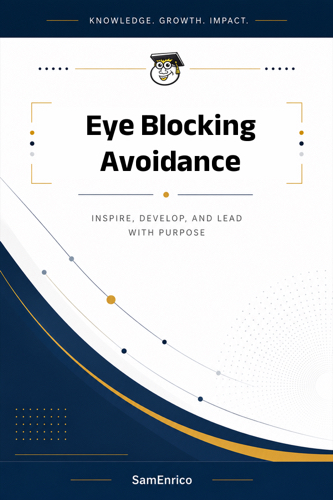
Eye Blocking Avoidance eBook
Closing eyes briefly signals discomfort or disbeli
Closing eyes briefly signals discomfort or disbelief.
Formats
Free sample
Chapter 1: The Honest Lie--–- In 1977, a young woman walked into a police station in Seattle. She was shaking. Her clothes were disheveled. Tears streamed down her face. She reported being kidnapped and sexually assaulted by a man who had picked her up while she was hitchhiking.
She provided detailed descriptions: the car was a brown sedan with a dented rear bumper, the man had a scar above his left eyebrow, he drove her down a specific back road, he said specific things that she remembered verbatim. Her story was coherent. Her distress seemed genuine. The police launched a full investigation.But the lead detective noticed something strange. Every time he asked about the man's car—the color, the model, the license plate—the woman closed her eyes.
Not a normal blink. A closure that lasted two or three seconds. A moment where she seemed to retreat inward, as if she was trying to make the question disappear. He had asked hundreds of witnesses about hundreds of crimes. He had seen people search their memories before.
They would look up, or away, or squint. They did not close their eyes like this. Not repeatedly. Not every single time the car came up.He kept asking. She kept closing her eyes.
Eventually, after hours of questioning, she confessed. She had made the whole story up. There was no kidnapping. There was no assault. There was no brown sedan, no scar, no back road.
Her eye closures had nothing to do with memory retrieval. They were her limbic system's attempt to block out the discomfort of lying. The detective did not know the term "eye blocking." He had never read a book about nonverbal communication. But he knew something was wrong because her eyes told him so.This book is about teaching you to see what that detective saw. It is about a specific, powerful, and reliable nonverbal signal that most people miss entirely.
It is about the brief closing of the eyes—what body language experts call eye blocking—and what it reveals about discomfort, disbelief, disagreement, and sometimes even trust. By the time you finish this chapter, you will understand why your body cannot lie, why your eyes are the most honest part of your face, and why the simple act of closing them for a moment longer than a blink is one of the most important signals you have been ignoring.The Two Conversations Every conversation you have ever had was actually two conversations happening simultaneously. The first conversation is spoken. It consists of words, sentences, arguments, questions, and promises. You are aware of this conversation.
You participate in it consciously. You choose your words (mostly) and you listen to theirs (sometimes). This is the conversation we have been trained to value since childhood.The second conversation is silent. It consists of gestures, postures, facial expressions, and eye movements. Most people are barely aware of this conversation.
They sense it vaguely—a feeling that something is off, a gut instinct that someone is not being honest, a vague discomfort they cannot articulate. But they cannot name what they are seeing because they have never been taught the language. The silent conversation is governed by ancient brain structures that react faster than conscious thought. It leaks truth before we have time to craft a lie. It is often more honest than the spoken conversation.Here is what makes the silent conversation so valuable: the brain structures that produce spoken language are also the brain structures that allow us to lie.
The neocortex, where language and rational thought reside, can fabricate stories, conceal motives, and present a false self to the world. But the limbic system—the ancient core of the brain responsible for emotional processing and survival—does not have that ability. It reacts to stimuli in milliseconds, producing facial expressions, eye movements, and postural shifts before the neocortex can intervene. By the time you have decided whether to tell the truth or lie, your limbic system has already broadcast your genuine emotional state to anyone who knows how to look.This book focuses on one specific signal from that silent conversation: the brief closing of the eyes. Former FBI agent Joe Navarro, who spent twenty-five years observing and interrogating spies, describes eye blocking as one of the most reliable indicators of psychological discomfort we possess.
When someone closes their eyes for longer than a blink, they are unconsciously trying to block out a person, a statement, or a situation that causes them distress. It is a freeze response of the eyes. It is fast, involuntary, and honest. And most people never notice it.The Limbic System: Your Honest Brain To understand why eye blocking is so reliable, you need to understand the brain that produces it. The limbic system is not a single structure but a network of structures deep within the brain, including the amygdala, the hippocampus, and the hypothalamus.
Its primary job is survival. It constantly scans your environment for threats, rewards, and opportunities. And it reacts with incredible speed—much faster than your conscious mind.When you see something threatening, your limbic system triggers a reaction in milliseconds. Your heart rate increases. Your muscles tense.
Your pupils dilate. You do not decide to do these things. They happen to you. When you hear something you do not want to believe, your limbic system produces a facial expression of disbelief before you have time to suppress it. You may quickly replace it with a neutral or pleasant expression, but the flash of disbelief was real.
It was honest. It was your limbic system telling the truth.Joe Navarro, who spent decades observing people under the most stressful conditions imaginable, emphasizes that the most reliable nonverbal signals come from the oldest parts of our nervous system. He describes three primary limbic responses to threat: freeze, flight, and fight. Freeze occurs when we suddenly stop moving, hoping to go unnoticed. Flight involves physical distancing—leaning away, turning the feet toward an exit.
Fight is the most obvious, involving aggressive postures and gestures.Eye blocking belongs to the freeze response. When we close our eyes, we are attempting to block out a visual stimulus that our limbic system has identified as threatening. This behavior is so hardwired that even children who are born blind will cover their eyes when they hear something unpleasant. They have never seen anyone cover their eyes. They have no visual model to imitate.
Yet they do it anyway, because the behavior is not learned. It is instinctive. It is programmed into the oldest parts of the human brain.Think about that for a moment. A behavior that appears in blind children who have never seen it demonstrated is not a social convention. It is not a cultural norm.
It is a biological imperative. When your limbic system detects a threat, it tries to block it out. And one of the fastest ways to block out a visual threat is to close the eyes. This is why eye blocking is so reliable. It is not something we decide to do.
It is something that happens to us.The Vendor of Deception There is a persistent myth that you have almost certainly…
This is the end of the free sample. Get the eBook to keep going. Buy now
About this book
Details
- Author
- Passmore Katheleen
- Publisher
- SamEnrico
- Language
- English
- Genre
- Non-Fiction, Self-Help, Eye Blocking
- Released
- 2026-06-11
- Pages (approx.)
- 122
- Available as
- eBook, Audiobook

Read better in the ZLOADR app
Your eBooks on your phone or tablet. Sign in with your SamEnrico account and start reading.
More by Passmore Katheleen
 Self Hypnosis for Multiple Sclerosis PainPassmore Katheleen$11.99
 Anger at Childs TherapistPassmore Katheleen$11.99
 Career Transition After LayoffPassmore Katheleen$11.99
 Self Esteem for TeachersPassmore Katheleen$11.99
 Brainwriting Pool GuidePassmore Katheleen$11.99
 Design Thinking for Urban PlannersPassmore Katheleen$11.99
 Conversation Starters for Dog ParksPassmore Katheleen$11.99
 Whispers of the Forgotten: The Lost Empire of MuPassmore Katheleen$11.99
 The Spy in the Cockpit: How a Pilot’s Betrayal Crashed a Commercial JetPassmore Katheleen$11.99
 How to Become a Group-sales RepresentativePassmore Katheleen$11.99
 Launching A Youtube Channel For Your Brand ImplementationPassmore Katheleen$12.99
 Islamic Development Bank GuidePassmore Katheleen$12.99