
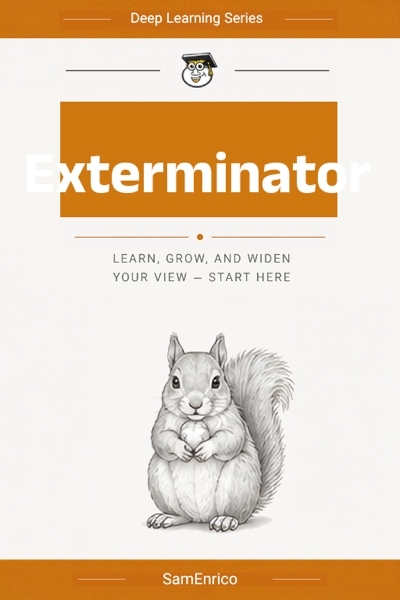
Non-FictionInformativeEducational
Exterminator eBook
A Coursebook on Exterminator
A Coursebook on Exterminator
Formats
Free sample
Chapter 1: The Exterminator’s Paradox...--The man who calls himself an exterminator walks into a kitchen at 6:47 on a Tuesday morning. He carries a flashlight, a small mirror on a telescoping rod, a clipboard, and a single gel bait gun. He wears white Tyvek booties over his work boots and blue nitrile gloves. He does not carry a fogger. He does not carry a compressed air sprayer filled with poison.
He does not carry the assumption that he already knows what he will find.This is the first lesson of this book, and if you learn nothing else, learn this: the exterminator who arrives with a plan to kill is already defeated. The exterminator who arrives with a plan to understand is the one who gets called back next month for a renewal contract.The woman who owns the kitchen—she runs a small bakery out of a converted garage, sells sourdough at the weekend farmers’ market—meets him at the back door. She is anxious, embarrassed, apologetic. “I think it’s roaches,” she says. “My sister saw one last week.
I’ve already sprayed twice with stuff from the hardware store, the aerosol cans, but they keep coming back. I’m so sorry. I keep this place so clean.”The exterminator nods. He does not say what he is thinking, which is that the hardware store sprays are mostly pyrethroids, that pyrethroids have been losing effectiveness against German cockroaches for twenty years, that the “stuff from the hardware store” has a repellent effect that will have scattered the roaches deeper into the walls, and that the bakery is not clean—not because the baker is lazy, but because cleanliness and sanitation are not the same thing. Clean is what you see.
Sanitation is what you don’t.He kneels beside the dishwasher. He pulls out the kick plate. He shines his flashlight into the gap between the bottom of the machine and the floor.There they are.Not dozens. Hundreds. German cockroaches, Blattella germanica, the most successful indoor pest species on the planet.
Adults with two dark parallel stripes running down their pronotums, like racing stripes on a tiny brown car. Nymphs, smaller and darker, scuttling away from the light. Egg cases—oothecae—protruding from the abdomen of a gravid female. The exterminator counts five oothecae in his field of view. Each contains approximately thirty to forty eggs.
Each egg will become a nymph in twenty-eight days at this temperature. The math is not comforting.The baker gasps. “Oh my God. How long has that been there?”The exterminator stands up. He does not look disgusted.
He does not look triumphant. He looks, if anything, thoughtful. “That’s not the right question,” he says. “The right question is: why are they here? What are they eating?
What are they drinking? Where are they hiding? Answer those questions, and we don’t have a roach problem. We have a roach history.”This is the Exterminator’s Paradox, and it will be the central argument of this entire book: The more you try to control nature through force alone, the less control you actually have. The more you seek to understand nature’s patterns, the more power you gain to redirect them.The exterminator in this story is not real.
She is a composite, drawn from a hundred technicians I have trained, supervised, and learned from over fifteen years in the structural pest management industry. But the paradox she embodies is real. It is the difference between the technician who gets called back every month to spray again and the one who solves the problem in two visits and gets referrals for years. It is the difference between the homeowner who spends $500 on aerosol cans and the one who spends $200 on a professional inspection and a tube of caulk. It is the difference between this book and every other pest control manual you have ever seen.Those manuals will teach you how to kill.
This book will teach you when to kill, why to kill, and—most importantly—when not to kill. Those manuals will give you chemical lists and application rates. This book will give you those things, yes, because you need them to pass your licensing exam. But this book will also give you something those manuals are afraid to give you: a philosophy of eradication that admits eradication is almost never the answer.Welcome to The Exterminator: A Coursebook on Control, Chaos, and Eradication. If you are a student preparing for your 7A certification exam, you will find everything you need in these pages: entomology, pesticide chemistry, calibration math, IPM protocols, business law, safety procedures.
But if you are also a human being who has ever wondered why your efforts to fix a problem only made it worse—whether that problem was cockroaches or clutter, debt or dysfunction—you will find something else here. You will find a way of thinking that applies to everything you will ever try to fix.Let us begin.The Two Faces of the Exterminator Every profession has its foundational tension. For doctors, it is between curing and comforting. For lawyers, between justice and victory. For exterminators, the tension is between two archetypes that pull in opposite directions but must be held together in the same mind and the same pair of work boots.The first archetype is the Technician.
This is the exterminator as applied scientist. The Technician memorizes the life cycle of the German cockroach (egg to nymph to adult in fifty days under ideal conditions). The Technician knows that subterranean termites need contact with soil moisture and that drywood termites do not. The Technician can calibrate a backpack sprayer to deliver exactly one gallon per thousand square feet, can read a pesticide label and understand the difference between “Caution,” “Warning,” and “Danger,” can don a respirator and inspect a crawlspace without panicking at the spiders. The Technician is disciplined, methodical, evidence-based.
The Technician passes exams.The second archetype is the Critical Thinker. This is the exterminator as detective, philosopher, and occasionally troublemaker. The Critical Thinker asks why the roaches are in the dishwasher and not the oven. The Critical Thinker notices that the customer has seventeen half-empty bags of dog food stored in the garage and that the bags are all gnawed at the corners. The Critical Thinker reads a pesticide label and wonders: Who wrote this?
What assumptions did they make? What risks did they downplay? The Critical Thinker is skeptical of easy answers, resistant to the chemical industry’s marketing, and willing to tell a customer that their house is the problem—not the pests. The Critical Thinker does not always pass exams on the first try, because exams test knowledge, not wisdom. But the Critical Thinker is the one who gets called back.Most pest control training focuses exclusively on the Technician.
You will memorize the life cycle of the cockroach. You will learn the LD50 of bifenthrin. You will practice calibration math until your calculator battery dies. All of that is necessary. None of it is sufficient.Because here is the truth that the chemical companies do not want you to know: you can be the most…
This is the end of the free sample. Get the eBook to keep going. Buy now
About this book
Details
- Author
- Velasquez Chung
- Publisher
- SamEnrico
- Language
- English
- Genre
- Non-Fiction, Informative, Educational
- Released
- 2026-06-02
- Pages (approx.)
- 156
- Available as
- eBook, Audiobook

Read better in the ZLOADR app
Your eBooks on your phone or tablet. Sign in with your SamEnrico account and start reading.
More by Velasquez Chung
 Travel Story StartersVelasquez Chung$11.99
 Lewis Recommended ReadingVelasquez Chung$11.99
 Causal vs Hardcore SpendingVelasquez Chung$11.99
 MBSR for Teachers GuideVelasquez Chung$11.99
 Body Scan For Social AnxietyVelasquez Chung$11.99
 The Storming of Taiwan: Kangxi's Naval Gambit (1683)Velasquez Chung$11.99
 Financial Services One Page PlanVelasquez Chung$12.99
 Co op Work for Express EntryVelasquez Chung$12.99
 Understanding Pulmonary AgenesisVelasquez Chung$17.99
 How to Become a Oil-pipe-inspector HelperVelasquez Chung$11.99
You may also like
 Hong Kong Handover 1997Dunn Johnnie$11.99
 Zumba For Postnatal Recovery CourseNeal Christian$11.99
 Zumba for BeginnersLadner Nikia$11.99
 YouTube Comment Mining GuideHumes Pandora$12.99
 Worry Box MeditationCarlin Rudy$11.99
 Workplace Stress MeditationNguyen Lynn$11.99
 Workplace Stress and Sleep RepairHawley Ivory$11.99
 Workplace Perfectionism CureDelaney Jeffry$11.99
 Workplace Injustice Anger GuideWallen Isabelle$11.99
 Work Addiction and Burnout LinkGreenwood Ester$11.99
 Women in Yoga and WellnessBeattie Galina$11.99
 Women in Stand Up ComedyChun Evangeline$11.99