
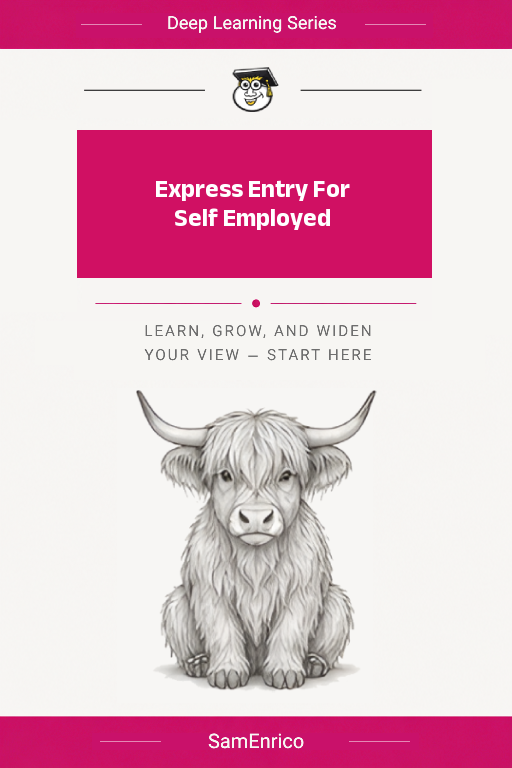
Express Entry For Self Employed eBook
Qualify for Express Entry through self-employed wo
by Slater Paz
Qualify for Express Entry through self-employed work in Canada after graduation.
Formats
Free sample
Chapter 1: The $50,000 Illusion--–- Priya checked her Express Entry profile for the forty-seventh time. The screen hadn’t changed. Her Comprehensive Ranking System score remained frozen at 412—far below the 520+ cutoff that had become the new normal for general draws. She had two years of Canadian work experience. A master’s degree from a respected Toronto university.
Perfect English scores. And yet, her profile was telling her she was invisible.The problem wasn’t her skills, her education, or her language ability. The problem was how she had chosen to work. Priya had graduated three years ago with a degree in marketing and immediately launched herself into the gig economy. She built a thriving freelance SEO consulting business.
She had twelve regular clients, most of them small Canadian e-commerce brands. She earned $85,000 in her second year—more than most of her classmates who had taken traditional salaried jobs. She paid her taxes. She filed her T2125 forms. She did everything right.Except one thing.
She had assumed that “Canadian work experience” meant work performed while physically sitting in Canada. And that assumption cost her two years of immigration eligibility.Priya’s story is not unique. It is the most expensive mistake being made by international graduates in Canada today. And this book is designed to ensure you do not make the same error.The Core Deception The Canadian Experience Class (CEC) was created in 2008 to help temporary foreign workers and international graduates transition to permanent residency. The logic was simple: if you have already integrated into the Canadian workforce, you should have an easier path to staying permanently.
On paper, this makes perfect sense.But there is a catch hidden in the regulatory language—a catch that most immigration consultants either do not understand or do not bother to explain.Section 87.1(3) of the Immigration and Refugee Protection Regulations explicitly states that for the purpose of CEC, “work experience” means employment in an occupation that is listed in TEER Category 0, 1, 2, or 3 of the National Occupational Classification, where the employment was pursuant to a contract of employment between the foreign national and an employer in Canada.That phrase—“contract of employment”—is the knife that cuts freelancers out of CEC.A contract of employment, in Canadian law, implies an employer-employee relationship. It requires that the employer controls the worker’s activities, provides the tools and equipment, determines the hours and location of work, and remits payroll deductions (Canada Pension Plan, Employment Insurance, and income tax) directly to the Canada Revenue Agency.A self-employed person has none of these characteristics. You control your own hours. You use your own laptop. You invoice multiple clients.
You pay your own taxes through installments or when you file. You are, in the eyes of the law, a business owner, not an employee.And IRCC treats those two categories very differently.The Regulatory Wall Let me read you the exact language from IRCC’s operational manual for the Canadian Experience Class (OP 25-B, Section 6.2):“Self-employment and work experience gained while the applicant was a full-time student (including co-op work terms and internships that were part of the curriculum) does not count toward the work experience requirement for the Canadian Experience Class. This is because self-employment is not employment pursuant to a contract of employment, and work performed as a full-time student is not considered to be full-time work in the labor market.”This rule has been in place since 2013. It is not new. It is not a secret.
And yet, thousands of international graduates discover it every year—only after they have already invested years of their lives building a freelance career that IRCC refuses to recognize.Priya discovered this rule when she hired a consultant after two years of freelancing. The consultant charged her $300 for a “profile assessment” and delivered the bad news in a fifteen-minute phone call. Her two years of self-employment were worthless for CEC. She would need to start over—either by finding a traditional salaried job for twelve months, or by abandoning CEC altogether and trying a different immigration stream.Priya cried. Then she got angry.
Then she found a different consultant—one who specialized in self-employed applicants—and learned the truth that this book will teach you: Your self-employment is not worthless. It is just worthless for the wrong program.The Physician Exception Before you give up hope entirely, let me show you an exception that proves the rule—and teaches you everything you need to know about how IRCC thinks.Physicians in Canada are often self-employed. They work in fee-for-service arrangements with provincial health authorities. They bill for each patient seen, each procedure performed. They pay their own overhead.
They hire their own staff. They are, in every meaningful sense, self-employed.And yet, IRCC allows self-employed physicians to count their work for CEC.Why? Because the regulatory exclusion for self-employment contains an implicit exception for “regulated health professionals who work in fee-for-service arrangements with a provincial health authority.” IRCC has determined that these physicians are not “truly” self-employed because they cannot operate independently of the health system—they must follow provincial rules, accept provincial rates, and cannot refuse patients arbitrarily.This exception is narrow. It applies almost exclusively to physicians and dentists in fee-for-service arrangements. But it reveals something crucial about IRCC’s reasoning: What matters is not whether you call yourself self-employed.
What matters is whether the structure of your work resembles an employment relationship.For physicians, the provincial health authority acts as a single client that controls the terms of work. For you, the question is different: Can you structure your freelance work so that it resembles employment for immigration purposes? The answer, as you will see in Chapter 4, is yes—but not for CEC. For FSWP.The Reframe Here is the single most important sentence in this book:Stop trying to force your Canadian freelance work into the Canadian Experience Class. It will never work.
Instead, treat your Canadian-based freelance work as “foreign work experience” for the Federal Skilled Worker Program.This reframe changes everything.CEC cares about where you worked. It requires a Canadian employer. FSWP cares about what you did and for whom. It does not care where you were physically located when you did it.Let me repeat that: The Federal Skilled Worker Program does not require you to have a Canadian employer. It does not require you to have worked in Canada.
It only requires that your work experience was legal, continuous, and in a skilled occupation.And here is the kicker: If you worked remotely from Canada for a client in the United States, the United Kingdom, Australia, or any country other than Canada, that work experience is classified as foreign work experience for FSWP purposes—even though you were sitting in a Toronto apartment while you did it.Your physical location does not determine the classification. The client’s location does.How This Book Works This book is divided into four parts, each building on the last.Part I: The Myth & The Strategy (Chapters 1-2) lays the foundation. Chapter 1 (this chapter) explains why your Canadian freelance work doesn’t count for CEC and introduces the reframe toward FSWP. Chapter 2 walks you through the FSWP eligibility…
This is the end of the free sample. Get the eBook to keep going. Buy now
About this book
Details
- Author
- Slater Paz
- Publisher
- SamEnrico
- Language
- English
- Genre
- Non-Fiction, Student's Shortcut
- Released
- 2026-06-01
- Pages (approx.)
- 150
- Available as
- eBook, Audiobook

Read better in the ZLOADR app
Your eBooks on your phone or tablet. Sign in with your SamEnrico account and start reading.
More by Slater Paz
 Writing Platform Comparison GuideSlater Paz$11.99
 Gambling Employment Risk GuideSlater Paz$11.99
 Financial Stress And Tax Anxiety GuideSlater Paz$11.99
 Cultural Trauma Dream ThemesSlater Paz$11.99
 Henry Ford BiographySlater Paz$11.99
 Imposter Syndrome And Childhood TraumaSlater Paz$11.99
 The Parent as Therapist ChildSlater Paz$11.99
 The Booster Shot ScheduleSlater Paz$11.99
 Secondary Infertility After LossSlater Paz$11.99
 Caesar and Pompey: The Blood Feud That Shattered RomeSlater Paz$11.99
 The Last Dive: The Unsinkable Truth of the USS ScorpionSlater Paz$11.99
 The Great Space Potato Rescue: How Scientists Saved a Cosmic Spud!Slater Paz$11.99
You may also like
 Hong Kong Handover 1997Dunn Johnnie$11.99
 Zumba For Postnatal Recovery CourseNeal Christian$11.99
 Zumba for BeginnersLadner Nikia$11.99
 YouTube Comment Mining GuideHumes Pandora$12.99
 Worry Box MeditationCarlin Rudy$11.99
 Workplace Stress MeditationNguyen Lynn$11.99
 Workplace Stress and Sleep RepairHawley Ivory$11.99
 Workplace Perfectionism CureDelaney Jeffry$11.99
 Workplace Injustice Anger GuideWallen Isabelle$11.99
 Work Addiction and Burnout LinkGreenwood Ester$11.99
 Women in Yoga and WellnessBeattie Galina$11.99
 Women in Stand Up ComedyChun Evangeline$11.99