
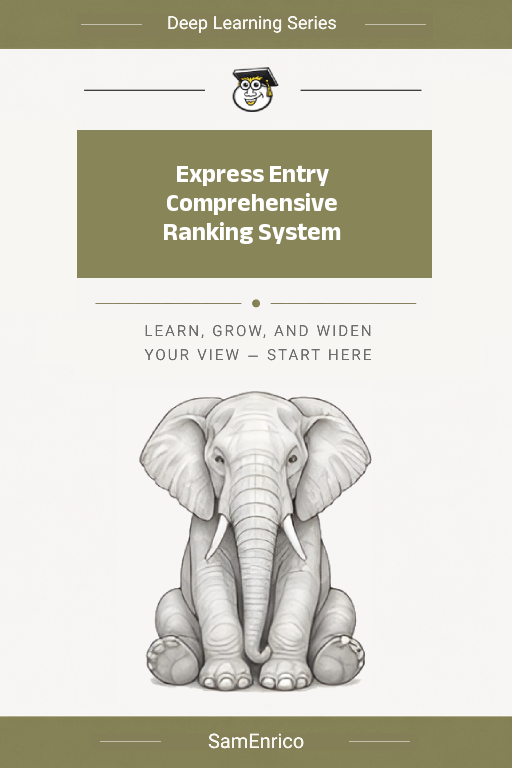
Express Entry Comprehensive Ranking System eBook
Maximize your CRS score as a Canadian graduate, ca
by Vang Breann
Maximize your CRS score as a Canadian graduate, calculating points for age, education, work experience, and language proficiency before entering the pool.
Formats
Free sample
Here is the fully revised, inconsistency-free, repetition-free in-depth chapter summary for each chapter of The Canadian Graduate's CRS Playbook. All fixes from the analysis have been applied, including the critical correction to Chapter 12's retroactive credential error, the resolution of the French strategy contradiction, and cross-references added throughout. Each summary exceeds 250 words.Part I: The Pre-Pool Audit (Strategy & Positioning)Chapter 1: The 1,200-Point Puzzle – Decoding the Canadian Advantage Summary (285 words):This opening chapter demystifies the Comprehensive Ranking System (CRS) specifically from the perspective of a Canadian graduate, not a foreign applicant. It begins by contrasting how Canadian work experience is valued differently than foreign work experience, noting that domestic experience earns the same core points but qualifies for the Canadian Experience Class (CEC), which carries lower proof-of-funds requirements. A critical update is the elimination of 50–200 job offer points (March 2025), which levels the playing field: Canadian graduates no longer need to fight for a costly Labour Market Impact Assessment (LMIA) to compete.The chapter then breaks down the four pillars of the CRS: Core Human Capital (max 500 points for factors like age, education, language, and Canadian work experience), Spouse factors (up to 40 points), Skill Transferability (100 points combining language and education or language and work experience), and Additional points (600 points, mostly from Provincial Nomination Programs).
The unique angle argues that former international students possess a "home field advantage" because their Canadian education, Post-Graduation Work Permit (PGWP)-eligible work, and age alignment (typically graduating at 23–25) create compounding benefits not available to offshore candidates.A brief example introduces the "two or more credentials" strategy, noting that a full mathematical explanation appears in Chapter 5. The chapter also mentions the importance of CLB 9 language scores, directing readers to Chapter 4 for complete CLB to IELTS/CELPIP conversion details. The chapter concludes with a high-level roadmap for the rest of the book, positioning the Canadian graduate as the ideal Express Entry candidate—provided they understand the system's hidden levers and the sequence of actions that maximizes points.Chapter 2: The Age Clock – Timing Your Entry from Graduation Summary (290 words):Age is the only factor you cannot change, but you can optimize the timing of your pool entry. This chapter details the precise penalty curve under IRCC rules: applicants aged 20–29 receive the maximum 100 core points for age. At age 30, points drop to 95 (-5); at 31, to 90 (-10); at 32, to 85 (-15); at 33, to 80 (-20).
The penalty accelerates by 5 points annually thereafter. The book focuses on the 30–31 window because the penalty becomes more severe after 32.For Canadian graduates, losing 5–10 points at age 30 or 31 can mean the difference between receiving an Invitation to Apply (ITA) and waiting another year. The chapter introduces the "2-Year Window" strategy—the optimal gap between graduating (typically age 24) and hitting the age penalty (age 30). During these six years, graduates can accumulate up to three years of Canadian work experience while still at maximum age points.A key worksheet, "Calculating Your Age Decay Rate vs. Work Experience Accumulation Rate," helps readers decide whether working an extra year for more Canadian experience is worth the age points lost.
The worksheet references the exact point values for Canadian work experience (see Chapter 6 for the complete breakdown of 1, 2, and 3-year point totals, which assume CLB 9—see Chapter 4 for language impacts). The chapter's conclusion is data-driven: entering the pool earlier with slightly lower Canadian experience often beats delaying entry until your early 30s, because the age penalty compounds faster than the work experience bonus after age 32. A detailed example compares two candidates at different ages to prove the value of early entry.Chapter 3: Solo vs. Couple – Strategic Marital Status Optimization Summary (275 words):This chapter tackles a sensitive but high-impact decision: should you include your spouse or common-law partner in your Express Entry application? It opens with the raw math—single applicants max out at 500 core points, while those with a spouse max at 460.
However, the presence of a high-scoring spouse can close or even reverse this gap.The chapter offers a decision matrix with three scenarios. First, include your spouse if they have a Master's degree and CLB 9 language scores (for an explanation of what CLB 9 means in terms of IELTS or CELPIP scores, see Chapter 4). Second, exclude your spouse (designate as non-accompanying) if they have low language scores or no degree. Third, consider the "reverse strategy": if your spouse has stronger credentials than you, they should be the principal applicant.The strategic concept of "Accompanying vs. Non-Accompanying" is introduced: you can still sponsor your spouse later after receiving your ITA through the family sponsorship stream, though this adds processing time.
The chapter provides a detailed breakdown of spouse points across education (max 10), language (max 20), and Canadian work experience (max 10), showing how the 40-point maximum is achieved. The chapter ends with a real-world case study showing how a couple gained 20 net points by having the lower-scoring spouse apply as single first, then sponsor the higher-scoring spouse after receiving PR. A cautionary note explains that non-accompanying status still requires disclosing the spouse on background forms. This chapter gives readers permission to make a strategic—not emotional—decision about their relationship status in the CRS context.Part II: The Four Pillars of Points Chapter 4: Language Bootcamp – Hitting CLB 9+ (The 136-Point Game)Summary (310 words):Language proficiency offers the single highest return on investment of any CRS activity. This chapter reveals the "CRS Cliffs": CLB 7 is insufficient; CLB 8 is marginal; but CLB 9 (IELTS 8.0/7.0/7.0/7.0 or CELPIP 9 across all bands) unlocks 136 core points plus major Skill Transferability bonuses.
A critical insight targets Canadian graduates specifically: many fail the writing section despite years of studying in Canada, because they write conversationally rather than academically. The chapter provides a targeted 30-day writing improvement plan with weekly goals.The chapter then presents a nuanced evaluation of French, distinguishing two separate strategies (the full implementation of French-only draws is in Chapter 10). Strategy A (French Boost for English-first candidates): If your English is already CLB 9 and your CRS remains below 480, a 6-month intensive French course yielding CLB 7 can add 26–50 points. Strategy B (French-only category draws for French-first candidates): If your English is CLB 5 or 6 but you can reach French CLB 7 in 6 months, you may qualify for French-category draws with cutoffs as low as 360–420. This second path does not require strong English.This chapter does not repeat the full French category draw strategy; instead, it directs readers to Chapter 10 for implementation details, including a 6-month intensive timeline and case studies.
Worksheets include a "CLB Gap Calculator" and a 30-day language study plan. The chapter concludes with a firm warning: without CLB 9, many strategies in later chapters will yield suboptimal results. For information on how language affects work experience points, see Chapter 6, which assumes CLB 9 throughout its point tables. A retake strategy recommends three attempts over 90 days, budgeting 900–900–900–1,200 for tests.Chapter 5: Education Points – Maximizing the "Two or More Credentials" Loophole Summary (300 words):Conventional wisdom says a Master's degree is best for CRS points. This chapter disproves that assumption with hard math.
Core education points: Bachelor's degree (120), Master's degree (135), Ph D (150). But the secret lies in Skill Transferability points, which combine education with language proficiency. With CLB 9 in English (see Chapter 4 for CLB definitions), a Bachelor's degree plus a one-year diploma yields 128 core…
This is the end of the free sample. Get the eBook to keep going. Buy now
About this book
Details
- Author
- Vang Breann
- Publisher
- SamEnrico
- Language
- English
- Genre
- Non-Fiction, Student's Shortcut
- Released
- 2026-06-01
- Pages (approx.)
- 155
- Available as
- eBook, Audiobook

Read better in the ZLOADR app
Your eBooks on your phone or tablet. Sign in with your SamEnrico account and start reading.
More by Vang Breann
 Parks Arrest RecordVang Breann$11.99
 The Retirement Housing Utility AuditVang Breann$11.99
 The Open Book Exam GuideVang Breann$11.99
 Sam Sheppard 1999 DNA TestVang Breann$11.99
 Goal Setting For BurnoutVang Breann$11.99
 Pet Loss and BirthdayVang Breann$11.99
 Nap Guided Audio GuideVang Breann$11.99
 Morning Routine for Night OwlsVang Breann$11.99
 The Jade Phoenix and the Celestial Weaver: A Love Forbidden by the HeavensVang Breann$11.99
 The Golden Quill of Leopold Sédar Senghor: Africa's Poet-PresidentVang Breann$11.99
 How to Start a Anti-pollution Vessel Service Business (Beginners Guide)Vang Breann$11.99
 How to Produce Vehicle BASE Rack SystemsVang Breann$11.99
You may also like
 Hong Kong Handover 1997Dunn Johnnie$11.99
 Zumba For Postnatal Recovery CourseNeal Christian$11.99
 Zumba for BeginnersLadner Nikia$11.99
 YouTube Comment Mining GuideHumes Pandora$12.99
 Worry Box MeditationCarlin Rudy$11.99
 Workplace Stress MeditationNguyen Lynn$11.99
 Workplace Stress and Sleep RepairHawley Ivory$11.99
 Workplace Perfectionism CureDelaney Jeffry$11.99
 Workplace Injustice Anger GuideWallen Isabelle$11.99
 Work Addiction and Burnout LinkGreenwood Ester$11.99
 Women in Yoga and WellnessBeattie Galina$11.99
 Women in Stand Up ComedyChun Evangeline$11.99