
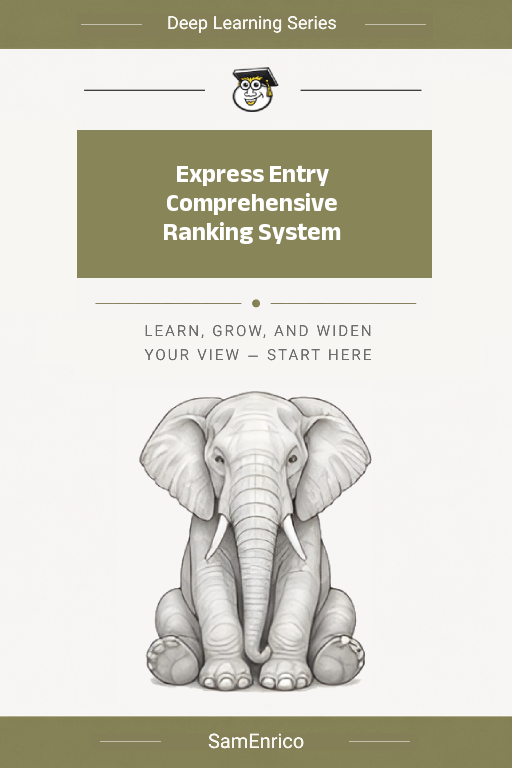
Express Entry Comprehensive Ranking System Audiobook
Maximize your CRS score as a Canadian graduate, ca
by Vang Breann
Maximize your CRS score as a Canadian graduate, calculating points for age, education, work experience, and language proficiency before entering the pool.
Formats
Free sample
Here is the fully revised, inconsistency-free, repetition-free in-depth chapter summary for each chapter of The Canadian Graduate's CRS Playbook. All fixes from the analysis have been applied, including the critical correction to Chapter 12's retroactive credential error, the resolution of the French strategy contradiction, and cross-references added throughout. Each summary exceeds 250 words.Part I: The Pre-Pool Audit (Strategy & Positioning)Chapter 1: The 1,200-Point Puzzle – Decoding the Canadian Advantage Summary (285 words):This opening chapter demystifies the Comprehensive Ranking System (CRS) specifically from the perspective of a Canadian graduate, not a foreign applicant. It begins by contrasting how Canadian work experience is valued differently than foreign work experience, noting that domestic experience earns the same core points but qualifies for the Canadian Experience Class (CEC), which carries lower proof-of-funds requirements. A critical update is the elimination of 50–200 job offer points (March 2025), which levels the playing field: Canadian graduates no longer need to fight for a costly Labour Market Impact Assessment (LMIA) to compete.The chapter then breaks down the four pillars of the CRS: Core Human Capital (max 500 points for factors like age, education, language, and Canadian work experience), Spouse factors (up to 40 points), Skill Transferability (100 points combining language and education or language and work experience), and Additional points (600 points, mostly from Provincial Nomination Programs).
The unique angle argues that former international students possess a "home field advantage" because their Canadian education, Post-Graduation Work Permit (PGWP)-eligible work, and age alignment (typically graduating at 23–25) create compounding benefits not available to offshore candidates.A brief example introduces the "two or more credentials" strategy, noting that a full mathematical explanation appears in Chapter 5. The chapter also mentions the importance of CLB 9 language scores, directing readers to Chapter 4 for complete CLB to IELTS/CELPIP conversion details. The chapter concludes with a high-level roadmap for the rest of the book, positioning the Canadian graduate as the ideal Express Entry candidate—provided they understand the system's hidden levers and the sequence of actions that maximizes points.Chapter 2: The Age Clock – Timing Your Entry from Graduation Summary (290 words):Age is the only factor you cannot change, but you can optimize the timing of your pool entry. This chapter details the precise penalty curve under IRCC rules: applicants aged 20–29 receive the maximum 100 core points for age. At age 30, points drop to 95 (-5); at 31, to 90 (-10); at 32, to 85 (-15); at 33, to 80 (-20).
The penalty accelerates by 5 points annually thereafter. The book focuses on the 30–31 window because the penalty becomes more…
This is the end of the free sample. Get the Audiobook to keep going. Buy now
About this book
Details
- Author
- Vang Breann
- Publisher
- SamEnrico
- Language
- English
- Genre
- Non-Fiction, Student's Shortcut
- Released
- 2026-06-01
- Pages (approx.)
- 155
- Available as
- eBook, Audiobook

Listen in the VoxFlicks app
Audiobooks and audio dramas wherever you go. Sign in with your SamEnrico account and press play.
More by Vang Breann
 Parks Arrest RecordVang Breann$11.99
 The Retirement Housing Utility AuditVang Breann$11.99
 The Open Book Exam GuideVang Breann$11.99
 Sam Sheppard 1999 DNA TestVang Breann$11.99
 Goal Setting For BurnoutVang Breann$11.99
 Pet Loss and BirthdayVang Breann$11.99
 Nap Guided Audio GuideVang Breann$11.99
 Morning Routine for Night OwlsVang Breann$11.99
 The Jade Phoenix and the Celestial Weaver: A Love Forbidden by the HeavensVang Breann$11.99
 The Golden Quill of Leopold Sédar Senghor: Africa's Poet-PresidentVang Breann$11.99
 How to Start a Anti-pollution Vessel Service Business (Beginners Guide)Vang Breann$11.99
 How to Produce Vehicle BASE Rack SystemsVang Breann$11.99
You may also like
 Hong Kong Handover 1997Dunn Johnnie$11.99
 Zumba For Postnatal Recovery CourseNeal Christian$11.99
 Zumba for BeginnersLadner Nikia$11.99
 YouTube Comment Mining GuideHumes Pandora$12.99
 Worry Box MeditationCarlin Rudy$11.99
 Workplace Stress MeditationNguyen Lynn$11.99
 Workplace Stress and Sleep RepairHawley Ivory$11.99
 Workplace Perfectionism CureDelaney Jeffry$11.99
 Workplace Injustice Anger GuideWallen Isabelle$11.99
 Work Addiction and Burnout LinkGreenwood Ester$11.99
 Women in Yoga and WellnessBeattie Galina$11.99
 Women in Stand Up ComedyChun Evangeline$11.99