
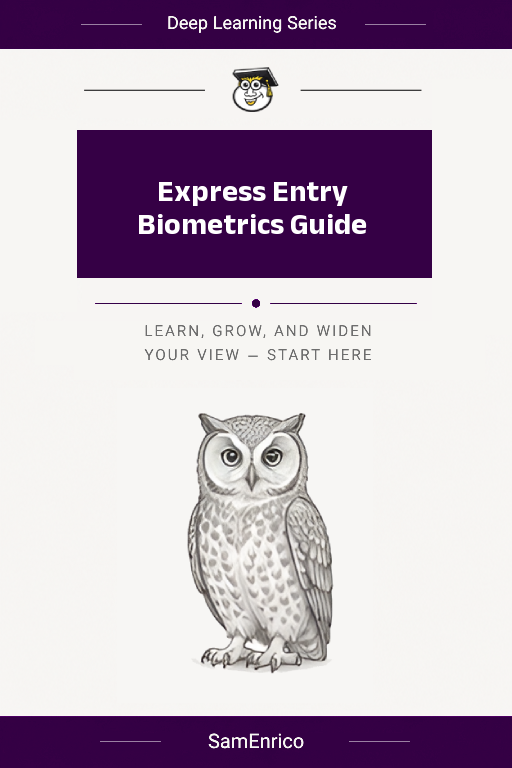
Express Entry Biometrics Guide eBook
Give fingerprints and photo at a designated biomet
Give fingerprints and photo at a designated biometric collection service point.
Formats
Free sample
Chapter 1: Your Fingerprints, Your Future--–- The last time you touched a glass, you left behind a map of your identity. Every ridge, every whorl, every loop on your fingertip is unique to you—not just different from everyone else on your flight, but different from every human who has ever lived. The chance of two people having identical fingerprints is approximately one in sixty-four billion. That is not a coincidence. That is nature’s most perfect form of identification.Canada wants those fingerprints.
Not to track you, not to profile you, not to invade your privacy. Canada wants them because they are the one thing about you that cannot be stolen, cannot be forged, and cannot be shared. In a world where passports are lost, identities are assumed, and documents are faked, your fingerprints are the immutable proof that you are who you say you are.This chapter explains what biometrics are, why Canada requires them for Express Entry, and how the collection process actually works. By the time you finish reading, you will understand not just the mechanics of giving your fingerprints and photograph, but the reasoning behind every step. You will see the biometrics requirement not as a bureaucratic hurdle, but as the most powerful tool you have to protect your identity and secure your Canadian future.What Biometrics Mean in Canadian Immigration In everyday language, "biometrics" refers to any measurable physical characteristic that can be used to identify an individual.
Fingerprints are the most common example, but facial recognition, iris scans, and even the way you walk can fall under this category. For Canadian immigration purposes, however, biometrics means two specific pieces of information collected at the same time: your digital fingerprints and your digital photograph.Let us be precise about what this means. When you arrive at a designated collection point—whether a Visa Application Centre in your home country, an Application Support Center in the United States, or a Service Canada office if you are already inside Canada—a technician will guide you through a painless fifteen-minute process. First, a digital camera will capture your photograph against a plain, neutral background. The technician will ensure your face is properly positioned, your eyes are open, and your expression is neutral.
No smiling. No frowning. Just a clear, unobstructed view of your face.Then comes the fingerprints. You will place your fingers on a small glass scanner, similar to the fingerprint reader on a modern smartphone but more sensitive and precise. The scanner will capture digital images of all ten fingers, typically starting with your left hand, then your right, then your thumbs individually, and finally all four fingers of each hand simultaneously.
The process is completely painless. There is no ink, no paper, no messy smudging. The scanner reads the unique pattern of ridges on your fingertip and converts it into a digital template that can be stored, transmitted, and compared against other prints with astonishing accuracy.These two data points—the photograph and the fingerprints—together create a biometric identifier that confirms your identity to Canadian immigration authorities with near-certainty. Unlike your name, which can be shared by thousands of people, or your date of birth, which can be guessed or altered, your fingerprints are effectively unique to you. The photograph confirms that the person presenting the fingerprints is the same person appearing in your passport and other identity documents.Why Canada Collects Biometrics Canada collects biometrics for three primary purposes, each one building on the last to create a system that is more secure, more efficient, and more fair than the alternatives.Identity verification is the first and most obvious purpose.
When you submit an application for Express Entry, you are asking the Canadian government to trust that you are who you say you are. Your passport provides some proof, but passports can be stolen, altered, or forged. Your birth certificate provides additional evidence, but it too can be falsified. Your fingerprints, by contrast, are bound to you in a way that no document can replicate. When immigration officers verify your identity at a port of entry years after your original application, they can scan your fingerprints and confirm within seconds that you are the same person who applied for permanent residence.
This prevents identity fraud at every stage of your immigration journey.Security screening is the second purpose. Once your fingerprints are collected, they are checked against databases maintained by the Royal Canadian Mounted Police (RCMP), the Federal Bureau of Investigation (FBI) in the United States, and international security partners. This screening identifies any criminal history or previous immigration violations that may affect your admissibility to Canada. The process is automated for most applicants; only if the system finds a potential match does a human officer review the file. This screening protects Canadian communities while allowing the vast majority of applicants to proceed without delay.Efficiency is the third purpose, and it is the one that benefits you directly.
Once your biometrics are collected and stored, they remain valid for ten years from the date of collection. During that decade, you do not need to provide biometrics again for most subsequent applications. If you apply for a visitor visa, a work permit, a study permit, or another permanent residence program within that period, IRCC will retrieve your existing biometrics from the database and use them to verify your identity. This saves you time, money, and the inconvenience of attending another appointment. (There is an important exception, which we will cover in the next section.)Beyond these three purposes, biometrics serve a broader function: they make the immigration system more fair for everyone.
When identity is certain, fraud becomes harder. When security screening is automated, processing becomes faster. When biometrics can be reused, applicants save money. Every applicant benefits from a system where no one can impersonate another, where criminal histories are caught early, and where legitimate applicants are not delayed by investigations into fraudulent claims.The Critical Distinction: Temporary vs. Permanent Residence This is the most important concept in the entire biometrics process, and misunderstanding it has caused countless applicants unnecessary confusion.
You must understand the distinction between biometrics collected for temporary residence and biometrics collected for permanent residence.Biometrics collected for a temporary residence application—a visitor visa, a work permit, or a study permit—are valid for ten years for other temporary residence applications. If you gave fingerprints for a work permit two years ago, you do not need to give them again for a visitor visa today. The system will retrieve your existing biometrics and use them for the new application.However—and this is the point where many applicants go wrong—biometrics collected for temporary residence are NOT valid for permanent residence. Express Entry is a permanent residence application. Even if you have valid biometrics from a work permit or visitor visa, you are still required to provide fresh biometrics for your Express Entry application.
IRCC considers permanent residence a separate category requiring its own biometrics collection. The security screening for permanent residence is more rigorous than for temporary residence, and the biometrics must be collected fresh to ensure no gaps in the screening process.The good news is…
This is the end of the free sample. Get the eBook to keep going. Buy now
About this book
Details
- Author
- Gardner Tabitha
- Publisher
- SamEnrico
- Language
- English
- Genre
- Non-Fiction, Student's Shortcut
- Released
- 2026-05-30
- Pages (approx.)
- 124
- Available as
- eBook, Audiobook

Read better in the ZLOADR app
Your eBooks on your phone or tablet. Sign in with your SamEnrico account and start reading.
More by Gardner Tabitha
 College Student Social PressureGardner Tabitha$11.99
 Financial Stress And Workplace PerformanceGardner Tabitha$11.99
 Dream Sharing With TherapistGardner Tabitha$11.99
 The Varicella Vaccine GuideGardner Tabitha$11.99
 Gaming Detox 30 Day PlanGardner Tabitha$11.99
 The Early Loss of Parent GriefGardner Tabitha$11.99
 Police Officer Stress GuideGardner Tabitha$11.99
 Imposter Syndrome At ConferencesGardner Tabitha$11.99
 Grit Research GuideGardner Tabitha$11.99
 Wings Over the Pacific: The Daring Flight of Amelia Earhart and the Forgotten Pacific PioneersGardner Tabitha$11.99
 Crypto’s Darkest Hour: The Colonial Pipeline Cyber HeistGardner Tabitha$11.99
 The Dancer's Guide to RedowaGardner Tabitha$11.99
You may also like
 LSE Online Program LengthAgee Letisha$11.99
 Harvard Extension School for Working AdultsRoush Yer$11.99
 LSE Online Reading ListAshford Ludivina$11.99
 LSE Online Language RequirementsWhitten Daphine$11.99
 LSE Online Class SizeHughey Garret$11.99
 LSE Online Alumni MentorshipWild Lyla$11.99
 London School of Economics Alumni NetworkDutton Chantal$11.99
 Harvard Extension School Student SupportCantrell Christene$11.99
 Harvard Extension School Library AccessSantana Adah$11.99
 Harvard Extension School Degree CompletionBray Wyatt$11.99
 Harvard Extension School Course AuditingAbbott Craig$11.99
 Harvard Extension School Extension DiplomaNew Joane$11.99