
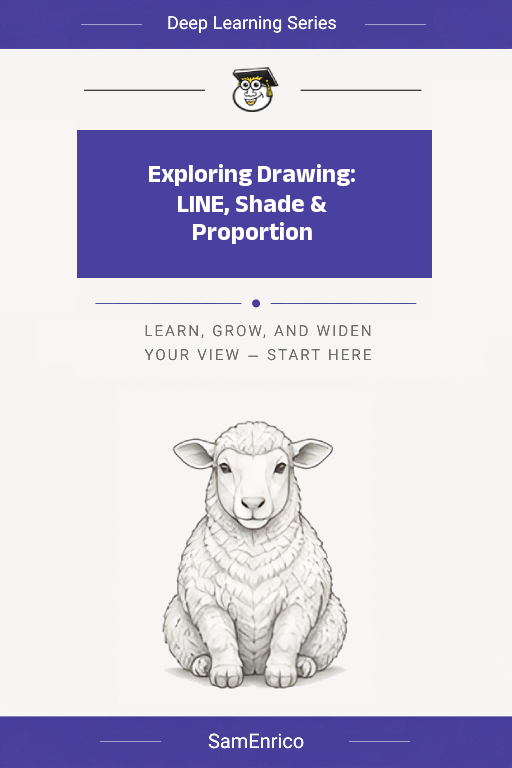
Non-FictionInformativeEducational
Exploring Drawing: LINE, Shade & Proportion eBook
This publication, published by SamEnrico, covers E
by Rich Alissa
This publication, published by SamEnrico, covers Exploring Drawing: LINE, Shade & Proportion
Formats
Free sample
Chapter 1: Your Hidden Artist--So you want to learn to draw. Or perhaps you have tried before, only to set down your pencil in frustration when the result on the page looked nothing like the image in your mind or the object before your eyes. You may have concluded, in that quiet moment of disappointment, that you simply lack "talent"—that mysterious quality some people possess and others do not.Let me stop you right there.That conclusion is wrong. Not slightly inaccurate. Not a modest underestimation of your potential.
Wrong in the way that believing the earth is flat is wrong. Drawing is not a gift bestowed upon a lucky few at birth. It is a learnable skill, no different from reading, typing, or driving a car. No one expects to sit at a piano for the first time and play a Chopin nocturne. Yet somehow, we expect our first drawing to look like a Renaissance masterpiece—and when it does not, we blame our DNA.This chapter will dismantle that myth permanently.
You will learn why previous attempts may have failed, how to set up a practice environment that sets you up for success, and what tools you actually need (far fewer than you think). You will complete your first exercises before the chapter ends—not to create a "good" drawing, but to prove to yourself that you can make marks with intention and control.By the time you turn to Chapter 2, you will no longer say "I can't draw." You will say "I am learning to draw." And those two sentences live in entirely different universes.The Talent Myth: A Funeral Let us conduct a proper burial for the talent myth. Examine the evidence.Every professional artist you admire was once a beginner who produced terrible drawings. Every single one. The sketchbooks of the masters are filled with failed attempts, awkward proportions, and drawings that never saw the light of day.
Vincent van Gogh produced hundreds of drawings before he ever sold a painting. Leonardo da Vinci filled thousands of pages with practice sketches—many of them repetitive studies of the same draped cloth, the same hand position, the same facial expression.What separated these artists from the person who gives up after three attempts was not an invisible gift. It was persistence, a willingness to learn from mistakes, and—most importantly—a method.Drawing is a constellation of sub-skills: hand-eye coordination, spatial reasoning, value perception, edge detection, proportion judgment, and mark-making control. No one is born with these fully formed. They are trained.
Your hand learns to make the marks your eyes see, just as your tongue learns to form the words your brain hears.Consider this analogy: If you met an adult who could not read, you would not say they lacked "reading talent." You would say they were never taught. Drawing is identical. You have simply never been taught the specific ways of seeing that make drawing possible. This book is that teaching.The Psychological Barrier: Fear of the Blank Page Before we discuss pencils or paper, we must address the most significant obstacle between you and successful drawing: the blank page.That white rectangle has a strange psychological power. It demands perfection.
It seems to say, "I am pure potential, and anything you put on me will be a compromise, a failure, a betrayal of what could have been." This fear is so common among beginners that it has a name: cainoia (pronounced ky-NO-ya), the fear of the blank page.The antidote is not courage. It is reframing.Stop thinking of each drawing as a "masterpiece" or even a "finished work." Think of it as data. A scientist does not despair when an experiment yields unexpected results; they analyze the data and adjust the hypothesis. You are now a scientist of drawing. Each mark on the page is information about what your hand does when your eye sees something specific.Here is a practical strategy that professional artists use daily: The Five-Minute Rule.
Commit to drawing for only five minutes. Set a timer. When the timer ends, you may stop with no guilt. What you will discover is that starting is the hardest part—and after five minutes, you will almost certainly continue. The blank page is terrifying only when it is blank.
The moment a single mark exists, it becomes a conversation.Another strategy: Draw on the same page repeatedly. Do not discard "bad" drawings. Flip to a fresh area of the page and draw again. Over time, your page becomes a record of progress rather than a gallery of failures. Professional sketchbooks are not collections of masterpieces; they are messy, crowded, layered documents of thinking and learning.Your Drawing Kit: Less Than You Think Beginners often believe that professional results require professional materials.
This is the equipment fallacy. A great drawer can produce a compelling image with a dull pencil on a napkin. A poor drawer cannot be saved by the most expensive paper and pencils.That said, using the wrong tools can frustrate your learning. Here is exactly what you need, why you need it, and what you can ignore.Graphite Pencils: The Workhorses Graphite pencils are labeled with a code: H, B, or HB, usually with a number. Here is what those letters mean:H stands for "hard." Hard pencils produce light, precise lines.
They hold a sharp point well but do not get very dark. The higher the number (2H, 4H, 6H), the harder and lighter the pencil.B stands for "black" (or soft). Soft pencils produce dark, rich lines. They dull quickly and smudge easily. The higher the number (2B, 4B, 6B), the softer and darker the pencil.HB sits in the middle.
This is the standard yellow pencil you used in school. It is fine for writing but less ideal for drawing.For this book, you need exactly three pencils: 2H, HB, and 4B.Pencil Use Why2HLight construction lines, initial sketching, precise details It leaves faint marks that erase cleanly and do not smudge HBGeneral drawing, contour lines, mid-tone work A versatile all-purpose pencil4BDark shadows, rich darks, expressive lines, shading It creates deep, velvety blacks that make drawings pop You do not need a full set of twelve pencils. You do not need 6B or 8B (too soft, too smudgy for beginners). You do not need 6H or 4H (too hard, scratchy). Start with these three, master them, and expand later if you wish.Charcoal: For When You Want Drama Charcoal is graphite's expressive cousin.
It is softer, blacker, and more forgiving—but also messier and less precise. There are two main types:Vine charcoal: Made from burned willow branches. It is light, crumbly, and erases almost completely. Excellent for blocking in large shapes and experimenting without commitment.Compressed charcoal: Powdered charcoal mixed with a gum binder and pressed into sticks. It is much darker, harder, and more permanent.
Good for finished drawings with deep blacks.For this book, vine charcoal is recommended but optional. If you choose to use it, buy a few sticks of medium thickness. You will also need a kneaded eraser (see below) because standard erasers smear charcoal rather than removing it.Erasers…
This is the end of the free sample. Get the eBook to keep going. Buy now
About this book
Details
- Author
- Rich Alissa
- Publisher
- SamEnrico
- Language
- English
- Genre
- Non-Fiction, Informative, Educational
- Released
- 2026-05-08
- Pages (approx.)
- 159
- Available as
- eBook, Audiobook

Read better in the ZLOADR app
Your eBooks on your phone or tablet. Sign in with your SamEnrico account and start reading.
More by Rich Alissa
 Paper Planner Daily ReviewRich Alissa$11.99
 Menopause Stress ReductionRich Alissa$11.99
 Personal Branding for CreativesRich Alissa$11.99
 Appreciation Practice CoupleRich Alissa$11.99
 Travel Adventures Started After FiftyRich Alissa$11.99
 Email Folder Structure LITERich Alissa$11.99
 People Pleasing Release HypnosisRich Alissa$11.99
 The Ballad of the Maori Troubadours: New Zealand's Forgotten Country RootsRich Alissa$11.99
 The Day the Internet Broke: How a Single Tweet Toppled a Fortune 500 CEORich Alissa$11.99
 How to Produce a PloughRich Alissa$11.99
 How to Produce Disposable Serving TraysRich Alissa$11.99
 Brazil Dropshipping Scams WorkbookRich Alissa$12.99
You may also like
 Hong Kong Handover 1997Dunn Johnnie$11.99
 Zumba For Postnatal Recovery CourseNeal Christian$11.99
 Zumba for BeginnersLadner Nikia$11.99
 YouTube Comment Mining GuideHumes Pandora$12.99
 Worry Box MeditationCarlin Rudy$11.99
 Workplace Stress MeditationNguyen Lynn$11.99
 Workplace Stress and Sleep RepairHawley Ivory$11.99
 Workplace Perfectionism CureDelaney Jeffry$11.99
 Workplace Injustice Anger GuideWallen Isabelle$11.99
 Work Addiction and Burnout LinkGreenwood Ester$11.99
 Women in Yoga and WellnessBeattie Galina$11.99
 Women in Stand Up ComedyChun Evangeline$11.99