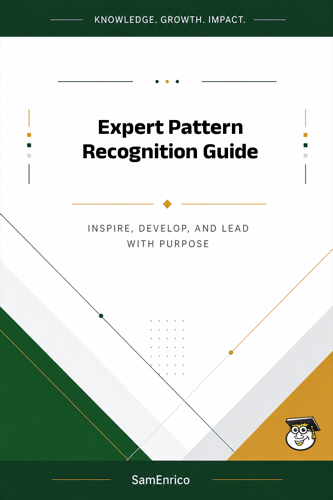
Expert Pattern Recognition Guide eBook
Develop the intuitive pattern spotting of grandmas
Develop the intuitive pattern spotting of grandmasters and experts.
Formats
Free sample
Chapter 1: The Seeing Paradox--–- The young man across the table believed he was about to witness a miracle. He had studied chess for six years, memorized hundreds of opening lines, and could calculate variations ten moves deep when he had enough time. But now the clock was ticking, and the grandmaster sitting opposite him wasn't even looking at the board. The grandmaster was looking at the ceiling, tapping his fingers, seeming almost bored. The young man made his move—a carefully calculated knight maneuver he had prepared the night before.
The grandmaster glanced down for less than two seconds, moved a pawn without hesitation, and leaned back in his chair. The young man stared at the board. His ten-move calculation had just been reduced to rubble by a single pawn push he hadn't even considered.After the game, the young man asked the question that haunts everyone who has ever faced true expertise: "How many moves were you calculating?"The grandmaster smiled. "None," he said. "I wasn't calculating.
I was watching. You moved your knight, and suddenly your king looked lonely. So I pushed my pawn to keep him company."The young man thought this was a joke. It was not.The Myth That Keeps You Stuck Let me tell you what you believe about expertise, because you almost certainly believe it, and that belief is the single greatest obstacle between you and the intuitive pattern spotting you want to develop.You believe that experts think faster than you do. You believe that when a grandmaster looks at a chess board, a surgeon looks at a scan, or a firefighter looks at a burning building, their brain is performing calculations at superhuman speed—processing more variables, running more scenarios, thinking more steps ahead than you could ever hope to match.This belief is wrong.
Completely, demonstrably, scientifically wrong.The most famous study in the history of expertise research was conducted by Adriaan de Groot, a Dutch psychologist and chess player who wanted to know what actually separated grandmasters from club players. In 1946, he sat down dozens of players at every skill level and asked them to think out loud while solving chess problems. He recorded their words, timed their decisions, and analyzed their thought processes with painstaking detail.What he found shocked the chess world and launched the modern science of expertise.Grandmasters did not calculate more moves than club players. They calculated roughly the same number—about thirty-five to forty positions per decision. They did not think faster.
They did not have superhuman working memory. In fact, when asked to recall random strings of numbers or unrelated visual patterns, grandmasters performed no better than anyone else.The difference was something else entirely. Something much stranger and much more useful to you.When de Groot showed players a chess position that came from a real game—a meaningful configuration of pieces—grandmasters could reconstruct it from memory with ninety to ninety-five percent accuracy after looking at it for just two to five seconds. Club players managed only forty to fifty percent. But here is the crucial detail that changed everything: when de Groot arranged the pieces randomly, in positions that could never arise from a real game, the grandmasters' advantage vanished.
They scored no better than the beginners.Think about what this means. The grandmasters were not memorizing the locations of individual pieces. Their brains were not functioning as high-speed cameras capturing every detail. Instead, they were recognizing meaningful patterns—configurations they had seen thousands of times before in their years of study and play. A club player saw thirty-two individual pieces.
A grandmaster saw a King's Indian Defense, a isolated queen's pawn, a classic pin against the knight on f3. These were not thirty-two pieces. They were four or five chunks, each containing dozens of relationships, threats, and possibilities.Your Brain Is Not a Computer—And That's Good News Here is what you need to understand about your own brain. It does not think the way you think it thinks.Most of us carry around an implicit model of thinking that looks something like a computer. Information comes in through the senses.
The brain processes that information through logical steps. It compares options, evaluates probabilities, and produces a decision. This model feels right because it matches our conscious experience of solving problems. When you balance your checkbook or figure out a tip at a restaurant, you experience yourself performing sequential, logical operations.But that conscious experience is not how your brain actually works most of the time. And it is certainly not how experts work when they perform at their best.Daniel Kahneman, the Nobel Prize-winning psychologist, gave us the language for this distinction.
He called the two modes of thinking System 1 and System 2.System 2 is the one you know about. It is slow, deliberate, logical, and energy-intensive. It is what you use when you learn a new skill, solve a math problem, or follow a recipe for the first time. System 2 requires attention. You cannot do two System 2 tasks at once.
And System 2 tires easily—which is why you make worse decisions at the end of a long day.System 1 is the hidden giant. It is fast, automatic, effortless, and pattern-based. It is what you use when you recognize a friend's face in a crowd, when you brake before you consciously register the obstacle in the road, when you know the answer to "what is two plus two?" without calculating. System 1 runs constantly in the background, processing the world and feeding you conclusions without any sense of effort.Here is the secret that grandmasters, expert radiologists, veteran firefighters, and master pilots all share: they have learned to move more and more decisions from System 2 to System 1. Not by thinking faster.
Not by calculating more steps per second. But by seeing more—by building such a rich library of patterns that System 1 can recognize situations instantly and hand off only the genuinely novel problems to System 2.Why Faster Thinking Is a Trap I want you to notice something about the word "expertise." It comes from the Latin expertus, meaning "tried, proved, known by experience." Not "fast." Not "smart." Known.The path to expertise is not about upgrading your processor. It is about expanding your memory—specifically, your memory for meaningful patterns in your domain.Consider a different kind of expert: a master birdwatcher. Stand with one in the field and watch a small brown bird flit through the bushes. You see "a small brown bird." The master sees "immature female purple finch, distinguishing features: brown cap, bold facial markings, heavily streaked underparts." You see one thing.
The master sees a dozen features organized into a meaningful category. And here is the crucial part: the master does not see these features sequentially, as a checklist. They see the whole bird as a gestalt—a pattern that triggers recognition before conscious analysis begins.Research on birdwatchers has shown that experts often identify birds before they can articulate the identifying features. They know what they are seeing, but the verbal description lags behind the perceptual recognition. This is not mysticism.
This is the brain's pattern recognition system operating at its peak speed, feeding a conclusion to conscious awareness without cluttering…
This is the end of the free sample. Get the eBook to keep going. Buy now
About this book
Details
- Author
- Bolduc Roseanne
- Publisher
- SamEnrico
- Language
- English
- Genre
- Non-Fiction, Self-Help, Expertise
- Released
- 2026-06-11
- Pages (approx.)
- 134
- Available as
- eBook, Audiobook

Read better in the ZLOADR app
Your eBooks on your phone or tablet. Sign in with your SamEnrico account and start reading.
More by Bolduc Roseanne
 The Anger Validity CheckBolduc Roseanne$11.99
 Self Hypnosis Fractionation CourseBolduc Roseanne$11.99
 Fitness After PregnancyBolduc Roseanne$11.99
 Phone Call Distraction TriageBolduc Roseanne$11.99
 The Comeback Kid: How a Broken Man Built a Billion-Dollar EmpireBolduc Roseanne$11.99
 Silk and Sabers: The Forgotten War of the Tea ClippersBolduc Roseanne$11.99
 Understanding Endocardial FibroelastosisBolduc Roseanne$17.99
 SAFe for Intel StartupsBolduc Roseanne$12.99
 Redbubble Store Setup GuideBolduc Roseanne$12.99
 Freon Recovery (Appliance)Bolduc Roseanne$11.99
 How to Start a Prefabricated Buildings Made of Metal Business (Beginners Guide)Bolduc Roseanne$11.99