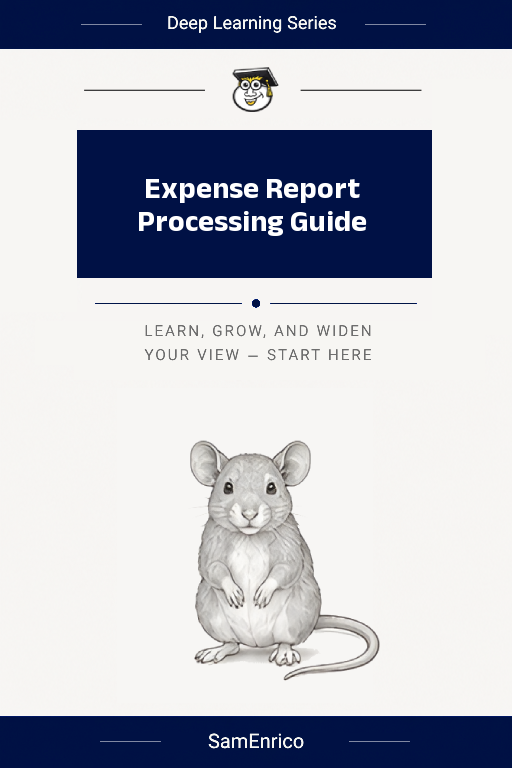
Expense Report Processing Guide eBook
Automate expense report validation and approval ro
Automate expense report validation and approval routing using AI workflows for finance operations.
Formats
Free sample
Chapter 1: The $470,000 Typo--–- In a mid-sized tech company in Austin, Texas, an accounts payable clerk named Denise had just approved the same crumpled restaurant receipt for the third time in ninety days. The receipt was for $347.50. The vendor was a steakhouse called Sullivan's. The justification field contained exactly four words: "Client dinner – Paul." That was it. No client name.
No business purpose. No explanation of why this particular dinner was worth nearly three hundred and fifty dollars of company money. Denise had approved it the first time because Paul was a senior sales director and she trusted him. She had approved it the second time because a temp was covering her desk and didn't know to be suspicious. Now, three months later, here it was again.
Same crumpled photo, same vague justification, same amount. And Denise, exhausted from reviewing four hundred expense reports that day, clicked "approve" without a second thought.She didn't know she had just participated in a quiet epidemic. Neither did her manager. Neither did the CFO. But the data knew.
Somewhere in the company's expense database, three identical receipts sat in three different months, each linked to a different corporate card transaction, each paid out to Paul's reimbursement account. The total overpayment was modest: $1,042.50. But the story behind that number was not modest at all.The real cost wasn't the money. It was the pattern.Multiply Paul's duplicate receipt by every salesperson, every consultant, every manager who submits the same expenses twice—some accidentally, some deliberately. Multiply Denise's eleven minutes of hesitation per suspicious receipt by the six hundred reports her team processed each month.
Multiply the late fees from approvals that took too long, the overtime paid to finance staff working weekends to close the books, the quiet resignation of employees who stopped submitting legitimate expenses because the process was too painful. When you do that multiplication, across a perfectly average five-hundred-person company, you arrive at a number that should make every finance leader sit up straight: $470,000 per year.That is the cost of a broken expense process. And it is almost entirely invisible.The Invisible Drain This chapter exists because most finance leaders have no idea how much money they are losing to manual expense processing. Not because they are bad at their jobs. Because the costs are hidden in plain sight, buried in line items that no one thinks to question.
The $12.44 average cost to manually process a single expense report—a number well-documented in industry research from APQC and The Hackett Group—includes not just the obvious labor of data entry but the soft costs of back-and-forth emails, manager review time, audit preparation, and the opportunity cost of finance staff who could be analyzing cash flow instead of chasing receipts.When you automate expense validation and approval routing using AI workflows, that cost drops to approximately 4.98pertransaction.A60percentreduction.Forthatsamefive−hundred−personcompanyprocessingtenthousandexpensereportsannually,thehard−dollarsavingsexceed4.98 per transaction. A 60 percent reduction. For that same five-hundred-person company processing ten thousand expense reports annually, the hard-dollar savings exceed 4.98pertransaction.A60percentreduction.Forthatsamefive−hundred−personcompanyprocessingtenthousandexpensereportsannually,thehard−dollarsavingsexceed74,000 per year. Add the soft savings—reduced fraud, faster cycle times, higher employee satisfaction—and the total return on investment often exceeds 300 percent in the first twelve months.But here is the problem that most books about expense automation get wrong. They focus on the technology.
They talk about OCR accuracy and API endpoints and workflow orchestration as if those things exist in a vacuum. They do not. Technology succeeds or fails based on two factors that have nothing to do with code: the maturity of your current process and the willingness of your people to change. This book exists to bridge that gap. It will teach you not just how to build AI workflows but how to diagnose your starting point, how to measure your progress, and how to bring your team along for the journey.The Five Levels of Expense Maturity Before you can automate anything, you need to know where you stand.
Over the past decade, working with finance teams across hundreds of companies, I have observed that expense processing evolves through five distinct levels of maturity. These levels are not judgments of competence. They are descriptive frameworks that help leaders see their current state and chart a path forward.Level 0: Manual Paper. Some organizations still operate here, though fewer every year. Receipts are printed and taped to paper forms.
Approvals require physical signatures. Reimbursements are cut by check. The average processing time is measured in weeks. Fraud detection is nonexistent. The only advantage is that everyone understands the system, even if they hate it.Level 1: Basic Digital.
Spreadsheets and email approvals replace paper. Employees fill out Excel templates and email them to managers, who reply with "approved" or "please revise." This feels like progress, but it is still almost entirely manual. The finance team spends hours copying numbers from spreadsheets into the accounting system. Duplicates are common. Policy violations go unnoticed.
Level 1 is where many small businesses get stuck because the pain is not yet acute enough to justify change.Level 2: Rules-Based Automation. This is where things get interesting. Simple RPA (Robotic Process Automation) handles the easiest cases: expenses under fifty dollars from low-risk categories like office supplies or internet reimbursement. The system checks a few basic conditions—amount below threshold, vendor on approved list, date within policy window—and auto-approves. Everything else still goes to a human.
The touchless rate (percentage of expenses that require no human intervention) typically lands between 10 and 25 percent. This is better than manual, but it is not yet intelligent.Level 3: Conditional Logic with Basic Machine Learning. At this level, the system starts learning from past approvals. If a specific manager has approved every team lunch expense under two hundred dollars for the past six months, the system begins auto-approving those expenses without sending them for review. Simple anomaly detection flags duplicate receipts using exact matching (same vendor, same amount, same date).
The touchless rate rises to 40 or 50 percent. But the system still struggles with context. It cannot tell the difference between a legitimate client dinner and a personal meal submitted by mistake because it does not understand the relationship between the expense and the business.Level 4: Contextual AI with Agentic Workflows. This is the primary focus of this book. At Level 4, the system uses Large Language Models (LLMs) to understand not just the numbers on a receipt but the context surrounding them.
It checks whether a client name in the justification field actually exists in the CRM. It flags mileage claims that defy traffic logic. It routes expenses dynamically based on department, region, amount, and project code, and when a manager is on vacation, it escalates automatically to the next available approver. The touchless rate reaches 70 to 85 percent. Processing time drops from days to hours.Level 5: Predictive Autonomous.
This is the frontier. At Level 5, the AI does not wait for expenses to be submitted. It predicts them. When a salesperson books a flight to Chicago for a client meeting, the system automatically reserves budget, pre-approves reasonable meal and transportation expenses, and flags any deviations in real time. Fraud is not detected after the fact—it is prevented before it…
This is the end of the free sample. Get the eBook to keep going. Buy now
About this book
Details
- Author
- Redding Kenyatta
- Publisher
- SamEnrico
- Language
- English
- Genre
- Non-Fiction, AI Operator, Expense Management
- Released
- 2026-06-01
- Pages (approx.)
- 128
- Available as
- eBook, Audiobook

Read better in the ZLOADR app
Your eBooks on your phone or tablet. Sign in with your SamEnrico account and start reading.
More by Redding Kenyatta
 The Mindful Pause HandbookRedding Kenyatta$11.99
 MBSR for IBS WorkbookRedding Kenyatta$11.99
 Teen Self Esteem After DivorceRedding Kenyatta$11.99
 Ayurvedic Heart Health GuideRedding Kenyatta$11.99
 Navigating Political Divides in FamilyRedding Kenyatta$11.99
 Ashoka's Redemption: The Kalinga War That Changed an EmpireRedding Kenyatta$11.99
 Understanding Methylmalonicacidemia With Homocystinuria, Cbl DRedding Kenyatta$17.99
 How to Start a Cement Articles for Use In Construction Business (Beginners Guide)Redding Kenyatta$11.99
 Ghana Ecommerce Fraud PreventionRedding Kenyatta$12.99
 Turnips HarvestingRedding Kenyatta$11.99