
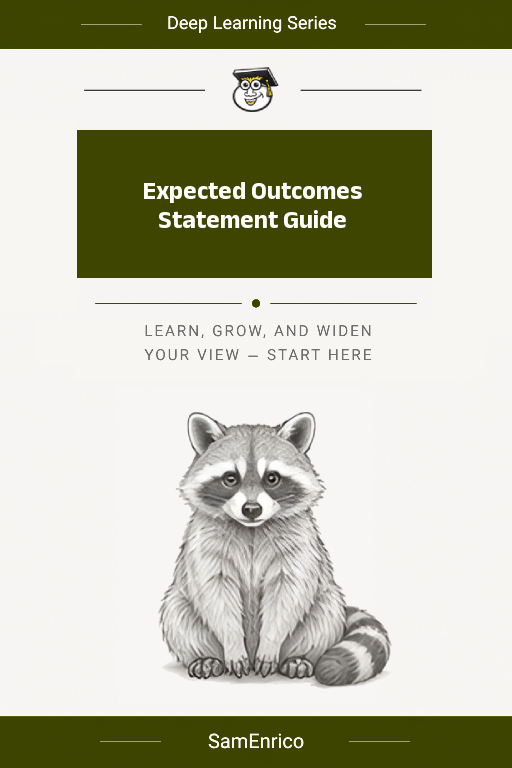
Non-FictionStudent's ShortcutOutcomes WritingSignificance Guide
Expected Outcomes Statement Guide
Write expected outcomes and significance sections
Write expected outcomes and significance sections that convince reviewers your research matters for the field.
Formats
About this book
Free sample
Chapter 1: The Rejection Epidemic--Dr. Sarah Chen had done everything right. Her preliminary data were solid – six months of painstaking experiments, replicated twice. Her literature review was exhaustive, citing 147 papers including the three most recent from the journal's editorial board. Her budget was lean, her timeline realistic, her collaborators distinguished.
When she clicked "submit" on her R01 application to the National Institutes of Health, she allowed herself a small, private smile. This was the one. She could feel it.Eight weeks later, the review came back. Not a summary statement. Not a request for revisions.
A straight rejection.The comments were polite, almost gentle. "The applicant is clearly a skilled investigator." "The preliminary data are promising." "The research question is of interest to the field." And then the killer: "However, the expected outcomes are not clearly articulated, and the significance of the proposed work is not well established."Sarah read that sentence seventeen times. She had written an entire section labeled "Expected Outcomes." She had written another section labeled "Significance." What did they mean, "not clearly articulated"? The words were right there on the page. She had used the word "novel" four times.
She had called the work "important" in three different paragraphs. What more did they want?What Sarah did not know – what no one had ever taught her – was that she had committed the single most common fatal error in grant writing. She had written her Expected Outcomes section for an audience that already believed her research mattered. But reviewers are not that audience. Reviewers are gatekeepers of scarcity, trained to find reasons to say no.
And her outcomes section, for all its technical correctness, had handed them that reason on a silver platter.This chapter is about understanding that error so you never make it again. It is about the psychology of rejection, the hidden logic of peer review, and the single most important diagnostic tool you will ever use to test whether your Expected Outcomes will convince a skeptic or bore them to sleep.The Dirty Secret of Peer Review Here is something that grant officers will never say…
This is the end of the free sample. Get the eBook to keep going. Buy now
Contents
- Chapter 1
- Chapter 2
- Chapter 3
- Chapter 4
- Chapter 5
- Chapter 6
- Chapter 7
- Chapter 8
- Chapter 9
- Chapter 10
- Chapter 11
- Chapter 12
Details
- Author
- Maier Danille
- Publisher
- SamEnrico
- Language
- English
- Genre
- Non-Fiction, Student's Shortcut, Outcomes Writing, Significance Guide
- Released
- 2026-06-01
- Pages (approx.)
- 152
- Available as
- eBook, Audiobook

Read better in the ZLOADR app
Your eBooks on your phone or tablet. Sign in with your SamEnrico account and start reading.
More by Maier Danille
 Gaming Disorder Recovery CourseMaier Danille$11.99
 Deal Financing Fee DatabaseMaier Danille$11.99
 Parental Addiction and ResilienceMaier Danille$11.99
 Bariatric Surgery Mindful Eating GuideMaier Danille$11.99
 Gluten Free Travel Survival GuideMaier Danille$11.99
 Love in the Time of Ice: The Frozen Romance of the Franklin ExpeditionMaier Danille$11.99
 Blood and Silk: The Empress Wu Zetian’s Rise to PowerMaier Danille$11.99
 10 Ways to Use Chapati Flour (Recipe Book)Maier Danille$11.99
 Business Credit for VeteransMaier Danille$12.99
 Understanding Cataract Congenital Dominant Non NuclearMaier Danille$17.99
 Learning Pod TeacherMaier Danille$11.99
You may also like
 Hong Kong Handover 1997Dunn Johnnie$11.99
 Zumba For Postnatal Recovery CourseNeal Christian$11.99
 Zumba for BeginnersLadner Nikia$11.99
 YouTube Comment Mining GuideHumes Pandora$12.99
 Worry Box MeditationCarlin Rudy$11.99
 Workplace Stress MeditationNguyen Lynn$11.99
 Workplace Stress and Sleep RepairHawley Ivory$11.99
 Workplace Perfectionism CureDelaney Jeffry$11.99
 Workplace Injustice Anger GuideWallen Isabelle$11.99
 Work Addiction and Burnout LinkGreenwood Ester$11.99
 Women in Yoga and WellnessBeattie Galina$11.99
 Women in Stand Up ComedyChun Evangeline$11.99