
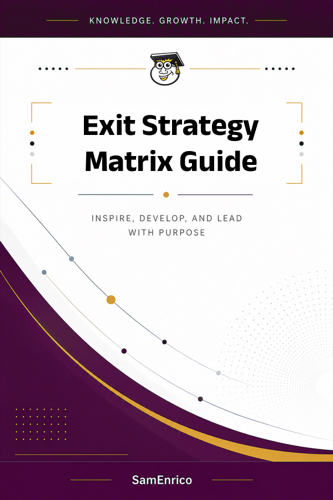
Non-FictionCapital & Valuation RegisterExit Planning
Exit Strategy Matrix Guide Audiobook
Model IPO, strategic sale, secondary buyout, and d
by Ware Jeffry
Model IPO, strategic sale, secondary buyout, and dividend recap exits.
Formats
Free sample
Chapter 1: The Seventy Percent Problem--–- Most business owners believe their company will sell the moment they decide it's time. They imagine a competitive bidding war, a handshake with a smiling buyer, and a wire transfer that lands in their account before lunch. Then they wake up six months later with no offers, a demoralized management team, and a growing realization that they have no idea what went wrong. The data tells a brutal story: seventy to eighty percent of businesses that go to market never transfer successfully. Not at a discounted price.
Not at any price. They simply fail to sell. This book exists because that number is not inevitable. It is the result of a single, correctable mistake: treating an exit like an event rather than a strategic choice.The four liquidity vectors introduced in this chapter—the Model IPO, Strategic Sale, Secondary Buyout, and Dividend Recap—represent fundamentally different paths, each with distinct trade-offs in control, timing, taxes, and risk. But before any founder can choose a path, they must first understand why most exits fail and how the winners think differently.
The winners share one uncomfortable trait: they started planning two to five years before they needed to. They did not wait for burnout, a health scare, or a market peak. They built their businesses to be sellable from day one, even when they had no intention of selling. This chapter explains how to adopt that mindset, introduces the unified framework that underpins the entire book, and resolves a critical confusion that derails most exit planning: the difference between an exit and a liquidity event.The Four Liquidity Vectors Defined Every founder eventually faces four possible paths to turning their equity into cash. The first three transfer control of the company to new owners.
The fourth does not. Understanding this distinction is the foundation of everything that follows.The Model IPO is the most visible and least accessible path. A company lists its shares on a public exchange like the Nasdaq or New York Stock Exchange, raising capital from institutional and retail investors. The founders and early shareholders become publicly traded stockholders, subject to SEC reporting requirements, quarterly earnings expectations, and a lock-up period that typically prevents them from selling for one hundred eighty days after listing. Contrary to popular mythology, an IPO does not give founders more control.
It gives them less. They gain liquidity only after the lock-up expires, and they gain scrutiny immediately. The Model IPO…
This is the end of the free sample. Get the Audiobook to keep going. Buy now
About this book
Details
- Author
- Ware Jeffry
- Publisher
- SamEnrico
- Language
- English
- Genre
- Non-Fiction, Capital & Valuation Register, Exit Planning
- Released
- 2026-06-07
- Pages (approx.)
- 149
- Available as
- eBook, Audiobook

Listen in the VoxFlicks app
Audiobooks and audio dramas wherever you go. Sign in with your SamEnrico account and press play.
More by Ware Jeffry
 Belgian Detective PerspectiveWare Jeffry$11.99
 LBO Waterfall WaterfallWare Jeffry$11.99
 Mindfulness for Workplace BurnoutWare Jeffry$11.99
 Bariatric Surgery Duodenal Switch GuideWare Jeffry$11.99
 Silicon Samurai: How Masayoshi Son Built a $100B Empire from ScratchWare Jeffry$11.99
 The Viking Voyagers and the Seeds of Evolution: Medieval Mariners Who Shaped Darwin's WorldWare Jeffry$11.99
 Understanding Cayler SyndromeWare Jeffry$17.99
 Interdisciplinary Proposal WritingWare Jeffry$12.99
 AI Financial Data Quality ScorecardWare Jeffry$12.99
 10 Ways to Use Chaunk (Recipe Book)Ware Jeffry$11.99
 EGSE HW EngineerWare Jeffry$11.99EGSE HW EngineerWare Jeffry$11.99
You may also like
 Hong Kong Handover 1997Dunn Johnnie$11.99
 Zumba For Postnatal Recovery CourseNeal Christian$11.99
 Zumba for BeginnersLadner Nikia$11.99
 YouTube Comment Mining GuideHumes Pandora$12.99
 Worry Box MeditationCarlin Rudy$11.99
 Workplace Stress MeditationNguyen Lynn$11.99
 Workplace Stress and Sleep RepairHawley Ivory$11.99
 Workplace Perfectionism CureDelaney Jeffry$11.99
 Workplace Injustice Anger GuideWallen Isabelle$11.99
 Work Addiction and Burnout LinkGreenwood Ester$11.99
 Women in Yoga and WellnessBeattie Galina$11.99
 Women in Stand Up ComedyChun Evangeline$11.99