
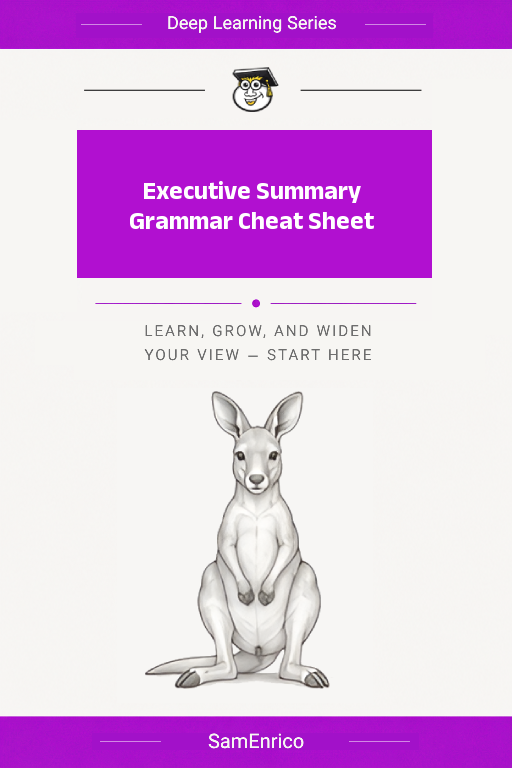
Non-FictionProfessional's Cheat SheetEditing Guide
Executive Summary Grammar Cheat Sheet eBook
Fix the ten most common writing errors that make p
by Bailey Sean
Fix the ten most common writing errors that make professionals look amateur, including passive voice traps and weak openings.
Formats
Free sample
Chapter 1: The First Four Seconds...--The first four seconds are all you get.That is not a metaphor. It is not an exaggeration drawn from marketing hype or productivity blog clickbait. It is a neurological fact. When a senior executive, a client, or even a busy peer opens your email, report, or memo, their brain makes a series of high-speed calculations in less time than it takes to read this sentence. They are not consciously thinking, “Shall I grant this person my attention?” They are reacting.
And the trigger for that reaction is the first three to five words of your document.If those words are empty, vague, or bureaucratic, the reader’s brain flags your message as low priority. They may still read it—eventually, if nothing more urgent appears—but they will read it as a chore. They will scan impatiently. They will miss nuance. They will assume that the rest of your writing is as soggy as your opening.
And they will be right, because research shows that writers who start weakly almost never tighten up later. The opening is a diagnostic tool. It tells the reader, in four seconds, whether you are an amateur or a professional.This chapter is about the single most common sentence-level opening error in business writing: the “It is / There are” black hole. It is the habit of starting sentences with vague, empty phrases that delay the subject, waste the reader’s attention, and signal indecision. Fix this one error, and you will instantly sound more confident, more authoritative, and more worth listening to.
Ignore it, and you will spend the rest of your career wondering why your emails get shorter replies than your peers’.The Diagnosis: Why “It Is” and “There Are” Are Destroying Your Credibility Let us begin with an uncomfortable truth. You write the way you speak. In conversation, starting a sentence with “It is” or “There are” is perfectly natural. “It is important to note that the deadline is Friday.” “There are three issues we need to discuss.” In speech, those opening words give you a moment to gather your thoughts. They are verbal placeholders.
Your listener’s brain filters them out automatically, processing the content that follows without penalty.Written language is different. Writing has no tone of voice, no body language, no real-time feedback loop. The reader cannot see you thinking. They see only the words on the page. And when the first words they see are empty, they have no way of knowing that you are about to say something important.
All they know is that they are wasting time.Consider these two sentences. Read them slowly, paying attention to how your brain processes each one.The Amateur: “It is vital that we address the budget discrepancy before the board meeting.”The Pro: “We must address the budget discrepancy before the board meeting.”The second sentence is not just shorter. It is more confident. The subject—“We”—appears immediately. The verb—“must address”—carries weight.
The reader knows who is responsible and what they need to do. The first sentence, by contrast, begins with two empty words (“It is”) followed by a weak adjective (“vital”) before finally reaching the subject four words in. By the time the reader reaches “we,” they have already processed four words of throat-clearing. Their brain has done unnecessary work. And unnecessary work in reading feels like annoyance.This is not a matter of personal preference.
Cognitive research on reading comprehension shows that readers form expectations about sentence structure within the first three to four words. When those words are predictable filler, the brain relaxes into a lower-attention mode. When those words are substantive, the brain engages. The difference between “It is” and “We must” is the difference between passive consumption and active attention.Now let us look at a real example. The following email was sent by a mid-level manager at a Fortune 500 company to her department head.
She was asking for approval to hire a temporary contractor. The email was well-intentioned and factually correct. It was also ignored for three days. When the department head finally replied, his answer was a single word: “No.”“There are several reasons why we need additional temporary support during Q4. It is clear that our current team lacks the bandwidth to handle the increased volume.
There is also the matter of the software migration, which is scheduled for October. It is my recommendation that we approve a 60-day contract for an external resource.”The manager was not wrong. Her reasoning was sound. But her sentences were soggy. Each one began with an empty phrase that delayed the point.
The department head, scanning the email on his phone between meetings, saw “There are several reasons” and assumed the rest would be equally vague. He was right. The email never got better.Now consider the same email rewritten by a professional who had read this chapter:“We need temporary support during Q4 for three reasons. First, our current team cannot handle the increased volume. Second, the software migration in October will require dedicated focus.
Third, a 60-day external contract is the most cost-effective solution. Please approve.”The second version is not more eloquent. It is not more creative. It is simply more respectful of the reader’s time. The subject appears in the first word.
The verb follows immediately. The reader knows what is being asked, why it matters, and what to do next. The department head read this version in eight seconds and replied, “Approved. Send me the budget line.”The difference between these two emails is not talent. It is technique.
And technique can be learned.The Fix: The “Start with the Subject” Rule Here is the rule. Write it down. Tape it to your monitor. Memorize it.If you can delete “It is,” “There are,” or “There is” from the beginning of a sentence and the sentence still makes grammatical sense, you should have done it.That is the entire rule. It is binary.
It requires no judgment calls, no stylistic nuance, no advanced grammar knowledge. If the sentence works without those two words, delete them. If the sentence becomes a fragment, keep them. But be honest with yourself: the sentence almost never becomes a fragment. “It is raining” becomes “Raining”—a fragment.
Keep “It is.” But “It is vital that we act” becomes “Vital that we act”—a fragment, so keep “It is”? No. Rewrite the whole sentence. “We must act.” The rule forces you to rewrite, not just delete.Let us test the rule on common business phrases:Amateur (Delete “It is” or “There are”)Result (Does it work?)Pro Version It is important to note that sales are down Sales are down Works. Delete.There are three factors driving the decision Three factors drive the decision Works.
Delete and adjust verb tense.It is my belief that the team can deliver My belief that the team can deliver Fragment. Rewrite: “I believe the team can deliver.”There is a risk that prices will rise A risk that prices will rise Fragment. Rewrite: “Prices may rise.”It is with great enthusiasm that I recommend With great enthusiasm that I recommend Fragment. Rewrite…
This is the end of the free sample. Get the eBook to keep going. Buy now
About this book
Details
- Author
- Bailey Sean
- Publisher
- SamEnrico
- Language
- English
- Genre
- Non-Fiction, Professional's Cheat Sheet, Editing Guide
- Released
- 2026-05-30
- Pages (approx.)
- 147
- Available as
- eBook, Audiobook

Read better in the ZLOADR app
Your eBooks on your phone or tablet. Sign in with your SamEnrico account and start reading.
More by Bailey Sean
 The Radak Life StoryBailey Sean$11.99
 Carjacking HostageBailey Sean$11.99
 Marijuana Anonymous Twelve StepsBailey Sean$11.99
 Emotion Regulation for Overwhelm ManualBailey Sean$11.99
 Hearst Stock Market CrashBailey Sean$11.99
 The 100-Meter Dash That Shook the World: Florence Griffith-Joyner's Unbreakable RecordBailey Sean$11.99
 Icebound Relics: The Hunt for the Lost Franklin ExpeditionBailey Sean$11.99
 Clinical Laboratory TechnologistBailey Sean$11.99
 Intel Virtual Chip Design GuideBailey Sean$12.99
 Ultimate Handbook Guide to Qinzhou : (China) Travel GuideBailey Sean$11.99
 Understanding Bowenoid PapulosisBailey Sean$17.99
You may also like
 Hong Kong Handover 1997Dunn Johnnie$11.99
 Zumba For Postnatal Recovery CourseNeal Christian$11.99
 Zumba for BeginnersLadner Nikia$11.99
 YouTube Comment Mining GuideHumes Pandora$12.99
 Worry Box MeditationCarlin Rudy$11.99
 Workplace Stress MeditationNguyen Lynn$11.99
 Workplace Stress and Sleep RepairHawley Ivory$11.99
 Workplace Perfectionism CureDelaney Jeffry$11.99
 Workplace Injustice Anger GuideWallen Isabelle$11.99
 Work Addiction and Burnout LinkGreenwood Ester$11.99
 Women in Yoga and WellnessBeattie Galina$11.99
 Women in Stand Up ComedyChun Evangeline$11.99