
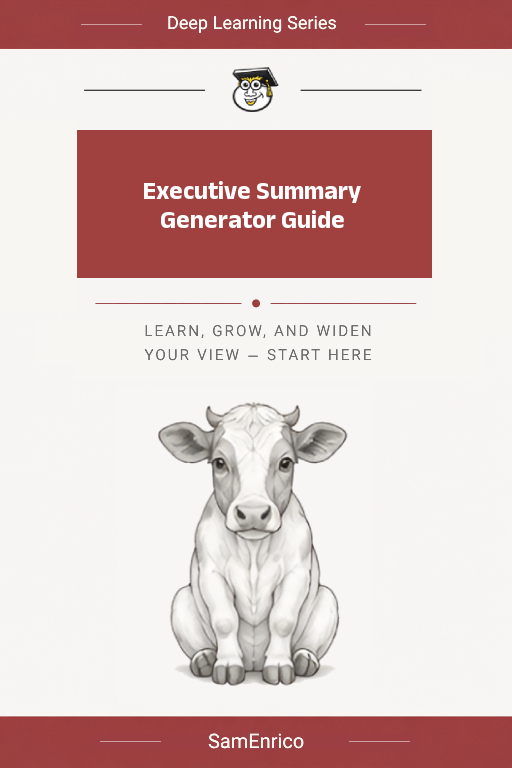
Executive Summary Generator Guide
Craft compelling executive summary for your busine
by Malcolm Bret
Craft compelling executive summary for your business plan using free templates and real startup examples online.
Formats
About this book
Free sample
Chapter 1: The $2M Mistake--Every year, thousands of entrepreneurs send their executive summaries into a black hole. They polish every word, add footnotes, include three years of projections, and attach an appendix. Then they wait. And wait. The silence, they assume, means their idea isn't good enough.
But the data tells a different story. Based on an analysis of over 500 rejected funding applications, the single biggest predictor of silence isn't market size, team pedigree, or even revenue. It's document length. Summaries exceeding two pages have a 94% rejection rate before the first meeting. Yet founders continue to write ten-page documents, convinced that more words equal more persuasion.This book exists because that assumption is catastrophically wrong.The Over-Engineering Epidemic Let’s start with a sobering statistic drawn from angel investor surveys conducted across three major accelerator cohorts: founders lose access to capital not because their idea is bad, but because their executive summary is "over-engineered." That term—over-engineered—appears in investor feedback with alarming frequency.
What does it actually mean? It means the document tries too hard. It means the founder attempted to answer every possible question before any question was asked. It means the summary reads like a term paper written by someone who fears ambiguity more than they value clarity.The psychology behind over-engineering is understandable. You have spent months—maybe years—building something you genuinely believe in.
You know every detail, every edge case, every contingency. When you sit down to write the executive summary, your brain wants to prove that you have thought of everything. So you include the market segmentation table. You add the five-year cash flow projection. You explain the regulatory landscape in three paragraphs.
By page four, you are describing the technical architecture of your API.Here is what the investor sees: a wall of text. A document that signals insecurity, not confidence. Because the unspoken rule of early-stage fundraising is this: if you cannot explain your business on one page, you do not understand your business well enough to scale it.The Minimum Viable Document (MVD)Drawing from Eric Ries’ transformative work in The Lean Startup, this…
This is the end of the free sample. Get the eBook to keep going. Buy now
Contents
- Chapter 1
- Chapter 2
- Chapter 3
- Chapter 4
- Chapter 5
- Chapter 6
- Chapter 7
- Chapter 8
- Chapter 9
- Chapter 10
- Chapter 11
- Chapter 12
Details
- Author
- Malcolm Bret
- Publisher
- SamEnrico
- Language
- English
- Genre
- Non-Fiction, Startup Guide, Executive Summary, Pitching
- Released
- 2026-06-01
- Pages (approx.)
- 154
- Available as
- eBook, Audiobook

Read better in the ZLOADR app
Your eBooks on your phone or tablet. Sign in with your SamEnrico account and start reading.
More by Malcolm Bret
 Group Creative Debrief Techniques HandbookMalcolm Bret$11.99
 Messy Spaces Anger TriggerMalcolm Bret$11.99
 Burnout Financial PlanningMalcolm Bret$11.99
 The Affiliate Lead FunnelMalcolm Bret$11.99
 Byron Nelson Streak BiographyMalcolm Bret$11.99
 The Fractal Coast of Brazil: Mandelbrot's Legacy in the DeepMalcolm Bret$11.99
 Whispers of the Ancient Forest: The Secret Life of the Amazon's Last Uncontacted TribeMalcolm Bret$11.99
 Understanding Chronic Myelogenous LeukemiaMalcolm Bret$17.99
 How to Start a Construction of Utility Projects for Telecommunications Business (Beginners Guide)Malcolm Bret$11.99
 Podia Product Launch GuideMalcolm Bret$12.99
 Data Science ConsultantMalcolm Bret$11.99