
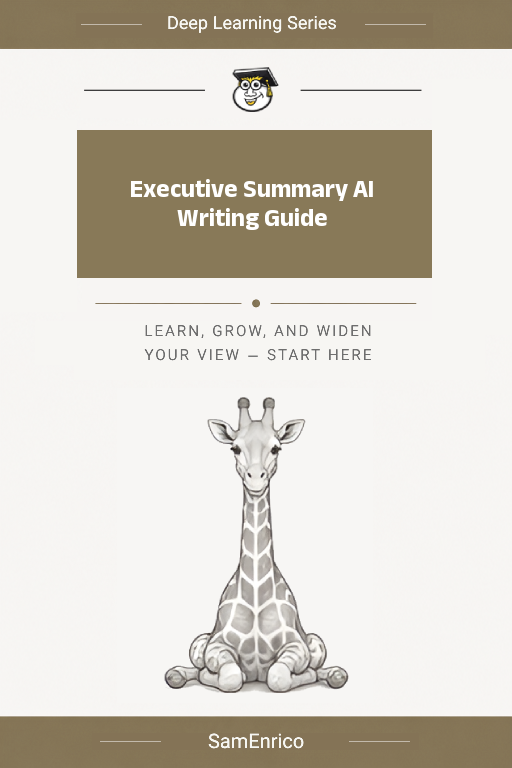
Non-FictionProfessional's Cheat SheetBusiness Writing
Executive Summary AI Writing Guide eBook
Use ChatGPT and other AI to draft executive summar
by Himes Dean
Use ChatGPT and other AI to draft executive summaries. Prompts and human editing checkpoints.
Formats
Free sample
Chapter 1: The $10 Million Typo--–- The VP of Product at a mid-sized Saa S company named Cloud Logic stared at his screen. He had just used Chat GPT to summarize a 50-page competitive threat report from his strategy team. The AI produced three clean paragraphs: fluent, confident, and grammatically perfect. It mentioned a “moderate competitive landscape,” noted that “several players are exploring adjacent technologies,” and concluded with the lethal phrase “further discussion recommended before any decisive action.”The VP skimmed the summary for 45 seconds, forwarded it to his CEO with a note that read “FYI – monitoring the situation,” and turned his attention to a more urgent fire drill. Three months later, a competitor filed a patent that Cloud Logic’s own engineers had documented in Appendix J of that very report—a patent that made Cloud Logic’s core product legally vulnerable.
The company lost a $10 million enterprise deal. The VP was fired before the quarter ended. The CEO later told the board, “I never saw the risk because the summary I received didn’t show it.”That VP was not lazy. He was not stupid. He was busy, he trusted the AI, and he did not know that executive summaries fail in predictable, preventable ways—and that AI makes those failures harder to see, not easier.The Three Fatal Flaws That Kill Executive Summaries Executive summaries have one job: to enable a decision-maker to say yes, no, or wait within 60 seconds.
Yet most executive summaries fail at this job. After analyzing over 500 real-world summaries—from Fortune 500 board decks to startup pitch memos to government briefings—three fatal flaws appear again and again, whether the summary was written by a human, an AI, or a combination of both.Flaw One: Burying the Lead The first and most common flaw is burying the lead. Writers present background, context, methodology, and history before stating the conclusion. They write as if the reader needs a running start before being told the answer. This is the academic essay model—thesis at the end—applied to a genre that demands the opposite.Consider a typical AI-generated summary from a real corporate report.
The AI produced:*“Over the past six quarters, the North American sales team has tested multiple channel strategies, including direct outreach, partner-led motions, and self-service digital funnels. The data shows varying degrees of success across regions. After analyzing conversion rates, customer acquisition costs, and lifetime value, we find that the partner-led motion outperforms other channels by 22%. This suggests a reallocation of marketing spend.”*The decision-maker has to read 68 words before discovering the answer (partner-led motion wins). In a 60-second scan, many readers will stop after the first sentence, assuming the summary is background noise.
The lead—the verdict—should be the first sentence:*“Reallocate 40% of marketing spend to partner-led motions, which outperform other channels by 22% in North America.”*Everything else is supporting evidence that follows after the verdict. The Pyramid Principle, developed by Barbara Minto at Mc Kinsey, calls this “conclusion first.” AI models, trained on a diet of academic papers, blog posts, and general web text, default to the opposite structure: context first, conclusion last. This is not the AI’s fault—it is mimicking the data it was trained on. The human’s job is to reverse that default.Flaw Two: Data Overload The second fatal flaw is data overload. Writers dump every number, every KPI, and every data point into the summary, assuming that more information equals better decision-making.
In reality, executives suffer from what decision scientist Daniel Kahneman calls “noise”—irrelevant variation that obscures signal.An AI summarizing a quarterly business review might produce:“Q3 revenue was 24.3M,upfrom24.3M, up from 24.3M,upfrom22.1M in Q2 and 21.0Min Q1.Grossmarginwas6821.0M in Q1. Gross margin was 68%, compared to 67% in Q2 and 66% in Q1. Customer acquisition cost was 21.0Min Q1.Grossmarginwas68412, down from 445in Q2.Churnwas4.2445 in Q2. Churn was 4.2%, up from 3.8% in Q2. Net retention was 112%, flat from Q2.
Operating expenses were 445in Q2.Churnwas4.218.2M, including 6.1M for R&D, 5.4M for sales and marketing, 4.2M for G&A, and 2.5M for other.”This is a data dump, not a summary. The reader has no idea which numbers matter most. Is churn up 40 basis points a crisis or noise? Is operating expense growth justified? The AI has provided quantity without hierarchy.The fix is to ask one question: what three numbers tell the story?
Every executive summary should have a maximum of three key metrics, each with a clear directional interpretation (up good, down bad, or variance explained). Everything else belongs in an appendix.A properly summarized version would read:“Three numbers define Q3: revenue grew 10% to 24.3M(targetwas824.3M (target was 8%), churn worsened to 4.2% (target was 3.5%), and CAC dropped 7% to 24.3M(targetwas8412 (target was flat). The churn increase is concentrated in one customer segment and requires a retention task force.”Three numbers. One sentence explaining why each matters. The reader can absorb this in ten seconds.Flaw Three: No Call to Action The third fatal flaw is the absence of an explicit call to action.
The summary describes a situation, analyzes options, presents data—and then ends. No ask. No decision required. No next step.AI models are particularly prone to this flaw because they are trained to be polite, neutral, and non-coercive. They end summaries with phrases like:“Further discussion may be needed.”“The team recommends continued monitoring.”“Management should consider these findings in future planning.”“No immediate action is required.”These are not calls to action.
They are invitations to do nothing. A real executive summary ends with one of three possible asks:Approve something: a budget, a hire, a contract, a strategy.Decide between options: A, B, or C.Schedule a review by a specific date with specific pre-work.The AI-generated summary that destroyed Cloud Logic ended with “further discussion recommended before any decisive action.” This was not a neutral statement—it was an active disservice. The VP read “further discussion” and heard “not urgent.” The CEO read “monitoring the situation” and heard “nothing to see here.” A proper call to action would have been:“Decide by Friday: authorize a patent search and provisional filing at a cost of $45K, or accept the risk that a competitor may beat us to the patent. Doing nothing is a decision to accept that risk.”That sentence would have saved the VP’s job and the company’s $10 million deal.How AI Amplifies Bad Writing Habits If these three flaws were only human problems, the solution would be simple: train humans to write better summaries. But AI introduces a new danger.
AI does not just fail in the same ways humans fail—it amplifies those failures by making them harder to detect.The Polished Plausibility Problem AI models are trained to produce text that is fluent, grammatically correct, and confident in tone. This is called “surface fluency.” A sentence like “The data suggests a moderate competitive landscape with several players exploring adjacent technologies” sounds authoritative. It has the rhythm of expertise. But it is almost entirely empty of meaning.What does “moderate” mean? Which players?
What “adjacent technologies”? How does this affect Cloud Logic’s specific product line? The AI has produced a sentence that feels…
This is the end of the free sample. Get the eBook to keep going. Buy now
About this book
Details
- Author
- Himes Dean
- Publisher
- SamEnrico
- Language
- English
- Genre
- Non-Fiction, Professional's Cheat Sheet, Business Writing
- Released
- 2026-06-01
- Pages (approx.)
- 139
- Available as
- eBook, Audiobook

Read better in the ZLOADR app
Your eBooks on your phone or tablet. Sign in with your SamEnrico account and start reading.
More by Himes Dean
 Lucid Dreaming For Nightmare Control CourseHimes Dean$11.99
 Trauma Based Anger TriggersHimes Dean$11.99
 The Teen Self Esteem Coaching GuideHimes Dean$11.99
 Creator Morning RoutineHimes Dean$11.99
 The Bullying Self Esteem RecoveryHimes Dean$11.99
 The Iron Protocol: Prussia's Pandemic DefenseHimes Dean$11.99
 Creative WritingHimes Dean$11.99
 Apple Ecosystem GuideHimes Dean$12.99Apple Ecosystem GuideHimes Dean$12.99
 How to Start a Balloon (not Toy) Business (Beginners Guide)Himes Dean$11.99
 Understanding ProgeriaHimes Dean$17.99
You may also like
 Hong Kong Handover 1997Dunn Johnnie$11.99
 Zumba For Postnatal Recovery CourseNeal Christian$11.99
 Zumba for BeginnersLadner Nikia$11.99
 YouTube Comment Mining GuideHumes Pandora$12.99
 Worry Box MeditationCarlin Rudy$11.99
 Workplace Stress MeditationNguyen Lynn$11.99
 Workplace Stress and Sleep RepairHawley Ivory$11.99
 Workplace Perfectionism CureDelaney Jeffry$11.99
 Workplace Injustice Anger GuideWallen Isabelle$11.99
 Work Addiction and Burnout LinkGreenwood Ester$11.99
 Women in Yoga and WellnessBeattie Galina$11.99
 Women in Stand Up ComedyChun Evangeline$11.99