
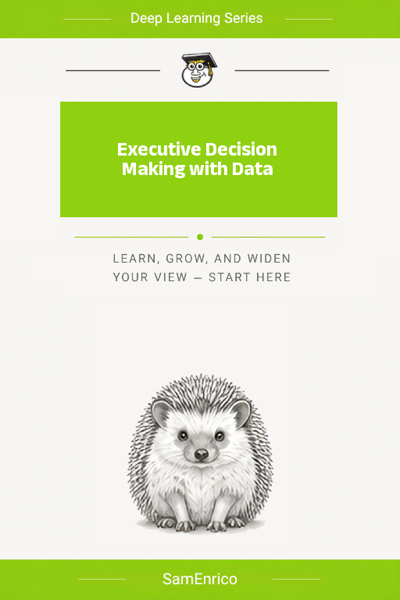
Non-FictionInformativeEducational
Executive Decision Making with Data eBook
A Coursebook on Executive Decision Making with Dat
A Coursebook on Executive Decision Making with Data
Formats
Free sample
Chapter 1: The Precision Trap--It was 3:47 PM on a Thursday when Sarah, a twenty-two-year-old analyst at a mid-sized retail chain, hit send on her fifteenth email of the day. The subject line read: “Q3 Forecast – FINAL_v12_ACTUAL_FINAL.”The CEO had asked a simple question three weeks earlier: Should we increase production by twenty percent ahead of the holiday season?Three weeks. Eleven versions of the forecast. Seven meetings. Four conflicting statistical models.
Two consultants. One analyst on the verge of tears.And the CEO still did not know what to do.The data was excellent. They had five years of transactional history, real-time inventory tracking, competitor pricing scrapers, customer sentiment from social media, and a newly implemented machine learning model that predicted demand with ninety-four percent accuracy. They had more data than any of their competitors. They were, by every measure, a “data-driven” organization.And it had made them slower.
Not smarter. Not more confident. Slower.This is the Paradox of Precision. And it is the single biggest reason data-rich companies fail to make better decisions than their intuition-driven rivals.The Myth of the Data-Driven Organization For the past decade, business leaders have been told a seductive story. The story goes like this: intuition is biased, experience is limited, and gut feelings are relics of a pre-digital age.
The future belongs to those who follow the data. “In God we trust,” the saying goes, “all others must bring data.”This story has spawned an entire industry of dashboards, data warehouses, chief data officers, and analytics consultants. It has convinced well-intentioned executives that if they just had one more dashboard, one more report, one more decimal place of precision, the right answer would finally appear.It is a lie.Not because data is useless. Data is essential. But because the promise of data-driven decision-making confuses two fundamentally different kinds of decisions: operational and strategic.Operational vs.
Strategic Decisions Operational decisions are repetitive, high-volume, and have clear feedback loops. Think: how many units of toothpaste should be restocked at Store #437? How much should we bid for this keyword ad? Which shipping carrier is cheapest for this package? These decisions benefit from precision.
They can be automated. The data is clean, the variables are known, and the cost of being slightly wrong is low.Strategic decisions are rare, high-stakes, and have no clear feedback loops. Think: should we acquire this competitor? Should we enter the Southeast Asian market? Should we bet the company on streaming video?
These decisions cannot be automated. The data is always incomplete. The future is genuinely uncertain—not just risky, but uncertain in the Knightian sense, where probabilities cannot be known in advance.The Precision Trap is the false belief that strategic decisions can be transformed into operational ones by adding more data. They cannot. More data does not reduce strategic uncertainty; it often reveals new uncertainties, creating an infinite regress of “one more analysis.”Blockbuster vs.
Netflix: A Case Study in the Precision Trap No case illustrates this better than the downfall of Blockbuster and the rise of Netflix.In the early 2000s, Blockbuster was a data giant. They had point-of-sale data from over nine thousand stores, tracking exactly which movies rented in which neighborhoods, at what times, on which days of the week. They had sophisticated inventory optimization models that told them how many copies of The Matrix to ship to each store. They had customer loyalty data, rental history, and late fee revenue forecasts. By any standard, Blockbuster was “data-driven.”Netflix, by contrast, was operating in the dark.
In 2007, when Reed Hastings decided to pivot from DVD-by-mail to streaming, he had almost no data on customer demand for streaming video. The market did not exist yet. There were no base rates to consult. The technology was unproven. The bandwidth wasn't there.
The content licensing model was a mystery.So why did Netflix succeed while Blockbuster failed?Because Blockbuster was trapped by its own precision. When the streaming threat emerged, Blockbuster’s data suggested that streaming was a tiny, unprofitable niche. Their models, trained on historical rental patterns, could not see the future. They demanded proof that streaming would work before they would invest. That proof could not exist—because the future had not happened yet.
So they waited. And waited. And while they waited, Netflix built a moat.Netflix succeeded not because they had better data, but because they understood something Blockbuster did not: when the cost of delay exceeds the cost of error, you must decide with the data you have, not the data you wish you had.Risk vs. Uncertainty: A Crucial Distinction To escape the Precision Trap, executives must internalize one of the most underappreciated distinctions in decision theory: the difference between risk and uncertainty.Risk is when the probabilities are known. A casino operates under risk.
The house knows that over millions of hands, blackjack will pay out at a statistically predictable rate. The variables are bounded. The system is closed. Data can reduce risk to a calculable number.Uncertainty is when the probabilities are not known—and cannot be known. A startup entering a new market operates under uncertainty.
The variables are unbounded. The system is open. History offers no clean precedents. Data from the past may actively mislead you about the future.Here is the painful truth that most data consultants will not tell you: strategic decisions are almost always made under uncertainty, not risk. You cannot calculate the probability that a competitor will launch a disruptive technology.
You cannot assign a confidence interval to a geopolitical event. You cannot run an A/B test on whether to acquire a company.The Precision Trap is the attempt to treat uncertainty as if it were risk. It is the demand for a probability distribution when no such distribution exists.The Four Signs You Are in the Precision Trap How do you know if your organization has fallen into the Precision Trap? Look for these four signs:Sign 1: The Infinite Regress of Analysis. Every report generates requests for three more reports.
Every answer reveals ten new questions. The team never feels ready to decide.Sign 2: The Phantom 100%. Someone says, “We just need to be sure.” But strategic decisions cannot be sure. They can only be confident enough to act. The demand for certainty is a disguised demand for delay.Sign 3: Dashboard Proliferation.
Your organization has more dashboards than decisions. New dashboards are celebrated. Decisions that use them are not.Sign 4: The Blameless Analyst. When a decision goes wrong, no one asks, “Was our decision process sound given what we knew at the time?” Instead, they ask, “Which data point did we miss?” This trains the organization to hoard data, not to decide.The Cost of Waiting Every executive knows, intellectually, that delay has a cost. But few internalize just how high that cost can be.Consider a simple model.
You are deciding whether to launch a new product. You have two options: decide now with 70% confidence, or wait six months for 90% confidence.Let’s say the product, if launched now, has a 70% chance of success, with a net present value of $100 million. If you wait six months, you increase…
This is the end of the free sample. Get the eBook to keep going. Buy now
About this book
Details
- Author
- Oleary Andria
- Publisher
- SamEnrico
- Language
- English
- Genre
- Non-Fiction, Informative, Educational
- Released
- 2026-06-02
- Pages (approx.)
- 143
- Available as
- eBook, Audiobook

Read better in the ZLOADR app
Your eBooks on your phone or tablet. Sign in with your SamEnrico account and start reading.
More by Oleary Andria
 Professor Office Hours UseOleary Andria$11.99
 Smoking Cessation for Construction WorkersOleary Andria$11.99
 Mindfulness for PhobiasOleary Andria$11.99
 Financial Stress for Truck DriversOleary Andria$11.99
 The Sword and the Scroll: Sun Tzu's Shadow Over the Warring StatesOleary Andria$11.99
 How to Produce Auto OilOleary Andria$11.99
 How to Start a Ferro Alloys (high Carbon Ferro Manganese) Business (Beginners Guide)Oleary Andria$11.99
You may also like
 Hong Kong Handover 1997Dunn Johnnie$11.99
 Zumba For Postnatal Recovery CourseNeal Christian$11.99
 Zumba for BeginnersLadner Nikia$11.99
 YouTube Comment Mining GuideHumes Pandora$12.99
 Worry Box MeditationCarlin Rudy$11.99
 Workplace Stress MeditationNguyen Lynn$11.99
 Workplace Stress and Sleep RepairHawley Ivory$11.99
 Workplace Perfectionism CureDelaney Jeffry$11.99
 Workplace Injustice Anger GuideWallen Isabelle$11.99
 Work Addiction and Burnout LinkGreenwood Ester$11.99
 Women in Yoga and WellnessBeattie Galina$11.99
 Women in Stand Up ComedyChun Evangeline$11.99