
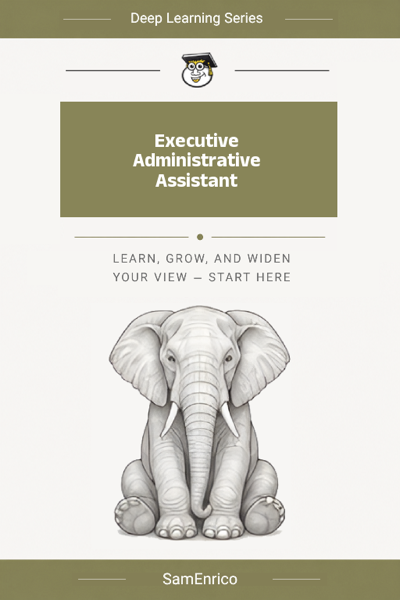
Non-FictionInformativeEducational
Executive Administrative Assistant eBook
A Coursebook on Executive Administrative Assistant
A Coursebook on Executive Administrative Assistant
Formats
Free sample
Chapter 1: The Invisible Engine...--You are already doing the work of three people. You anticipate your executive’s next move before they make it. You absorb chaos, translate ambiguity into order, and carry the unspoken weight of an entire office. And yet, when someone asks what you do, you probably say something like, “I’m an assistant” or “I handle schedules and email.”Stop saying that.Not because you should be ashamed of the title, but because you have been describing a job you left behind two years ago. The world has changed.
The corner office has changed. The executive’s needs have changed. But the script most administrative professionals use to explain their role is still stuck in 1995. This book exists to fix that gap—not just in how you talk about your work, but in how you actually do it.Welcome to the new standard. Welcome to the invisible engine.The Moment Everything Changed Let us start with a story.
Not a hypothetical example pulled from a textbook, but a composite of conversations with hundreds of executive assistants who have sat across from me in coaching sessions, workshop breakout rooms, and conference panels.Maria had been an Executive Assistant for eleven years. She supported a Vice President of Sales at a publicly traded technology company. She was excellent at her job—fast, accurate, loyal, and unfailingly pleasant. Her executive, a man named David, trusted her completely. He gave her access to his calendar, his email, his travel accounts, and his team’s internal Slack channels.
She knew his coffee order, his flight preferences, his tolerance for back-to-back meetings, and the exact tone he wanted in emails declining a request versus emails accepting one.Then David quit. He took a CEO role at a smaller private company and asked Maria to come with him. She said yes.Within three weeks, Maria realized she was no longer an Executive Assistant. She was a Chief of Staff, an Office Manager, an HR coordinator, an IT liaison, and a project lead for a software implementation that David had promised the board but had not told anyone about. Her title did not change.
Her salary increased modestly. But her responsibilities tripled.“I thought I knew how to be an EA,” Maria told me. “But I had only learned how to support one person in one system. I had never learned how to be a strategic partner regardless of who I supported or where I sat.”Maria’s problem was not a lack of effort. It was a lack of framework.
She had been trained—by experience, by intuition, by trial and error—to support a specific executive in a specific context. When that context changed, she had to rebuild her understanding from scratch.This book is the framework Maria wished she had. It is not about your specific boss, your specific industry, or your specific software stack. It is about the underlying architecture of excellence in the modern Executive Administrative Assistant role—an architecture that works whether you support a start-up founder in a We Work or a Fortune 500 CEO on the forty-seventh floor.The Stereotype You Are Still Fighting Let us name the enemy clearly. It is not your executive.
It is not your organization. It is the lingering ghost of the 1950s secretarial stereotype that refuses to die.That stereotype has many faces. Sometimes it is the visiting executive who asks you to “grab coffee” for a meeting you are not invited to attend. Sometimes it is the HR system that classifies you as “administrative support” alongside the mailroom and the catering team. Sometimes it is your own parent, who still asks, “So have you thought about what you want to do with your career?”Here is what the stereotype assumes: that your work is reactive (you wait for instructions), clerical (you type and file), and invisible (you enable others to look good while you remain in the background).
Here is what the stereotype gets wrong: nearly everything.The modern Executive Administrative Assistant does not wait for instructions; they anticipate needs before the executive articulates them. They do not just type and file; they synthesize information, manage complex projects, and make judgment calls that affect budgets and timelines. They are not invisible; they are the connective tissue that holds teams together, the early warning system that catches mistakes before they become crises, and the strategic partner who frees the executive to focus on what only they can do.If you have ever felt frustrated that people do not understand your job, you are not alone. But the solution is not to wait for the stereotype to die. The solution is to outgrow it so completely that it becomes irrelevant.
That process starts with a single, uncomfortable question: Are you still doing work that reinforces the stereotype?The P.A.S.S. Framework: Your New Operating System Over the next twelve chapters, you will learn dozens of specific skills, scripts, templates, and tools. But before you learn any of them, you need a mental operating system to organize everything. That operating system is the P.A.S.S. Framework.P.A.S.S.
stands for four interconnected competencies:P – Proactive You do not wait for requests; you anticipate them. Proactivity means looking at the executive’s calendar, inbox, and priorities and asking, “What will they need that they have not asked for yet?” It means preparing the board deck before they remember the board meeting exists. It means flagging a scheduling conflict before the executive double-books themselves. Proactivity is the difference between being a firefighter (running from crisis to crisis) and a fire marshal (preventing crises before they start).A – Anticipatory Anticipation is proactivity with a time horizon. Specifically, it is the discipline of thinking in three windows: three hours, three days, and three weeks.
What will your executive need in the next three hours? The agenda for the upcoming call, the talking points for a difficult conversation, the corrected version of a document they just spotted an error in. What will they need in the next three days? The travel arrangements for next week’s offsite, the pre-read materials for a Monday morning board meeting, the completed expense report that is due Friday. What will they need in the next three weeks?
The quarterly business review presentation drafted, the headcount approval form submitted, the venue confirmed for the client event. Most assistants think one hour ahead. Good assistants think one day ahead. Elite assistants think three weeks ahead while still handling the three-hour tasks.S – Strategic Strategic work is any activity that directly advances the executive’s highest priorities. This is where the stereotype dies.
Answering email is operational. Triaging email so the executive only sees what requires their unique judgment—that is strategic. Scheduling a meeting is operational. Designing a weekly calendar architecture that protects the executive’s deep work time and accommodates stakeholder needs—that is strategic. Taking notes is operational.
Synthesizing messy, meandering discussion into a clear decisions-and-action-items document that drives execution—that is strategic. The difference is always value added beyond transcription. Strategic work requires judgment, context, and an understanding of the business.S – Supportive Supportiveness is not…
This is the end of the free sample. Get the eBook to keep going. Buy now
About this book
Details
- Author
- Fortune Treva
- Publisher
- SamEnrico
- Language
- English
- Genre
- Non-Fiction, Informative, Educational
- Released
- 2026-05-11
- Pages (approx.)
- 160
- Available as
- eBook, Audiobook

Read better in the ZLOADR app
Your eBooks on your phone or tablet. Sign in with your SamEnrico account and start reading.
More by Fortune Treva
 Recovering From Awkward SilenceFortune Treva$11.99
 Parent vs Non Parent GamersFortune Treva$11.99
 Receipt BPA Exposure GuideFortune Treva$11.99
 MBSR for Anxiety DisordersFortune Treva$11.99
 Body Scan For Grief WavesFortune Treva$11.99
 From the Outback to the Nobel Stage: The Unlikely Rise of Patrick WhiteFortune Treva$11.99
 Understanding Ptosis Strabismus DiastasisFortune Treva$17.99Understanding Ptosis Strabismus DiastasisFortune Treva$17.99
 Agency Marketing One Page PlanFortune Treva$12.99
 French Language for Express EntryFortune Treva$12.99
 How to Become a Oil-well-service OperatorFortune Treva$11.99
You may also like
 Hong Kong Handover 1997Dunn Johnnie$11.99
 Zumba For Postnatal Recovery CourseNeal Christian$11.99
 Zumba for BeginnersLadner Nikia$11.99
 YouTube Comment Mining GuideHumes Pandora$12.99
 Worry Box MeditationCarlin Rudy$11.99
 Workplace Stress MeditationNguyen Lynn$11.99
 Workplace Stress and Sleep RepairHawley Ivory$11.99
 Workplace Perfectionism CureDelaney Jeffry$11.99
 Workplace Injustice Anger GuideWallen Isabelle$11.99
 Work Addiction and Burnout LinkGreenwood Ester$11.99
 Women in Yoga and WellnessBeattie Galina$11.99
 Women in Stand Up ComedyChun Evangeline$11.99