
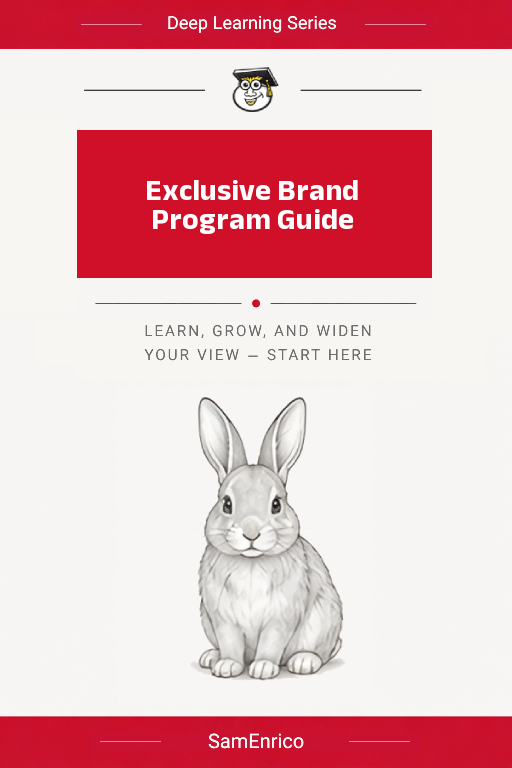
Non-FictionBusiness BriefBrand Programs
Exclusive Brand Program Guide eBook
Apply for Jumia Mall versus Amazon Brand Registry
by Rush Meta
Apply for Jumia Mall versus Amazon Brand Registry versus Alibaba Gold Supplier. Verified status increases buyer trust and reduces competition for sellers.
Formats
Free sample
Chapter 1: The Trust Premium--The most expensive product on Amazon is rarely the best. It is simply the one buyers are least afraid to purchase.This is not a theory. It is a behavioral fact backed by billions of transactions. When a buyer cannot touch, see, or test a product before buying, their brain defaults to a single question: “What is the worst that could happen?” If the answer involves losing money to a scammer, receiving a counterfeit, or waiting weeks for a box of rocks, they will not click “Buy Now.” They will click away.And then they will buy from someone else. Often at a higher price.
Often from a seller who has done nothing more than signal trust more effectively.This chapter dismantles the single most damaging myth in e-commerce: that price is the primary driver of purchase decisions. It introduces the concept of the Trust Premium—the measurable extra margin that verified sellers can charge simply because buyers perceive them as safer. You will learn why a verified badge can be worth more than a 20% price cut, how to calculate your own Trust Premium, and why chasing the lowest price is the fastest path to bankruptcy.By the end of this chapter, you will never look at a “sale” or a “discount” the same way again.The $7 Billion Blind Spot Let us start with a story.In 2021, a seller named Priya launched a line of wireless earbuds on Amazon. She priced them at 39.99.Hercompetitor,anunverifiedsellerusingagenericbrandname,pricednearlyidenticalearbudsat39.99. Her competitor, an unverified seller using a generic brand name, priced nearly identical earbuds at 39.99.Hercompetitor,anunverifiedsellerusingagenericbrandname,pricednearlyidenticalearbudsat29.99.
Priya worried that her higher price would kill her sales.She was wrong.Over the next 90 days, Priya sold 4,700 units at 39.99.Thecheapercompetitorsold1,200unitsat39.99. The cheaper competitor sold 1,200 units at 39.99.Thecheapercompetitorsold1,200unitsat29.99. Priya’s revenue was 188,000.Thecompetitor’srevenuewas188,000. The competitor’s revenue was 188,000.Thecompetitor’srevenuewas35,880. Priya’s product had a 4.8-star rating.
The competitor had 3.2 stars, largely driven by complaints about “fake product” and “not as described.”What happened?Priya had invested in Amazon Brand Registry. She had A+ Content with professional photography. She had a trademarked brand name. Her listing displayed the “Brand Registry” badge—a subtle blue checkmark that most buyers do not consciously notice but unconsciously trust. The cheaper seller had none of these.Priya was not selling earbuds.
She was selling safety.The global e-commerce trust gap—the difference between what buyers want to spend and what they actually spend due to fear of fraud, counterfeits, and poor quality—is estimated at $7 billion annually. This is not money lost to scams. This is money that buyers are willing to pay but choose not to because they do not trust the seller.Every time a buyer clicks away from your listing because something feels “off,” you lose revenue. Every time a buyer chooses a verified seller at a higher price over your unverified listing at a lower price, you lose margin. And every time you drop your price to compete with unverified sellers, you enter a race to the bottom that only one person wins: the platform.The verified badge is not a gold star.
It is a permission slip for buyers to spend more money with you.The Psychology of the Blue Check To understand why verification beats cheap, you must first understand how the human brain makes purchase decisions under uncertainty.Psychologists call this heuristic decision-making. When faced with too much information (thousands of products, hundreds of sellers, dozens of price points), the brain takes shortcuts. It looks for signals. A verified badge is one of the most powerful signals available.Consider the “blue check” phenomenon on social media. When Twitter (now X) introduced verified badges for celebrities and public figures, engagement on verified accounts skyrocketed—not because the content changed, but because users trusted the source more.
The same psychology applies to e-commerce.The Blue Check Effect: A verified badge reduces perceived risk, which increases willingness to pay.In a 2022 study conducted by a consortium of e-commerce researchers, buyers were shown two identical product listings. The only difference was a “Verified Seller” badge on one. When asked how much they would pay for the product, buyers offered an average of 18% more for the verified listing. When asked why, the most common response was: “It feels safer.”This effect is even stronger on mobile devices. When a buyer is scrolling on a small screen with limited attention, they do not have time to compare return policies, read reviews, or investigate seller history.
They look for the badge. If they see it, they click. If they do not, they scroll past.On Jumia, where mobile-first commerce dominates across Nigeria, Kenya, Egypt, and Morocco, the effect is magnified. Jumia Mall sellers—those who have passed the platform’s rigorous audit and been granted the Mall badge—convert at 2-3 times the rate of standard sellers. Not because their products are better.
Because their trust signal is louder.On Alibaba, where B2B transactions can exceed $100,000 per order, the trust premium is even more dramatic. Gold Suppliers with Verified status close deals 40% faster than unverified competitors. In B2B, speed is money. A 40% faster sales cycle means more deals per quarter, lower customer acquisition costs, and higher annual revenue.The blue check works because it answers the buyer’s unspoken question: “Can I trust you?” Before price, before features, before shipping speed, the buyer wants to know that you are real, that your product is genuine, and that they will not be scammed.Debunking the “Lowest Price Wins” Myth The belief that “lowest price always wins” is one of the most destructive ideas in e-commerce. It persists because it feels intuitive.
Of course buyers want to pay less. But wanting to pay less and actually paying less are two different things.Behavioral economists have documented the price-quality heuristic for decades. When buyers lack information about a product’s actual quality, they assume that price reflects quality. A higher price signals higher quality. A lower price signals lower quality.
This is why luxury goods can charge 10 times the cost of production—the high price is part of the product.In e-commerce, the price-quality heuristic interacts with the trust badge in fascinating ways. A verified seller charging 49.99isperceivedas“premiumbuttrustworthy.”Anunverifiedsellercharging49.99 is perceived as “premium but trustworthy.” An unverified seller charging 49.99isperceivedas“premiumbuttrustworthy.”Anunverifiedsellercharging29.99 is perceived as “cheap but risky.” Most buyers will choose the premium option because the cost of being wrong (receiving a counterfeit, dealing with a return, losing money entirely) is higher than the $20 savings.Let us put numbers on this.The Risk-Adjusted Purchase Decision Imagine you are buying a pair of noise-canceling headphones. Two options:Option A: Verified seller, $79.99, 4,000 reviews, 4.7 stars.Option B: Unverified seller, $49.99, 12 reviews, 3.2 stars.Which do you choose?If you are like most buyers, you choose Option A. The 30savingsisnotworththeriskofreceivingacounterfeitproductthatbreaksintwoweeks.Yourbrainhasperformedariskcalculation:∗“Whatistheprobabilitythat Option Bfails,andwhatisthecostofthatfailure?”∗Ifthefailureprobabilityfeelshigh(andwith3.2stars,itdoes),the30 savings is not worth the risk of receiving a counterfeit product that breaks in two weeks. Your brain has performed a risk calculation: *“What is the probability that Option B fails, and what is the cost of that failure?”* If the failure probability feels high (and with 3.2 stars, it does), the 30savingsisnotworththeriskofreceivingacounterfeitproductthatbreaksintwoweeks.Yourbrainhasperformedariskcalculation:∗“Whatistheprobabilitythat Option Bfails,andwhatisthecostofthatfailure?”∗Ifthefailureprobabilityfeelshigh(andwith3.2stars,itdoes),the30 savings is irrelevant.Now consider the…
This is the end of the free sample. Get the eBook to keep going. Buy now
About this book
Details
- Author
- Rush Meta
- Publisher
- SamEnrico
- Language
- English
- Genre
- Non-Fiction, Business Brief, Brand Programs
- Released
- 2026-05-30
- Pages (approx.)
- 146
- Available as
- eBook, Audiobook

Read better in the ZLOADR app
Your eBooks on your phone or tablet. Sign in with your SamEnrico account and start reading.
More by Rush Meta
 Pet Loss For Dog WalkersRush Meta$11.99
 Micronutrients For Migraine GuideRush Meta$11.99
 Heart Health Napping GuideRush Meta$11.99
 Venture Debt TermsRush Meta$11.99
 Fibromyalgia Fatigue SolutionsRush Meta$11.99
 Imposter Syndrome For New GradsRush Meta$11.99
 Caregiver for Alzheimer's PatientsRush Meta$11.99
 The Comedy Store DiariesRush Meta$11.99
 Fair Housing Compliance GuideRush Meta$11.99
 The Golden Ledgers of Timbuktu: Africa's Financial GeniusesRush Meta$11.99
 Rum Wars: The Caribbean’s Bootlegger KingpinsRush Meta$11.99
 Prompting for Real-Time Decision SystemsRush Meta$11.99
You may also like
 Hong Kong Handover 1997Dunn Johnnie$11.99
 Zumba For Postnatal Recovery CourseNeal Christian$11.99
 Zumba for BeginnersLadner Nikia$11.99
 YouTube Comment Mining GuideHumes Pandora$12.99
 Worry Box MeditationCarlin Rudy$11.99
 Workplace Stress MeditationNguyen Lynn$11.99
 Workplace Stress and Sleep RepairHawley Ivory$11.99
 Workplace Perfectionism CureDelaney Jeffry$11.99
 Workplace Injustice Anger GuideWallen Isabelle$11.99
 Work Addiction and Burnout LinkGreenwood Ester$11.99
 Women in Yoga and WellnessBeattie Galina$11.99
 Women in Stand Up ComedyChun Evangeline$11.99