
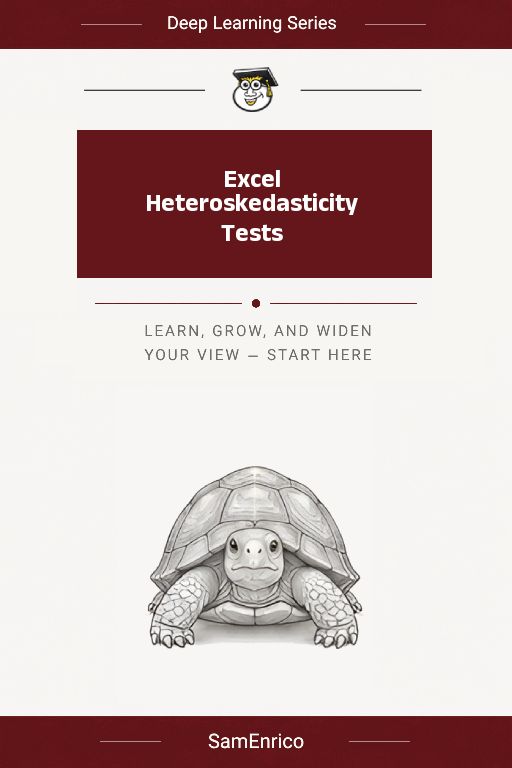
Non-FictionStudent's ShortcutRegression Diagnostics
Excel Heteroskedasticity Tests
Detects and corrects heteroskedasticity in economi
by Jenson Eloy
Detects and corrects heteroskedasticity in economic regressions using Excel residual plots and White test approximations.
Formats
About this book
Free sample
Chapter 1: The Invisible Saboteur--You’ve just finished a regression in Excel. The coefficients look reasonable. The R-squared is respectable. Your p-values are tiny—statistically significant at the 1% level. You’re ready to present your findings to your boss, your client, or your dissertation committee.But there’s a problem you can’t see. A silent saboteur hiding in your residuals. It doesn’t bias your coefficients, so your eyes won’t catch it. But it quietly destroys your standard errors, inflates your t-statistics, and makes your hypothesis tests a lie.Its name is heteroskedasticity.And if you don’t learn to detect it and fix it, every regression you run from today forward is suspect.This chapter is not a dry theoretical introduction. It is a wake-up call. By the time you finish these pages, you will understand why household spending data behaves so differently from national GDP, why financial analysts lose millions trusting flawed standard errors, and—most importantly—exactly how to set up Excel to defend yourself against the invisible saboteur.Let’s start with a story.The Economist Who Almost Lost Her Reputation Dr. Sarah Chen was a rising star at a regional Federal Reserve bank. She had built a model predicting consumer default rates using household income, debt-to-income ratio, and credit score. Her regression looked perfect: high R-squared, all variables significant at 5%, and a clean residual plot—or so she thought.She presented her findings to the senior economists. The room nodded approvingly. Then one senior economist asked a single question: “Did you check for heteroskedasticity?”Sarah froze. She had run the regression in Excel using the Analysis Tool Pak. She had checked the residuals plot quickly. She saw no obvious pattern. But she hadn’t formally tested for heteroskedasticity.The senior economist smiled—not kindly, but knowingly. “If you’re using cross-sectional household data,” he said, “and you didn’t correct for heteroskedasticity, your standard errors are probably half of what they should be. Those significant coefficients? Might be garbage.”Sarah spent the next week re-running her analysis. He was right. Three of her five “significant” variables became insignificant after applying robust standard errors. Her model was wrong.She learned the hard way. You’re about to learn the easy…
This is the end of the free sample. Get the eBook to keep going. Buy now
Contents
- Chapter 1
- Chapter 2
- Chapter 3
- Chapter 4
- Chapter 5
- Chapter 6
- Chapter 7
- Chapter 8
- Chapter 9
- Chapter 10
- Chapter 11
- Chapter 12
Details
- Author
- Jenson Eloy
- Publisher
- SamEnrico
- Language
- English
- Genre
- Non-Fiction, Student's Shortcut, Regression Diagnostics
- Released
- 2026-06-01
- Pages (approx.)
- 120
- Available as
- eBook, Audiobook

Read better in the ZLOADR app
Your eBooks on your phone or tablet. Sign in with your SamEnrico account and start reading.
More by Jenson Eloy
 Partner Moods Self EsteemJenson Eloy$11.99
 Kigali Blockchain Registry GuideJenson Eloy$11.99
 Formaldehyde Offgassing PreventionJenson Eloy$11.99
 Driving Anger TriggersJenson Eloy$11.99
 The Luxury Brand Shopping AddictionJenson Eloy$11.99
 The Lost Code of Hammurabi: Deciphering the World's First Legal RevolutionJenson Eloy$11.99
 Understanding PseudogoutJenson Eloy$17.99
 District Service ManagerJenson Eloy$11.99
 Severance Agreement TrapsJenson Eloy$12.99
 How to Become a Operations And Intelligence AssistantJenson Eloy$11.99
You may also like
 Hong Kong Handover 1997Dunn Johnnie$11.99
 Zumba For Postnatal Recovery CourseNeal Christian$11.99
 Zumba for BeginnersLadner Nikia$11.99
 YouTube Comment Mining GuideHumes Pandora$12.99
 Worry Box MeditationCarlin Rudy$11.99
 Workplace Stress MeditationNguyen Lynn$11.99
 Workplace Stress and Sleep RepairHawley Ivory$11.99
 Workplace Perfectionism CureDelaney Jeffry$11.99
 Workplace Injustice Anger GuideWallen Isabelle$11.99
 Work Addiction and Burnout LinkGreenwood Ester$11.99
 Women in Yoga and WellnessBeattie Galina$11.99
 Women in Stand Up ComedyChun Evangeline$11.99