
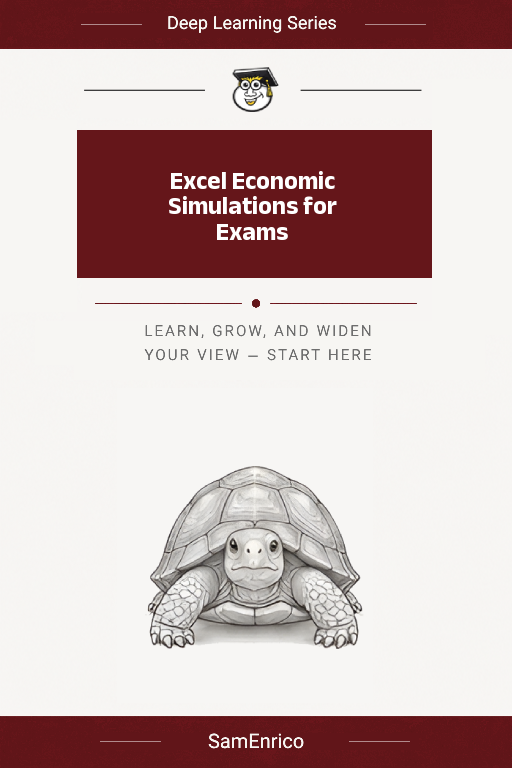
Non-FictionStudent's ShortcutEconomic Simulation
Excel Economic Simulations for Exams
Models economic systems using iterative calculatio
by Eastman Sam
Models economic systems using iterative calculations, feedback loops, and dynamic simulations for advanced economics exams.
Formats
About this book
Free sample
Chapter 1: The Spiral Truth...--–- Most students open Excel like a calculator on steroids. They type numbers into cells, write simple formulas, press Enter, and get a single answer. That approach works for adding up a column of exam scores or calculating the mean of a data set. But it fails catastrophically when you try to model an economy. An economy is not a static sum.
It is a web of circular dependencies: spending becomes income, income becomes spending, and the loop never ends. When you try to force that circle into a linear spreadsheet, Excel screams back at you with the error message that terrifies beginners: Circular Reference. Most students panic at that red warning. They assume they have made a mistake. This book will teach you the opposite.
A circular reference is not an error. It is the beginning of a simulation.This chapter introduces the single most important technical setting in the entire book: Iterative Calculation. Without it, you cannot model the multiplier effect, the circular flow of income, or any economic system where today depends on yesterday and yesterday depended on the day before. With it, you transform Excel from a static calculator into a dynamic simulation engine. You will learn how to enable iterative calculation, understand its two critical controls (Max Iterations and Max Change), and build your first working economic simulation: the Circular Flow of Income.
By the end of this chapter, you will have a living spreadsheet where GDP starts from a disequilibrium value and converges to equilibrium before your eyes. Examiners reward this dynamic understanding. Let us begin.The Static Trap: Why Most Spreadsheets Fail Economics Exams Imagine an examiner asks: "Using the multiplier model, explain how an increase in government spending of 100 affects national income over five periods." A static spreadsheet gives one answer: the new equilibrium. But the examiner wants to see the path. They want to know whether GDP jumps immediately to equilibrium or approaches it gradually.
They want to see whether the adjustment is smooth or oscillatory. They want to know how many periods it takes for…
This is the end of the free sample. Get the eBook to keep going. Buy now
Contents
- Chapter 1
- Chapter 2
- Chapter 3
- Chapter 4
- Chapter 5
- Chapter 6
- Chapter 7
- Chapter 8
- Chapter 9
- Chapter 10
- Chapter 11
- Chapter 12
Details
- Author
- Eastman Sam
- Publisher
- SamEnrico
- Language
- English
- Genre
- Non-Fiction, Student's Shortcut, Economic Simulation
- Released
- 2026-05-30
- Pages (approx.)
- 143
- Available as
- eBook, Audiobook

Read better in the ZLOADR app
Your eBooks on your phone or tablet. Sign in with your SamEnrico account and start reading.
More by Eastman Sam
 Partner Night Out AnxietyEastman Sam$11.99
 BPH Free Water Bottle GuideEastman Sam$11.99
 Cape Town Equity Split GuideEastman Sam$11.99
 Teen Body Scan For StressEastman Sam$11.99
 The Salary Negotiation Script BookEastman Sam$11.99
 The Ball That United a Kingdom: Medieval Football and the Birth of a National PassionEastman Sam$11.99
 Understanding Pseudoobstruction Idiopathic IntestinalEastman Sam$17.99
 EOR First Hire GuideEastman Sam$12.99EOR First Hire GuideEastman Sam$12.99
 How to Start a Pension Consultants (own Account) Business (Beginners Guide)Eastman Sam$11.99
 Electronics Engineering TechnicianEastman Sam$11.99
You may also like
 Hong Kong Handover 1997Dunn Johnnie$11.99
 Zumba For Postnatal Recovery CourseNeal Christian$11.99
 Zumba for BeginnersLadner Nikia$11.99
 YouTube Comment Mining GuideHumes Pandora$12.99
 Worry Box MeditationCarlin Rudy$11.99
 Workplace Stress MeditationNguyen Lynn$11.99
 Workplace Stress and Sleep RepairHawley Ivory$11.99
 Workplace Perfectionism CureDelaney Jeffry$11.99
 Workplace Injustice Anger GuideWallen Isabelle$11.99
 Work Addiction and Burnout LinkGreenwood Ester$11.99
 Women in Yoga and WellnessBeattie Galina$11.99
 Women in Stand Up ComedyChun Evangeline$11.99