
Non-FictionAdvanced Formulas GuidePractical Skills
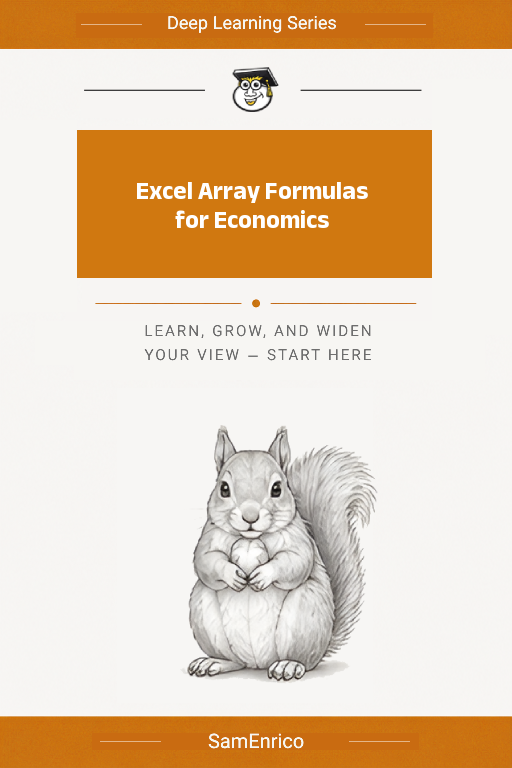
Excel Array Formulas for Economics eBook
Master CSE and dynamic array formulas for multi-ce
Master CSE and dynamic array formulas for multi-cell calculations. Essential for advanced economic modeling on exams.
Formats
Free sample
Chapter 1: The 2 AM Reckoning--It was 2:17 AM on a Tuesday when Marcus Vaughn, a senior economist at a regional economic consulting firm, discovered that his department’s flagship forecasting model had been miscalculating inflation expectations for the past eighteen months. The error was not dramatic. It was not an obvious crash or a glaring red flag. It was a subtle misalignment: a single relative reference that had shifted when someone inserted a new row of data, causing a chain reaction through forty-seven dependent formulas. The model had been wrong by an average of 0.3 percentage points per quarter.
In macroeconomic terms, that meant the firm had advised three major clients to make suboptimal investment decisions based on faulty projections. In career terms, it meant Marcus was about to have a very uncomfortable conversation with the managing partner at 8:00 AM.Marcus was not careless. He had built that model himself, meticulously, following every best practice he had learned in his MBA program and his twelve years in the industry. He used named ranges. He documented his assumptions.
He color-coded inputs, calculations, and outputs. He had even implemented a basic error-checking system that flagged inconsistencies. None of it caught the shifted reference because the shift had happened in a helper column that fed into the main calculation. The error-checking system checked the outputs, not the intermediate steps. By the time the error manifested as a visible output discrepancy, it was embedded so deeply that untangling it required three hours of cell-by-cell detective work.Marcus’s story is not unique.
It is the hidden epidemic of modern economic modeling. Spreadsheet errors cost organizations billions of dollars annually, not through fraud or malice, but through the slow accumulation of tiny mistakes that no one notices until they become large problems. The financial services industry alone loses an estimated $1 billion per year to spreadsheet errors, according to a study by the Spreadsheet Research Group. Government agencies, consulting firms, and central banks have similar stories. The errors are not caused by incompetence.
They are caused by tools and workflows that were never designed for the scale and complexity of modern economic analysis.The Fundamental Flaw You Didn’t Know You Had To understand why Marcus’s model failed, we must examine the hidden flaw in how almost every economist learns to use Excel. From your first spreadsheet class in college through your most recent training session, you have been taught a single mental model: a worksheet is a grid of cells, each cell contains either a value or a formula, and formulas reference other cells. You write a formula in one cell. You copy that formula to other cells by dragging or double-clicking the fill handle. The copied formulas adjust their references relative to their new positions.
This is called relative referencing, and it is the bedrock of spreadsheet modeling.This model has one catastrophic weakness. When you copy a formula across hundreds or thousands of cells, you are no longer maintaining one logical statement. You are maintaining hundreds or thousands of individual statements that happen to be similar but are not identical. Each copied formula is its own independent entity. If you need to change the logic, you must change every copy.
If one copy gets overwritten accidentally, the model silently produces wrong results. If you insert or delete rows, some copies may shift while others do not, depending on how you structured your ranges.This weakness is not theoretical. It is the direct cause of the majority of spreadsheet errors in professional practice. A study of 250 real-world financial models found that formula extension errors—incorrectly copied formulas—accounted for 44 percent of all material errors. Another study of models used by a major investment bank found that 86 percent of spreadsheets with more than 500 rows contained at least one formula extension error.
The more complex the model, the more likely it is to be wrong.The Array Alternative: One Formula, Many Results There is an alternative, and it is the central subject of this book. Instead of writing one formula and copying it many times, you write one formula that returns many results at once. This is called an array formula. In modern versions of Excel, these formulas spill their results across a range of cells automatically, creating a dynamic array that expands and contracts as your data changes.Consider a simple economic example. Suppose you have a column of quarterly GDP figures in cells B2 through B50 and a column of population estimates in cells C2 through C50.
You want to calculate GDP per capita for each quarter. The traditional approach is to write =B2/C2 in cell D2 and then drag that formula down to D50. You now have forty-nine copies of the formula, each slightly different because the relative references have shifted. If you insert a new row of data at row 25, the formulas below row 25 shift down, but the formulas above do not. The calculation for row 25 references the wrong cells.
The model breaks silently.The array approach is fundamentally different. In a single cell, you write =B2:B50/C2:C50 and press Enter. Excel calculates the entire division operation once, across the entire range, and spills the results down from that cell. If you insert a new row at row 25, the formula automatically updates to =B2:B51/C2:C51 and the spill range expands to include the new result. You did nothing.
The model maintained itself. There is only one formula to audit, one formula to change, one formula to debug.This is not a minor convenience. It is a paradigm shift in how you relate to spreadsheets. You stop thinking about individual cells and start thinking about relationships between ranges. You stop maintaining formulas and start defining models.
You stop fixing errors and start designing them out of existence.The Economic Cost of the Old Way Let us quantify what traditional methods cost your organization. A senior economist earning 120,000peryearspendsapproximately1,500hoursannuallyin Excel.Ofthose1,500hours,researchsuggeststhatroughly500hoursarespentonwhatwemightcall“formulaoverhead”—draggingformulas,updatingranges,auditingforconsistency,anddebuggingtheerrorsthatresultfrommissedupdates.Atapproximately120,000 per year spends approximately 1,500 hours annually in Excel. Of those 1,500 hours, research suggests that roughly 500 hours are spent on what we might call “formula overhead”—dragging formulas, updating ranges, auditing for consistency, and debugging the errors that result from missed updates. At approximately 120,000peryearspendsapproximately1,500hoursannuallyin Excel.Ofthose1,500hours,researchsuggeststhatroughly500hoursarespentonwhatwemightcall“formulaoverhead”—draggingformulas,updatingranges,auditingforconsistency,anddebuggingtheerrorsthatresultfrommissedupdates.Atapproximately60 per hour in loaded compensation, that overhead costs 30,000pereconomistperyear.Forateamoftwentyeconomists,thatis30,000 per economist per year. For a team of twenty economists, that is 30,000pereconomistperyear.Forateamoftwentyeconomists,thatis600,000 annually spent on work that could be eliminated almost entirely by adopting array-based modeling.These numbers are conservative because they only count direct time.
They do not count the cost of errors that slip through. When Marcus’s model was wrong for eighteen months, the indirect cost—damaged client relationships, suboptimal investment recommendations, and internal loss of trust—far exceeded the direct time cost of debugging. A single undetected error in a high-stakes model can erase years of productivity gains.The real cost, however, is not financial. It is human. It is the cost of the 2 AM realization that your model has been wrong.
It is the cost of the knot in your stomach when you present numbers that you are not fully confident…
This is the end of the free sample. Get the eBook to keep going. Buy now
About this book
Details
- Author
- Wheat Leonora
- Publisher
- SamEnrico
- Language
- English
- Genre
- Non-Fiction, Advanced Formulas Guide, Practical Skills
- Released
- 2026-05-30
- Pages (approx.)
- 154
- Available as
- eBook, Audiobook

Read better in the ZLOADR app
Your eBooks on your phone or tablet. Sign in with your SamEnrico account and start reading.
More by Wheat Leonora
 The Pain Flare Rescue GuideWheat Leonora$11.99
 Attempt Survivor Burnout StoryWheat Leonora$11.99
 IRA Investment Options GuideWheat Leonora$11.99
 Loving Kindness for Hearing LossWheat Leonora$11.99
 The Undiagnosed Loss Support GuideWheat Leonora$11.99
 The Battle of the Philippine Sea: The Great Marianas Turkey ShootWheat Leonora$11.99
 Dick's Sporting Goods SWOTWheat Leonora$12.99
 Understanding Nephrosis Neuronal Dysmigration SyndromeWheat Leonora$17.99
 How to Become a Ordering-machine OperatorWheat Leonora$11.99
 Historical PreservationWheat Leonora$11.99
You may also like
 Hong Kong Handover 1997Dunn Johnnie$11.99
 Zumba For Postnatal Recovery CourseNeal Christian$11.99
 Zumba for BeginnersLadner Nikia$11.99
 YouTube Comment Mining GuideHumes Pandora$12.99
 Worry Box MeditationCarlin Rudy$11.99
 Workplace Stress MeditationNguyen Lynn$11.99
 Workplace Stress and Sleep RepairHawley Ivory$11.99
 Workplace Perfectionism CureDelaney Jeffry$11.99
 Workplace Injustice Anger GuideWallen Isabelle$11.99
 Work Addiction and Burnout LinkGreenwood Ester$11.99
 Women in Yoga and WellnessBeattie Galina$11.99
 Women in Stand Up ComedyChun Evangeline$11.99